Official culture and the new Constitution (Edexcel GCSE History): Revision Notes
📚Revision Notes
Official culture and the new Constitution
Stalin's control over Soviet society
Stalin understood that controlling what people saw, heard, and read was essential to maintaining power. Under his rule, the Soviet state implemented comprehensive censorship and used propaganda to shape public opinion and create a carefully crafted image of Soviet success.
Understanding censorship and propaganda
Note
Key Definitions:
Censorship occurs when the state controls what information people can access through media, books, and other sources. In the USSR, this control extended to every form of communication and artistic expression.
Propaganda involves spreading specific ideas or viewpoints to influence public opinion. Stalin's government used both tools extensively to maintain control over Soviet society.
Stalin's government recognised that information control was a powerful weapon for maintaining authority over the population.
Media control and manipulation
The Soviet state exercised complete authority over all forms of media. Propaganda films were distributed throughout the USSR, presenting a distorted picture of Soviet achievements and progress. These films deliberately showed only positive aspects of life under Stalin's rule while hiding any problems or failures.
Artists, writers, filmmakers, and musicians all became employees of the state. Rather than creating independent works, they were commissioned to produce content that glorified the Soviet Union and Stalin's leadership. This meant that all creative output served the government's propaganda purposes.
Example
Worked Example: Historical Manipulation
Historical records were systematically altered to support the official narrative. Photographs featuring Trotsky and Lenin were edited to show only Lenin, erasing Trotsky from Soviet history after he fell from favour. This manipulation of historical evidence helped Stalin consolidate his position as Lenin's rightful successor.
The state controlled all reading and listening materials, ensuring they presented positive views of the USSR. Books written by "enemies of the people" like Trotsky were banned and removed from libraries. Even economic data became propaganda - only successful statistics were published, while negative information was suppressed to maintain the illusion of continuous progress.
Important
Critical Point: Stalin's regime didn't just hide negative information - it actively created false positive narratives to replace reality. This comprehensive approach to information control was far more effective than simple censorship alone.
Educational transformation
Stalin's government completely reformed the Soviet education system to serve its propaganda goals. New curricula were developed that praised Stalin's achievements and presented his version of history as absolute truth. All school textbooks required state approval and had to reflect Stalin's perspective on every subject.
Note
The education system experienced a fundamental shift in teaching approach. A new generation of Communist teachers introduced strict discipline to schools, replacing the previous system where radical students had been allowed to denounce unpopular teachers to the NKVD (secret police). This change helped ensure that education served the state's interests rather than encouraging independent thinking.
Religious suppression
The Communist Party, being officially atheist, placed all religious practices under severe pressure. Places of worship were systematically closed down, and religious education was completely banned from schools. The state particularly targeted Muslim communities in the southern regions of the USSR, launching specific attacks against their religious practices and cultural traditions.
Socialist realism in art
Note
Understanding Socialist Realism:
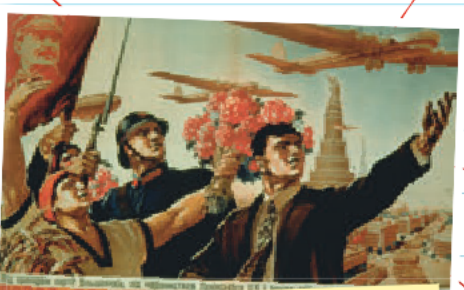
Stalin promoted a specific artistic style known as socialist realism, which required all art to depict Soviet life in an unrealistically positive manner. This art form was designed to help the general public understand and embrace what socialism was supposed to achieve - creating a better life for everyone.
However, rather than reflecting reality, socialist realism presented an idealised version of Soviet society that bore little resemblance to actual conditions.
The new Constitution of 1936
Promises versus reality
Stalin introduced a new Constitution in 1936 that appeared to grant significant rights and freedoms to Soviet citizens. However, the gap between what this Constitution promised and what actually occurred in practice reveals the true nature of Stalin's dictatorship.
Important
The Great Deception: The 1936 Constitution represents one of history's most cynical examples of propaganda masquerading as democratic reform. Every promise made was systematically violated in practice.
Constitutional promises
The new Constitution made several appealing commitments to the Soviet people. It replaced the Congress of Soviets with the Supreme Soviet of the USSR, suggesting a more representative form of government. Universal suffrage was introduced, allowing everyone to vote rather than limiting this right to specific groups.
Note
Constitutional Rights Promised:
- Secret ballot voting, protecting citizens' privacy when making electoral choices
- Workers were guaranteed extensive rights including holidays, healthcare, housing, education, and other benefits
- The fifteen republics within the USSR were supposedly given the same rights as Russia itself
The harsh reality
Despite these grand promises, the actual implementation told a very different story. While people could vote, there was only one political party - the Communist Party - to vote for, making elections meaningless. Workers technically had many rights, but the secret police could ignore these rights entirely whenever they chose.
All activities within the USSR's republics remained under strict control from Moscow and the Communist Party, despite promises of equal rights. Most significantly, Stalin completely ignored the Constitution and continued operating the USSR as a personal dictatorship, using terror and repression to maintain control.
Propaganda purposes
Important
The Real Purpose: The Constitution served primarily as a propaganda tool rather than a genuine framework for governance. Stalin used it to persuade both the Soviet public and the international community, particularly other countries like Germany, that the USSR was becoming more democratic and progressive.
In reality, the brutal nature of life under Stalin's rule continued unchanged, demonstrating the complete disconnect between official promises and actual policies.
Timeline of key developments
- 1924-1928: Stalin consolidates power while beginning to control cultural institutions
- 1930s: Comprehensive censorship system established across all media
- 1936: New Constitution introduced with false promises of democratic rights
- 1936-1941: Socialist realism becomes mandatory artistic style
- Late 1930s: Religious suppression intensifies, education system fully controlled
Summary
Key Points to Remember:
- Stalin used censorship and propaganda to control every aspect of Soviet culture, from films and books to education and art
- The 1936 Constitution promised democracy and rights but was purely propaganda - Stalin continued ruling as a dictator
- Socialist realism forced all artists to present an unrealistically positive view of Soviet life
- Historical records were deliberately altered to support Stalin's version of events, including erasing Trotsky from photographs
- Religious practices were severely suppressed, with places of worship closed and religious education banned