Bolshevik centralisation (Edexcel GCSE History): Revision Notes
📚Revision Notes
Bolshevik centralisation
What was Bolshevik centralisation?
From 1918 onwards, the Communist Party (as the Bolsheviks renamed themselves) believed that the state needed to control the economy, society, and culture of the Soviet Union from a single central point. This approach, known as centralisation, meant that all major decisions would be made in Moscow and then implemented throughout the vast territories of the former Russian Empire.
Note
Centralisation represented a fundamental shift from the decentralised nature of the old Russian Empire, where local nobles and administrators had significant autonomy. The Bolsheviks deliberately chose this approach to ensure their revolutionary ideals could be uniformly implemented across the diverse territories they now controlled.
The Bolsheviks saw centralisation as essential for building their communist society and maintaining control over their revolutionary gains. Rather than allowing local regions to govern themselves independently, they created a system where power flowed from the centre outward to every corner of the Soviet Union.
The Communist Party structure
The Communist Party developed a hierarchical structure that concentrated power at the very top. This system worked through several levels:
Members of the Communist Party formed the base of the pyramid. These party members would elect representatives to the next level up.
Party Congress was elected by party members and was supposed to decide the policies of the party. However, in reality, the Congress increasingly became a body that simply approved decisions made by higher authorities.
Central Committee was elected by the Party Congress and was responsible for running different areas of party operations. This body had significant power but was itself controlled by an even smaller group.
Politburo sat at the very top of the party structure. This small group made the really important decisions for the entire party and, by extension, the entire Soviet Union.
Important
A crucial aspect of this system was that only Communist Party members could stand in elections. This meant there was no real political choice or competition - the Communist Party had a complete monopoly on political power.
The Soviet government structure
Alongside the party structure, the Bolsheviks also created a government structure that appeared more democratic but was actually controlled by the Communist Party. This structure included:
Elected local soviets formed the foundation of the government system. These local councils were supposed to represent the people in towns and villages across the Soviet Union.
All-Russian Congress of Soviets was elected by the local soviets and was meant to make national laws. However, this body increasingly became what critics called a "rubber stamp" - it simply agreed to whatever the government proposed without meaningful debate or opposition.
Council of People's Commissars (Sovnarkom) was elected by the All-Russian Congress and actually ran the government departments. This was where real governmental power resided.
Note
The key point to understand is that while the Soviet government and Communist Party worked in parallel, it was actually the Communist Party that held real control. The government structure provided a facade of democracy while the party made all the important decisions.
How the Bolsheviks consolidated central control
Initially, the slogan "All power to the soviets" suggested that local councils would have significant authority. However, this quickly changed as the Bolsheviks consolidated their control.
By 1919, the Communist Party had established a five-man Politburo consisting of Lenin, Trotsky, Zinoviev, Kamenev, and Stalin. This small group became the real centre of power in the Soviet Union. The Politburo's decisions determined what happened throughout the entire country, making the Soviet Union a centralised dictatorship rather than the democratic workers' state that had been promised.
Important
The transformation from the revolutionary slogan "All power to the soviets" to the reality of Politburo control marked the end of any genuine democratic participation in Soviet governance. Just five men now controlled the fate of millions across the vast Soviet territories.
The All-Russian Congress of Soviets, which was supposed to be the highest authority in the land, became increasingly powerless. It simply approved whatever the Communist Party leadership decided, effectively ending any pretence of democratic governance.
The formation of the USSR in 1924
The process of centralisation reached a major milestone in 1924 when the lands of the old Russian Empire were formally reorganised into the Union of Soviet Socialist Republics (USSR).
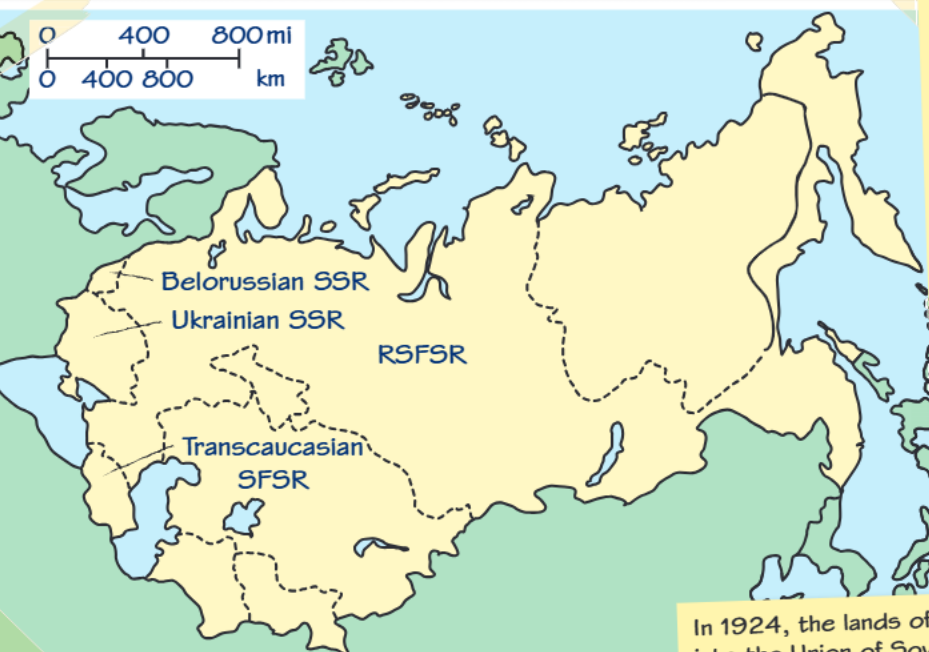
The USSR initially consisted of several major republics:
Russian Soviet Federative Socialist Republic (RSFSR) was by far the largest republic, covering the vast central and eastern territories of the former empire.
Ukrainian Soviet Socialist Republic (SSR) and Belorussian SSR were established in the western regions, recognising the distinct identities of these peoples while keeping them under Soviet control.
Transcaucasian Soviet Federative Socialist Republic (SFSR) covered the southern regions including Georgia, Armenia, and Azerbaijan.
Note
While each republic had its own communist party, these parties all followed the orders of the All-Union Communist Party (the new name for the Communist Party from 1925). The communist parties were led from Moscow, ensuring that central control extended across all the republics.
Local parliaments existed but had very little real power, as all major decisions were controlled by the party hierarchy. This federal structure gave the appearance of recognising different nationalities and regions within the USSR, but in reality, it was another tool for maintaining centralised Bolshevik control over the diverse populations of the former Russian Empire.
Timeline of key events
- 1918: Bolsheviks rename themselves the Communist Party and begin implementing centralisation
- 1919: Five-man Politburo established with Lenin, Trotsky, Zinoviev, Kamenev, and Stalin
- 1924: Formation of the USSR - old Russian Empire territories reorganised into Soviet Socialist Republics
- 1925: Communist Party renamed as All-Union Communist Party
Summary
Key Points to Remember:
-
Centralisation meant all major decisions were made in Moscow and then implemented throughout the Soviet Union, removing local autonomy and democratic participation.
-
The Communist Party monopolised political power - only party members could stand in elections, eliminating any real political choice or opposition.
-
Real power was concentrated in the Politburo - by 1919, just five men (Lenin, Trotsky, Zinoviev, Kamenev, and Stalin) controlled the entire Soviet Union.
-
The government structure was controlled by the party - while soviets and congresses appeared democratic, the Communist Party made all important decisions behind the scenes.
-
The USSR's federal structure was centralised - although different republics were created in 1924, all were controlled by communist parties that took orders from Moscow.