New Economic Policy (NEP) (Edexcel GCSE History): Revision Notes
📚Revision Notes
New Economic Policy (NEP)
Background and context
By 1921, the Soviet Union faced a severe crisis. War Communism, which had helped the Bolsheviks win the Civil War, was now threatening to destroy the Communist Party's control over Russia and the other Soviet republics. The economic situation was desperate, and political opposition was growing stronger. Lenin recognised that the rapid push towards socialism had been too harsh and inflexible for the country to handle.
Note
The crisis of 1921 was so severe that it threatened the very survival of the Bolshevik government. Industrial production had virtually collapsed, and millions faced starvation. Lenin understood that without immediate action, the Communist Party could lose power entirely.
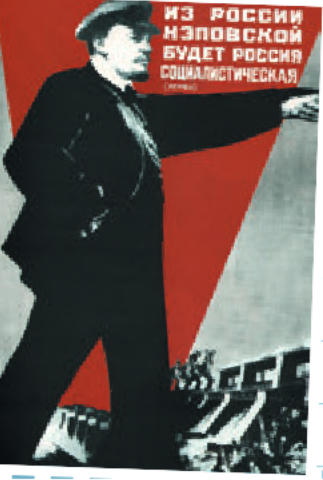
Lenin's solution to this mounting crisis was the New Economic Policy, introduced in 1921. This represented a significant shift away from the strict socialist policies of War Communism towards a more mixed economic approach.
Why NEP was introduced
Lenin and the Bolshevik leadership decided to implement NEP for two crucial reasons:
Economic disasters caused by War Communism The socialist policies of War Communism had created catastrophic economic problems. Industrial production had collapsed, agricultural output had plummeted, and the general standard of living had deteriorated dramatically across the Soviet Union.
Growing political opposition War Communism had sparked dangerous political resistance to Bolshevik rule. Lenin understood that continuing with such unpopular policies could lead to the overthrow of the Communist government.
Important
Lenin acknowledged that the drive towards socialism had been implemented too rapidly and with excessive severity. This admission represented a major ideological shift for the Communist Party, showing Lenin's pragmatic approach to maintaining power.
Key features of the new system
NEP represented a dramatic reversal of War Communism's socialist policies, reintroducing several market-based elements:
Restoration of the free market Peasants regained the right to sell their agricultural products and could now decide their own prices. This gave them much greater economic freedom and incentive to produce surplus crops.
Note
Free Market Revival
The return to free market principles was perhaps the most significant change under NEP. For the first time since 1918, peasants could engage in normal commercial activities, setting their own prices and keeping their profits.
End of grain requisitioning The state stopped forcibly taking grain and other crops from peasants. Instead, peasants now paid taxes based on what they sold, allowing them to keep more of their produce.
Return of money and wages Currency was reintroduced into the economy, and workers began receiving wages again instead of payment in goods. This restored normal economic transactions.
Mixed ownership in industry While the state maintained control of major factories and heavy industry, smaller businesses and farms could now be privately owned and operated for profit.
Foreign expertise The government brought in experts from other countries to help improve factory management and industrial efficiency. These foreign specialists received higher wages than regular Soviet workers.
Economic impact of NEP
The New Economic Policy produced significant but uneven results across different sectors:
Agricultural recovery Farming production increased substantially as peasants had renewed motivation to grow crops. Grain production rose from 37 million tonnes in 1921 to 56 million tonnes by 1925, though it still remained below pre-war levels of 80 million tonnes by 1913.
Industrial challenges Industrial growth occurred but at a much slower pace than agricultural recovery. The shortage of manufactured goods made industrial products expensive while food became cheaper. This created what economists called the "scissors crisis" - peasants stopped producing surplus food because they feared famine, while the government had to reduce industrial prices to make goods affordable.
Example
The Scissors Crisis Explained
Step 1: Agricultural recovery made food cheaper and more plentiful
Step 2: Industrial production remained slow, keeping manufactured goods expensive
Step 3: The price gap widened like opening scissors - cheap food vs. expensive industrial goods
Step 4: Peasants couldn't afford to buy industrial products, so they reduced food production
Step 5: This threatened both agricultural progress and industrial development
Rise of inequality Some traders, known as "NEP-men", made substantial profits from the shortages of food and manufactured goods. Wealthier peasants also prospered as they had the most surplus produce to sell. This created growing inequality within Soviet society, which contradicted socialist principles.
Important
The emergence of wealthy "NEP-men" and prosperous peasants created a new capitalist class within the supposedly socialist Soviet Union. This contradiction would later become a major source of political tension and criticism of the policy.
Political reactions to NEP
The policy generated mixed responses across Soviet society:
Support from peasants and traders NEP proved popular with peasants and small-scale traders. Although wealthier peasants benefited most from the new freedoms, all peasants preferred having the liberty to sell their products rather than having the state requisition almost everything they produced.
Opposition from Communist Party members Many dedicated Communist Party members strongly disliked NEP because it seemed like a backwards step that brought capitalism back to the USSR. They worried that it gave peasants what they wanted while potentially harming the interests of urban workers who formed the party's core support base.
Note
Political Divide
The split in opinion about NEP reflected a fundamental tension within the Communist Party between ideological purity and practical governance. This divide would persist throughout the 1920s and influence future Soviet policies.
Timeline of key events
- 1917-1921: War Communism period - strict socialist policies implemented
- 1921: Economic and political crisis reaches critical point
- 1921: Lenin introduces New Economic Policy
- 1921-1925: Agricultural production gradually recovers
- 1920s: "Scissors crisis" develops as industrial and agricultural prices diverge
- 1924: Lenin dies, leaving questions about NEP's future
Summary
Key Points to Remember:
- NEP was Lenin's pragmatic response to the failures of War Communism by 1921
- The policy mixed socialist and capitalist elements, allowing peasants to sell produce freely while the state kept control of major industry
- Agricultural production recovered significantly, but industrial growth remained slower
- NEP created new inequalities through "NEP-men" and prosperous peasants, causing tension within the Communist Party
- The policy represented Lenin's recognition that the transition to socialism needed to be more gradual and flexible