The Civil War (Edexcel GCSE History): Revision Notes
📚Revision Notes
The Civil War (1918-1921)
What was the Russian Civil War?
The Russian Civil War was a devastating conflict that erupted following the Bolshevik Revolution. The Bolsheviks established their military force called the Red Army to fight against various opposition groups collectively known as the Whites. This alliance of anti-Bolshevik forces included nationalists, conservatives, former moderates, and other groups who opposed Bolshevik rule. The war transformed Russia and significantly shaped the Bolsheviks' approach to governing.
Note
The term "Whites" referred to the diverse coalition of anti-Bolshevik forces, named after the white cockade worn by supporters of the Russian monarchy. This alliance included many different groups with varying political goals, making coordination difficult.
Why did the Civil War begin?
Several key factors led to this brutal conflict that would tear Russia apart for three years.
The Treaty of Brest-Litovsk created widespread anger among many Russians due to the enormous territorial losses it imposed. This unpopular peace deal with Germany gave the Bolsheviks' opponents a rallying point, as many saw it as a betrayal of Russian interests.
Political opposition came from multiple directions. Nationalists and conservatives had lost everything under the Bolsheviks' plans for a workers' and peasants' state. Former moderate politicians, including Mensheviks and some Socialist Revolutionaries, opposed the Bolshevik dictatorship, particularly after the Bolsheviks had dissolved the Constituent Assembly where they lacked majority support.
Important
The dissolution of the Constituent Assembly was a critical turning point. The Bolsheviks had won only 24% of the vote in the elections, but when the Assembly met in January 1918, they forcibly closed it after just one day. This action alienated many moderate socialists who had initially supported the revolution.
The Bolsheviks also created new enemies through their actions. They made adversaries of the Czech Legion, comprising 40,000 Czech troops who had taken control of parts of the Trans-Siberian Railway. Additionally, various nationalities within the old Russian Empire sought to break away from Russian control and establish their independence.
Even monarchists played a role, as they wanted to restore the Tsar to power, completely opposing everything the Bolsheviks represented.
Key events and military campaigns
The Civil War was fought on multiple fronts, with White Army generals launching coordinated attacks against Bolshevik-controlled territory.
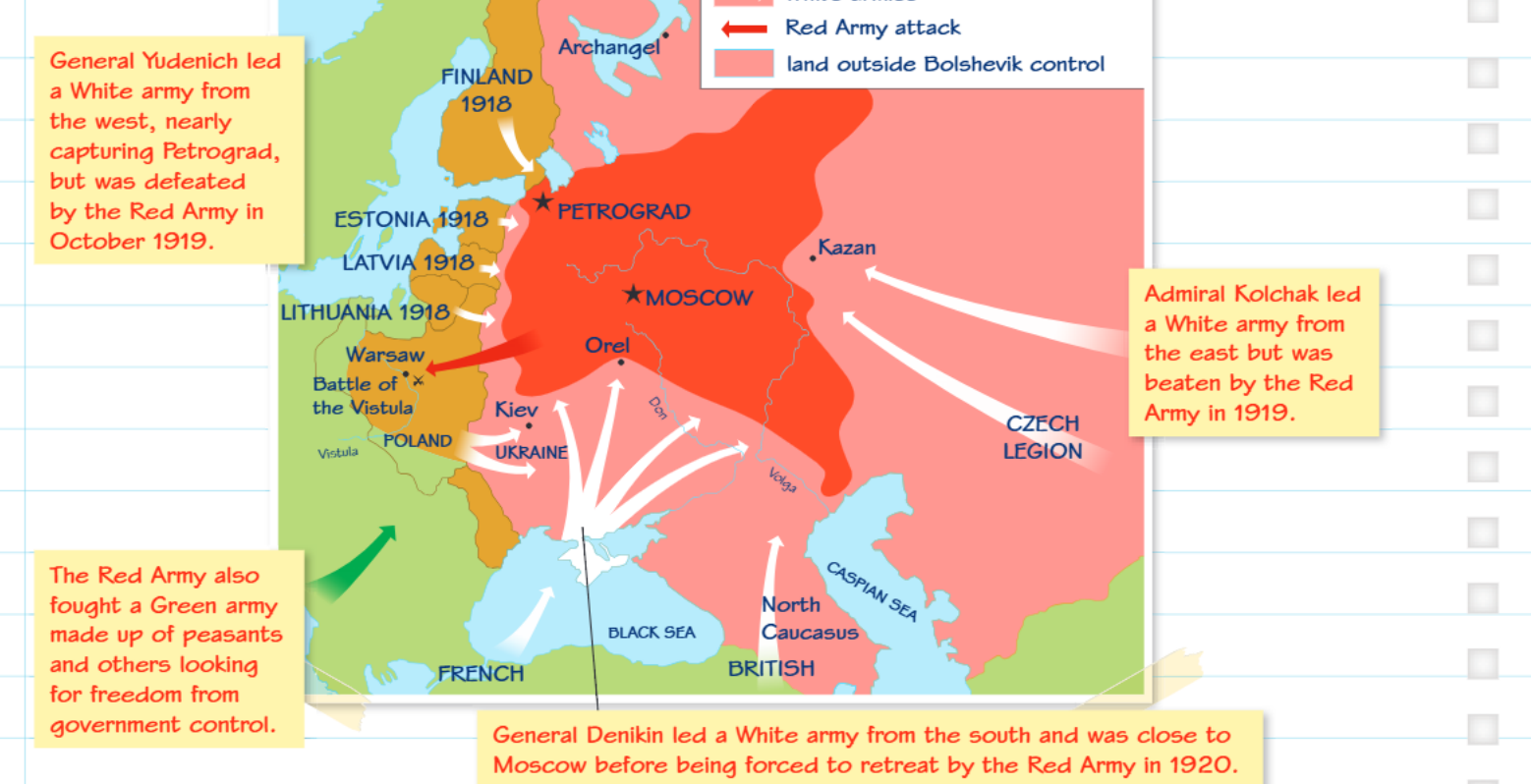
General Yudenich led White forces from the west, launching attacks towards Petrograd (now St. Petersburg). His campaign nearly succeeded in capturing this crucial city, but the Red Army ultimately defeated him in October 1919.
Admiral Kolchak commanded White armies from the east, but despite initial successes, his forces were beaten by the Red Army in 1919. His campaign demonstrated the challenges of coordinating attacks across Russia's vast distances.
General Denikin led the most threatening campaign from the south, advancing towards Moscow and coming dangerously close to capturing the Bolshevik capital before being forced to retreat by Red Army counterattacks in 1920.
Example
Military Campaign Analysis: Denikin's Southern Offensive
Denikin's campaign demonstrated both the potential and limitations of White Army strategy:
Phase 1 (Early 1919): White forces advanced rapidly northward, capturing key cities including Tsaritsyn (later Stalingrad).
Phase 2 (Mid-1919): The offensive reached within 300 kilometres of Moscow, causing panic among Bolshevik leadership.
Phase 3 (Late 1919-1920): Red Army counterattacks exploited White Army supply line weaknesses, forcing a complete retreat that led to the evacuation of White forces from the Crimea.
The Red Army also faced the Green Army, composed of peasants and others seeking freedom from any government control. This added another layer of complexity to an already chaotic situation.
Effects of the Civil War on the Bolsheviks
The Civil War profoundly impacted how the Bolsheviks governed Russia and shaped their future policies.
Terror tactics became a standard method for ensuring control. Once Bolshevik forces captured an enemy area, the Cheka (the Bolshevik secret police) systematically hunted down suspected opponents and executed them. This created a climate of fear that helped maintain Bolshevik authority.
Important
The Cheka's terror campaign was unprecedented in its scale and systematic nature. Led by Felix Dzerzhinsky, the organisation executed an estimated 200,000-500,000 people during the Civil War period. This established a pattern of state terror that would continue throughout Soviet history.
The Bolsheviks implemented harsh discipline to ensure obedience within their own ranks. Red Army deserters faced execution, and if a Red Army unit retreated without orders, commanders would execute one soldier in every ten as punishment. This brutal system helped maintain military discipline during desperate times.
The experience of ideological victory against so many different opponents strengthened the Bolsheviks' belief in their revolutionary mission. Successfully defeating various enemies from multiple directions convinced them that their cause was just and that their methods were effective.
The war led to increased centralised control. The conflict strengthened the Bolsheviks' commitment to highly organised control from the centre, as this approach had proven successful in winning the war.
Note
The policy of "War Communism" emerged during this period, featuring state control of industry, forced grain requisitions from peasants, and the abolition of private trade. While these measures helped win the war, they also caused enormous economic hardship and would later be replaced by the New Economic Policy (NEP) in 1921.
Finally, the involvement of foreign allies like France and Britain supporting the White armies made the Bolsheviks fear foreign invasion. This fear would influence Soviet foreign policy for decades to come.
Timeline of major events
- 1918: Civil War begins; Finland, Estonia, Latvia, and Lithuania gain independence
- 1919: Admiral Kolchak's eastern campaign defeated by Red Army
- October 1919: General Yudenich's western assault on Petrograd fails
- 1920: General Denikin's southern campaign forced to retreat from Moscow
- 1921: Civil War effectively ends with Bolshevik victory
Summary
Key Points to Remember:
-
The Civil War pitted the Bolshevik Red Army against the White Army alliance of anti-Bolshevik groups from 1918-1921
-
Multiple factors caused the conflict, including anger over the Treaty of Brest-Litovsk's territorial losses and opposition from various political groups
-
White armies attacked from three main directions: Yudenich from the west, Kolchak from the east, and Denikin from the south
-
The Bolsheviks used terror tactics through the Cheka and harsh military discipline to maintain control during the war
-
Victory in the Civil War strengthened Bolshevik belief in centralised control and their revolutionary mission, while creating lasting fears of foreign invasion