The Treaty of Brest-Litovsk (Edexcel GCSE History): Revision Notes
📚Revision Notes
The Treaty of Brest-Litovsk
Background and the need for peace
When the Bolsheviks seized power in October 1917, they faced enormous pressure to fulfil their promise of taking Russia out of the First World War. This became one of their most urgent priorities for several important reasons.
Many Bolshevik supporters were soldiers and sailors who desperately wanted the war to end. Lenin had promised them a "breathing space" - time to consolidate Bolshevik power without the distraction of fighting Germany. Lenin believed the Bolsheviks needed to focus all their energy on defeating internal enemies rather than continuing an expensive foreign war.
Note
The concept of "breathing space" was crucial to Lenin's strategy. He understood that the new Bolshevik government was extremely vulnerable and needed time to establish control over Russia before it could effectively fight any wars, whether foreign or domestic.
Both Lenin and Trotsky were convinced that communist revolutions would soon break out across Europe. They believed that any peace treaty with Germany would become meaningless once German workers overthrew their own government and joined the worldwide revolution.
The treaty negotiations
Lenin gave Leon Trotsky the responsibility of negotiating a peace deal with the Germans. However, none of the other Allied powers (Britain, France, and the USA) supported these negotiations, leaving Russia to face Germany alone.
Trotsky initially tried to secure a peace treaty with no territorial losses for Russia. When this failed, he attempted a clever strategy of "no war, no peace" - essentially ending Russian participation in the war without formally signing a treaty.
Important
The Germans responded by advancing deeper into Russian territory, making it clear they would capture Petrograd if Russia didn't agree to their terms. This forced Lenin's hand and showed that Germany was not willing to accept anything less than a formal peace treaty with substantial concessions.
Faced with this impossible situation, Lenin insisted that Russia accept whatever terms Germany offered. He argued that any price was worth paying to secure peace and give the Bolsheviks time to consolidate their power.
The terms and significance of the treaty
The treaty was finally signed on March 3, 1918, with devastating consequences for Russia. The country lost enormous territories in its western regions, including Ukraine, the Baltic provinces, Finland, parts of Poland, and Georgia.
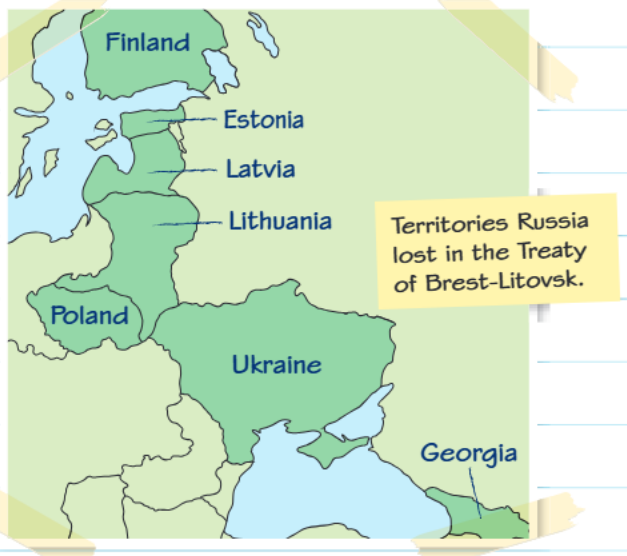
The territorial losses were accompanied by massive economic damage. Russia lost:
- 74% of its coalmines and iron ore deposits
- 50% of its industrial capacity
- 26% of its railway network
- 27% of its most fertile farmland
- 26% of its population - approximately 62 million people
Additionally, Russia was forced to pay Germany 300 million gold roubles as compensation. These losses represented a catastrophic weakening of Russian economic and military power.
Example
Understanding the Scale of Loss: Economic Impact
To understand how devastating these losses were, consider that Russia lost nearly three-quarters of its coal and iron ore - the foundation of any industrial economy. This meant:
- The remaining Russian territories could only produce half of what they had before
- Transportation became severely limited with only 74% of railways remaining
- Food production dropped dramatically with the loss of the most productive agricultural regions
These losses would take decades to recover from, even under the best circumstances.
Reactions to the treaty
The harsh terms of Brest-Litovsk produced very different reactions across Russian society. Many ordinary soldiers welcomed the end of fighting and were relieved that the threat of German invasion had passed.
However, the Bolsheviks hoped that German workers would be outraged by their government's harsh treatment of Russia. They believed this would provide another reason for German workers to rise up in revolution, similar to what had happened in Russia.
Note
The Bolsheviks' expectation of European revolution was a fundamental part of their worldview. They genuinely believed that the Russian Revolution was just the beginning of a worldwide communist uprising, which would make territorial losses to Germany temporary.
The Left Socialist Revolutionaries (Left SRs) were furious about the treaty terms. They walked out of the government in protest and even assassinated the German ambassador, hoping to restart the war and reverse the humiliating peace.
Nationalist groups and conservatives were horrified by the territorial losses and the damage to Russian pride. For many Russians, the treaty became a powerful symbol of Bolshevik weakness and betrayal. This anger became vital motivation for forming opposition armies - the "White armies" - to fight against the Bolshevik "Red Army".
Long-term consequences
The Treaty of Brest-Litovsk became a major cause of the Russian Civil War that devastated the country from 1918 to 1921. The harsh terms convinced many Russians that the Bolsheviks had sold out their country to Germany, providing powerful propaganda for anti-Bolshevik forces.
Important
The treaty revealed the Bolsheviks' willingness to make enormous sacrifices to maintain power. Lenin's decision showed that he prioritised the survival of his government over traditional Russian territorial interests - a principle that would define Soviet policy for years to come.
The treaty also demonstrated how international isolation could force even the most ideologically committed government to make pragmatic compromises when faced with military reality.
Timeline of key events
- October 1917: Bolsheviks seize power, promising to end the war
- December 1917: Peace negotiations begin with Germany
- February 1918: Germany resumes military advance into Russia
- March 3, 1918: Treaty of Brest-Litovsk signed
- 1918-1921: Russian Civil War partly triggered by anger over the treaty
Summary
Key Points to Remember:
- The Treaty of Brest-Litovsk was signed on March 3, 1918, fulfilling the Bolshevik promise to end Russia's involvement in WWI
- Russia lost massive territories and resources, including 74% of its coal and iron ore, weakening the country significantly
- Different groups reacted very differently - soldiers were pleased, but Left SRs and nationalists were outraged
- The harsh terms became a major cause of the Russian Civil War as they convinced many Russians that the Bolsheviks had betrayed the country
- Lenin prioritised giving the Bolsheviks "breathing space" to consolidate power over protecting Russian territory and pride