The First World War (Edexcel GCSE History): Revision Notes
📚Revision Notes
The First World War's impact on Russia
The First World War brought devastating consequences for Russia, creating the conditions that would lead to revolution in 1917. The conflict exposed fundamental weaknesses in the Russian state and society, undermining confidence in Tsar Nicholas II's government and creating widespread discontent across all levels of society.
Russia's military failures
Russia entered the war in 1914 with what appeared to be significant advantages - the country possessed the largest army in the world. However, this apparent strength masked serious underlying problems that would prove catastrophic during the conflict.
The Russian military suffered from poor leadership and inadequate equipment compared to their German opponents. German commanders effectively used their superior organisation and railway networks to outmanoeuvre Russian forces. They were able to move well-trained troops and modern equipment efficiently, then concentrate their attacks on Russia's most vulnerable positions.
The scale of Russia's military collapse became evident by 1917, when the country was forced to surrender large portions of its western territories to Germany. The disruption of agricultural areas made food shortages even worse, as harvests were severely reduced in regions affected by the fighting.
Economic devastation
The war created enormous financial pressures that the Russian economy could not withstand. The conflict required massive government spending at a time when the country's ability to generate revenue was severely limited.
Germany's strategic blocking of Russia's trade routes meant that factories could not obtain essential raw materials, leading to widespread industrial shutdowns. Economic activity declined dramatically as the war progressed, reducing the government's tax income precisely when expenses were increasing.
To fund the war effort, the Russian government sought loans from its allies, significantly increasing the country's national debt. When this proved insufficient, authorities began printing additional money to cover military costs. This decision triggered severe inflation that made prices rise at twice the rate of wage increases, causing tremendous hardship for ordinary Russians.
Growing political opposition
The Duma, Russia's parliament, initially supported the war effort when hostilities began. However, as military defeats mounted and economic conditions worsened, parliamentary deputies became increasingly critical of the government's handling of the crisis.
In 1915, Duma representatives formally requested that the Tsar replace his current ministers with new appointees who had parliamentary support. This represented a significant challenge to the Tsar's traditional authority, as it implied that elected representatives should have influence over government appointments.
Nicholas II's refusal to share power with the Duma transformed parliament into a centre of opposition to his rule. This political confrontation would prove crucial in undermining the Tsar's legitimacy and creating the conditions for revolution.
The Tsar's fatal decision
In August 1915, Tsar Nicholas II made the momentous decision to personally take command of Russia's armed forces as commander-in-chief. This choice would prove to be one of his most damaging mistakes.
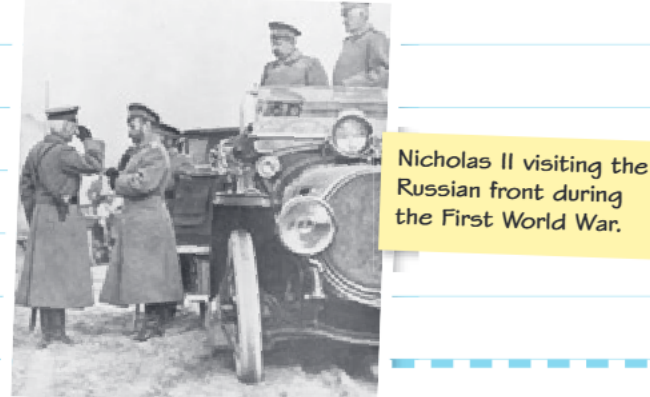
The Tsar's advisers warned him that assuming military leadership was extremely risky. If Russian forces continued to suffer defeats, the Russian people would hold him directly responsible for the failures. Despite these warnings, Nicholas II proceeded with his plan.
The decision forced the Tsar to leave the capital city of Petrograd (formerly St. Petersburg) in September 1915 to establish his headquarters closer to the front lines. His absence from the political centre meant he lost touch with the growing crisis in the cities and could not effectively manage domestic affairs.
This move cost the Tsar crucial support from military officers and noble families, who had previously been among his strongest supporters. By taking personal responsibility for military strategy while being physically absent from the capital, Nicholas II appeared to be failing in both his military and political responsibilities.
Social upheaval
The war created massive social disruption that affected every aspect of Russian life. The government conscripted approximately 15 million peasants along with their horses to serve in the military, severely disrupting agricultural production throughout the country.
Military authorities also requisitioned peasant crops and livestock for army supplies, prioritising military needs over civilian food requirements. These policies meant that both rural and urban populations faced serious food shortages and widespread hunger.
The conflict created an enormous refugee crisis, with possibly 6 million people fleeing German occupation in western regions. The government struggled to provide adequate housing and food for these displaced populations, and tensions between refugees and local communities increased significantly.
Economic problems led to factory closures and widespread unemployment in industrial areas. Combined with severe food shortages, these conditions created growing social unrest that would eventually contribute to revolutionary movements.
Timeline of key events
- 1914: Russia enters WWI with the world's largest army
- August 1915: Tsar Nicholas II assumes personal command of Russian forces
- September 1915: Tsar leaves Petrograd for military headquarters
- 1916: Economic crisis deepens with severe inflation and food shortages
- November 1916: Liberal Duma leader delivers critical speech attacking the government
- 1917: Large areas of western Russian empire lost to German forces
Primary source evidence
The growing opposition to the Tsar's government is evident in speeches made by Duma representatives. In November 1916, a liberal leader declared: "We have many reasons for being discontented with this government, but these reasons all boil down to one general one: the incompetence and evil intentions of the present government."
This statement was significant because it represented not just criticism of specific policies, but a fundamental attack on the legitimacy of the Tsar's rule and his ministers. Such open criticism in parliament demonstrated how completely confidence in the government had collapsed by late 1916.
Remember!
- The First World War exposed Russia's military weaknesses despite having the world's largest army in 1914
- Economic pressures from the war created severe inflation, debt, and unemployment that affected all social classes
- The Tsar's decision to become commander-in-chief in 1915 made him personally responsible for military failures
- By 1916, even the Duma was openly criticising the "incompetence" of the government
- Social disruption from conscription, food shortages, and refugees created the conditions for revolutionary change in 1917