The Kornilov Revolt (Edexcel GCSE History): Revision Notes
📚Revision Notes
The Kornilov revolt
Context in August 1917
By August 1917, the Provisional Government found itself in an extremely vulnerable position. The disastrous June Offensive had severely damaged military morale, leaving soldiers frustrated and angry with the government's leadership. Meanwhile, workers were increasingly drawn to the promises of the Petrograd Soviet, particularly their calls for immediate change that would directly benefit the working class. At the same time, peasants across Russia were demanding land redistribution. This widespread unrest created the perfect conditions for General Kornilov to attempt his seizure of power.
Note
The combination of military failure, worker unrest, and peasant demands created a triple crisis that left the Provisional Government extremely vulnerable to challenge from both left and right-wing forces.
Background to the revolt
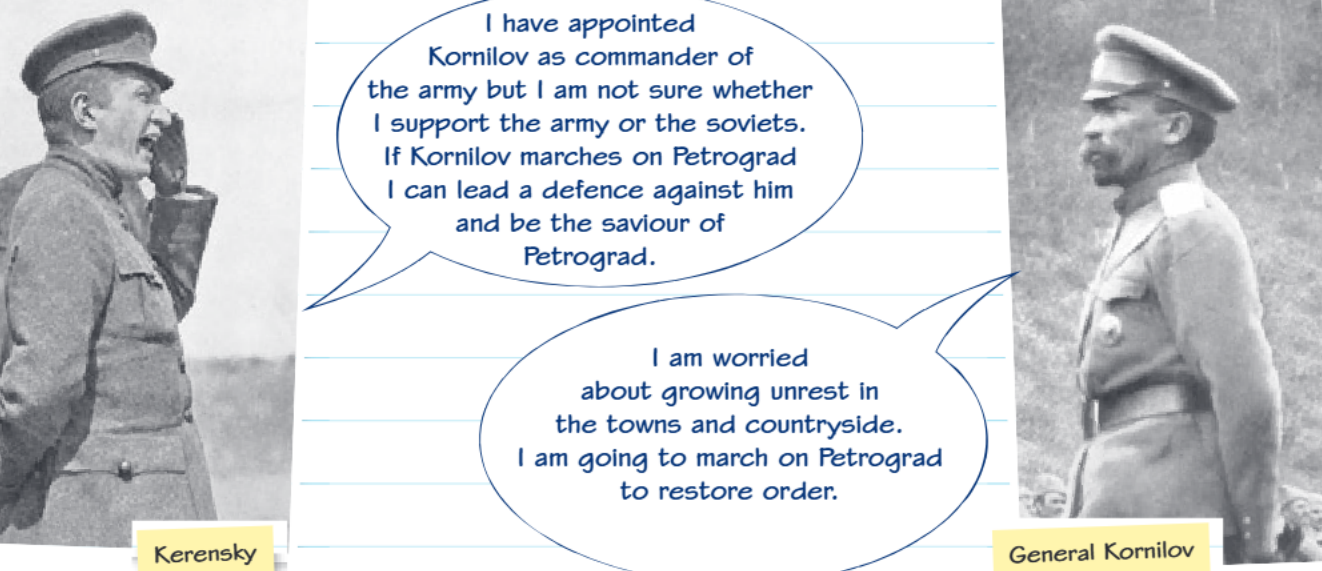
In July 1917, Alexander Kerensky made the significant decision to appoint General Lavr Kornilov as the new commander of the Russian army. Kerensky hoped this appointment would help restore military discipline, which had collapsed following the failed June Offensive. However, Kornilov had very different ideas about how to solve Russia's problems.
Kornilov believed that Russia desperately needed military rule to restore order throughout the country. He was particularly concerned about the growing influence of the soviets and the increasing chaos in both urban and rural areas. The general saw the Provisional Government as too weak to handle the revolutionary situation and believed that only strong military leadership could save Russia from complete collapse.
Note
The fundamental disagreement between Kerensky and Kornilov about how to restore order - civilian vs. military leadership - set the stage for their eventual confrontation.
The sequence of events
The Kornilov Revolt unfolded through several key stages during late August 1917:
Stage 1: The decision to act Kornilov decided that Russia required military intervention to restore order. He believed the Provisional Government was failing to maintain control and that the soviets posed a serious threat to the country's stability.
Stage 2: Agreement on troop deployment Initially, Kornilov and Kerensky appeared to agree that additional soldiers were needed in Petrograd to maintain order. However, their understanding of the situation and their intentions were very different.
Stage 3: The march begins On 24 August, Kornilov ordered his troops to advance towards Petrograd with the intention of shutting down the Petrograd Soviet. This action revealed his true plan to establish military control over the capital.
Stage 4: Kerensky's response When Kerensky realised that Kornilov intended to overthrow the Provisional Government, he took the desperate step of allowing the Bolsheviks to arm their supporters. These armed groups became known as the Red Guards.
Stage 5: The revolt collapses Railway workers played a crucial role in stopping Kornilov's advance by blocking his route to Petrograd. Additionally, many of Kornilov's soldiers refused to follow his orders once they understood the true nature of his mission.
Stage 6: The aftermath The Bolsheviks successfully convinced Kornilov's troops not to attack, effectively ending the revolt without major bloodshed.
Why the revolt failed
The Kornilov Revolt collapsed for two main reasons. First, Kornilov's own soldiers lost confidence in their officers and refused to continue following orders. The breakdown in military discipline that Kornilov had hoped to restore actually worked against him. Second, the workers of Petrograd actively defended their revolution by organising resistance and blocking the advancing troops, rather than welcoming military intervention.
Important
The irony of the Kornilov Revolt was that the very military indiscipline Kornilov sought to cure became the primary reason for his failure - his own soldiers refused to obey orders.
Significance and consequences
The failure of the Kornilov Revolt had profound consequences for all the major political groups in Russia:
Impact on the Bolsheviks: The revolt significantly boosted Bolshevik popularity and influence while simultaneously weakening the Provisional Government. The Bolsheviks had successfully positioned themselves as the defenders of Petrograd and the revolution, gaining credibility among workers and soldiers.
Impact on Kerensky: Kerensky's plan to present himself as the saviour of Petrograd completely backfired. Instead of strengthening his position, the crisis revealed his government's weakness and forced him to rely on the very groups he was trying to control.
Vindication of Bolshevik warnings: The Bolsheviks had long predicted that counter-revolutionary forces would attempt to overthrow the revolution. The Kornilov Revolt appeared to prove their warnings correct, lending credibility to their political message.
Military consequences: The revolt destroyed what little trust remained between soldiers and their officers. This breakdown in military hierarchy would have lasting implications for Russia's ability to continue fighting in World War One.
Political consequences: On 31 August, just days after the revolt's failure, the Bolsheviks won the majority of seats in the Petrograd Soviet election, demonstrating their dramatically increased political support.
Important
The Kornilov Revolt's most significant consequence was that it armed and legitimised the Bolsheviks, directly contributing to their ability to seize power in October 1917. Kerensky's decision to arm his future enemies proved to be a fatal strategic error.
Timeline of the Kornilov revolt
- July 1917: Kerensky appoints Kornilov as army commander
- August 1917: Provisional Government seriously weakened by military failures
- 24 August 1917: Kornilov sends troops towards Petrograd
- Late August 1917: Railway workers block Kornilov's advance; Bolsheviks organise resistance
- 31 August 1917: Bolsheviks win majority in Petrograd Soviet elections
Summary
Key Points to Remember:
- The Kornilov Revolt occurred when the Provisional Government was already severely weakened by military failures and social unrest
- General Kornilov attempted to establish military rule but was stopped by a combination of worker resistance and military insubordination
- The revolt's failure dramatically strengthened the Bolsheviks, who positioned themselves as defenders of the revolution
- Kerensky's decision to arm the Bolsheviks backfired spectacularly, giving them both weapons and credibility
- The revolt demonstrated the complete breakdown of military discipline and paved the way for the Bolsheviks' eventual takeover in October 1917