Weaknesses and failures (Edexcel GCSE History): Revision Notes
📚Revision Notes
Weaknesses and failures of the Provisional Government
The Provisional Government that took power after the February Revolution faced numerous challenges that ultimately led to its downfall in October 1917. Understanding these weaknesses helps explain why the Bolsheviks were able to seize control so successfully.
The concept of 'dual control'
The Provisional Government operated under a system known as 'Dual Control', which created significant problems for effective governance. This arrangement meant that while the Provisional Government held official political power, the Petrograd Soviet wielded considerable influence over key areas like the military and workers. This division of authority severely weakened the government's ability to implement decisive policies and maintain control over the country.
Note
The system of 'Dual Control' was unique in Russian political history. Never before had the country experienced such a clear division between official government authority and practical power, which created an inherently unstable political situation.
Key weaknesses of the Provisional Government
Ineffective leadership and decision-making
The government struggled with a fundamental lack of strong, decisive leadership throughout its existence. Leaders were often unable to make tough decisions quickly, particularly regarding the most pressing issues facing Russia. This indecisiveness became increasingly problematic as the country faced mounting crises.
Continuing the unpopular war effort
One of the most damaging decisions was the choice to continue fighting in World War One rather than seeking peace. The government felt committed to Russia's allies and believed in defending the country's borders, but this stance proved extremely unpopular with war-weary soldiers and civilians. The decision to launch new military operations rather than adopting a purely defensive strategy alienated much of the population who desperately wanted an end to the conflict.
Important
The decision to continue the war was perhaps the single most damaging policy of the Provisional Government. While the leaders believed they were acting patriotically, this choice directly contradicted the wishes of the majority of Russian people who had grown exhausted by three years of devastating warfare.
Economic failures and shortages
The government proved unable to address Russia's severe economic problems effectively. Food shortages, inflation, and supply issues continued to plague ordinary Russians, and the government had no quick solutions to offer. This failure to improve living conditions meant that people saw little benefit from the change in government.
Military control problems
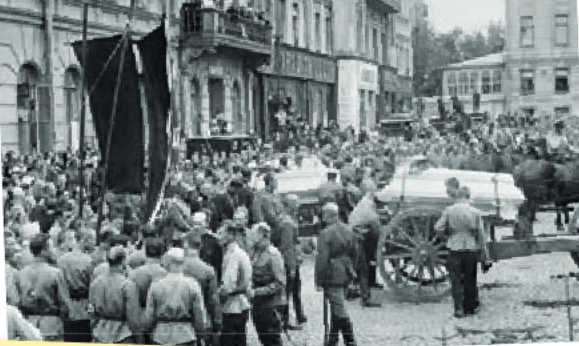
The Provisional Government lost crucial control over military affairs due to Soviet Order Number 1, issued on 1 March 1917. This order essentially gave the Petrograd Soviet the final say on military matters, not the official government. Military units were instructed to follow the Soviet's commands when they conflicted with government orders, severely undermining the government's authority over its own armed forces.
Lack of democratic legitimacy
Unlike the soviets, which were elected by workers and soldiers, the Provisional Government was not chosen by the people through elections. This lack of democratic mandate meant many Russians questioned whether the government had the right to make major decisions affecting the country. The government's failure to organise general elections further weakened its claim to represent the Russian people.
Land reform delays
The government failed to address one of the most important issues for the majority of Russians - land redistribution to peasants. Rural communities were desperate for land reform, but the government delayed making concrete decisions on this crucial matter, losing vital support from the peasantry.
The June Offensive disaster
Alexander Kerensky, serving as War Minister, made the fateful decision to launch a major military offensive against German and Austrian forces in June 1917. This operation, known as the June Offensive, proved to be a catastrophic failure that severely damaged the government's credibility.
The offensive resulted in approximately 200,000 Russian casualties and led to further territorial losses. The military disaster was so severe that Kerensky was forced to take over the leadership of the entire Provisional Government from Prince Lvov. However, this change in leadership came too late to restore public confidence.
Important
The June Offensive represented a critical turning point for the Provisional Government. The massive casualties and military failure demonstrated to the Russian people that the new government was making the same mistakes as the Tsar's regime, continuing a costly and unpopular war despite public opposition.
Primary source evidence: Soviet Order Number 1
The impact of divided authority becomes clear when examining Soviet Order Number 1, published by the Petrograd garrison on 1 March 1917. This order stated:
Note
Primary Source Analysis:
"In all companies, battalions, regiments... committees of elected representatives from the lower ranks of the above-mentioned military units shall be chosen... The orders of the military commission of the State Duma shall be executed only in such cases as they do not conflict with the orders and resolutions of the Soviet of Workers' and Soldiers' Deputies."
This source demonstrates how the Provisional Government's authority was systematically undermined from its very beginning, as military units were instructed to prioritise Soviet commands over government orders.
Timeline of key events
- 1 March 1917: Soviet Order Number 1 published, limiting government military control
- June 1917: June Offensive launched by Kerensky
- Late June 1917: June Offensive fails with massive casualties
- July 1917: Kerensky takes over as head of Provisional Government
- October 1917: Bolsheviks overthrow the Provisional Government
Summary
Key Points to Remember:
- The Provisional Government suffered from 'Dual Control' with the Petrograd Soviet, which severely limited its actual power and authority
- Continuing to fight in World War One, especially launching the disastrous June Offensive, proved extremely unpopular and costly in both lives and credibility
- The government lacked democratic legitimacy since it wasn't elected by the people, unlike the soviets which had clear popular mandates
- Economic problems and food shortages continued under the Provisional Government, showing people that the revolution hadn't improved their daily lives
- Soviet Order Number 1 gave military control to the Petrograd Soviet rather than the official government, making effective governance nearly impossible