Rivalry with Portugal (Edexcel GCSE History): Revision Notes
📚Revision Notes
Rivalry with Portugal
Background to the conflict
When Columbus completed his first voyage to the Americas, the discovery immediately sparked a major territorial dispute between Spain and Portugal. Both powerful maritime nations believed they had legitimate claims to these new lands, setting up a confrontation that could have led to war between the two Iberian kingdoms.
Columbus's return to Spain in 1493
Columbus's journey back to Europe took an unexpected turn when he first arrived in Lisbon, Portugal on 4 March 1493, before reaching his intended destination of Spain. This brief stop in Portuguese territory would prove significant for the emerging rivalry.
When Columbus finally reached Spain on 15 March 1493, he received a hero's welcome in Palos. Ferdinand and Isabella warmly congratulated the explorer and honoured him with a triumphant procession to Barcelona, where cheering crowds celebrated his achievements. The Spanish monarchs fulfilled their promises by granting Columbus all the titles and financial rewards they had originally agreed to sponsor for his expedition.
The Portuguese challenge
King João II of Portugal quickly learned about Columbus's successful expedition and the discovery of lands across the Atlantic. The Portuguese king immediately challenged Spain's claim to these territories, arguing that Portugal had the superior right to rule the Americas.
Portugal's claim was based on the existing Treaty of Alcáçovas, signed in 1479, which stated that all lands to the west belonged to Portugal. King João II used this earlier agreement to justify Portuguese control over the newly discovered territories. The Portuguese king's assertion created a dangerous situation, as Ferdinand and Isabella firmly rejected this claim to any part of the Americas.
The dispute escalated when Ferdinand and Isabella began assembling a fleet of ships in southern Spain, positioning them close to Portugal. This military preparation suggested that war between the two kingdoms seemed increasingly likely if the territorial dispute could not be resolved diplomatically.
The Treaty of Tordesillas, 1494
The intervention of Pope Alexander VI proved crucial in resolving this dangerous conflict between two Catholic nations. The Pope decided to support Spain's territorial claims, influenced primarily by Queen Isabella's well-known piety and religious devotion. Pope Alexander VI believed that Spain would be more effective in spreading Christianity throughout the Americas, which aligned with the Catholic Church's missionary goals.
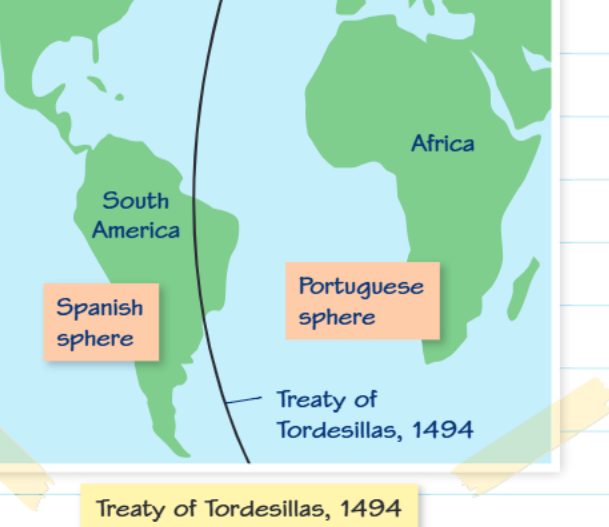
Under the terms of the Treaty of Tordesillas, signed in 1494, a clear geographical boundary was established to divide the colonial territories between Spain and Portugal. The treaty created an imaginary line running from the North Pole to the South Pole, positioned 2000 kilometres to the west of the Cape Verde islands off the African coast.
The territorial division was straightforward but had enormous consequences. All lands located to the west of this demarcation line would belong to Spain, while all territories to the east of the line, except for the Canary Islands, would be controlled by Portugal. This arrangement meant that virtually all of the Americas fell under Spanish control, with only some eastern parts of South America remaining in the Portuguese sphere of influence. Meanwhile, Portugal retained its dominance over African exploration and colonisation.
Why was the Treaty of Tordesillas important?
The Treaty of Tordesillas had several major consequences that shaped the future of European colonisation in the Americas. First, it gave Spain legal control over the vast majority of the American territories, including Mexico, most of North America, and most of South America. This meant that Ferdinand and Isabella were now in a strong position to claim these territories and establish Spanish colonies in the Caribbean region.
The economic implications were enormous. The treaty guaranteed that any gold and silver discovered in these Spanish territories would flow directly to Spain rather than Portugal. This provided Spain with a powerful financial incentive to continue exploring and conquering much of the Americas, as the potential for obtaining precious metals, tobacco, and other valuable resources was now exclusively theirs.
The treaty also prevented a potentially devastating war between two major European powers, allowing both nations to focus their resources on exploration and colonisation rather than military conflict. This peaceful resolution enabled the Age of Exploration to continue without the disruption of Iberian warfare.
Timeline of key events
- 4 March 1493: Columbus arrives in Lisbon, Portugal
- 15 March 1493: Columbus reaches Spain and receives royal congratulations
- 1493: King João II of Portugal challenges Spanish claims based on Treaty of Alcáçovas (1479)
- 1493: Spain assembles naval fleet near Portugal, war seems likely
- 1494: Pope Alexander VI intervenes to support Spain's claim
- 1494: Treaty of Tordesillas signed, establishing the dividing line 2000km west of Cape Verde
Remember!
- The Treaty of Tordesillas in 1494 resolved the territorial dispute between Spain and Portugal by creating a north-south dividing line 2000km west of Cape Verde
- Spain gained control of virtually all the Americas, while Portugal kept Africa and small parts of eastern South America
- Pope Alexander VI supported Spain's claim because of Queen Isabella's piety and commitment to spreading Christianity
- The treaty prevented war between Spain and Portugal and gave Spain exclusive rights to American gold and silver
- This agreement provided Spain with a major incentive to continue exploring and conquering the Americas for economic gain