The Conquistadors, c1513-c1528 (Edexcel GCSE History): Revision Notes
📚Revision Notes
Pizarro and Panama
Francisco Pizarro's early ambitions
Francisco Pizarro emerged as a key figure among the Spanish conquistadors in the early 16th century. His path to becoming one of history's most famous explorers began through his experiences in Panama. In 1513, Pizarro had joined Vasco Núñez de Balboa on the historic expedition that first reached the Pacific Ocean from the Americas. This experience gave Pizarro valuable knowledge of the Pacific coast and sparked his interest in further exploration.
Pizarro was deeply influenced by accounts of Hernán Cortés's remarkable conquest of the Aztec Empire in Mexico. These stories of vast wealth and successful conquest inspired Pizarro to seek similar opportunities. Additionally, he heard compelling tales from traders who spoke of a mysterious land called "Pirú" - described as a territory to the south that was incredibly rich in gold. These accounts fuelled Pizarro's ambitions and convinced him that great wealth and glory awaited those brave enough to explore southward from Panama.
Note
The stories of Cortés's conquest of the Aztec Empire served as a powerful motivator for many Spanish conquistadors, demonstrating that immense wealth and glory could be achieved through successful conquest of indigenous civilizations.
Contact with the Incas
During the 1520s, Pizarro launched a series of expeditions southward along the Pacific coast, with the ultimate goal of reaching the fabled gold-rich lands. His persistence would eventually lead him to make contact with one of the most sophisticated civilizations in the Americas - the Inca Empire.
Pizarro's first expedition in 1524 achieved limited success, reaching only as far as Colombia. However, his second expedition between 1526-27 proved far more significant, as it brought him into direct contact with the Incas for the first time. The Spanish were amazed by what they discovered - a civilisation of incredible scale and wealth that far exceeded their expectations. Some of the Incas they encountered were friendly towards the Spanish, while others showed hostility. Crucially, Pizarro immediately recognised the enormous potential value this civilisation could bring to Spain and to himself personally.
Pizarro's second expedition, 1526-27
The second expedition marked a turning point in Pizarro's career and Spanish exploration of South America. In November 1526, Pizarro departed from Panama with a substantial force of two ships, 180 men, and several horses - a significant investment that demonstrated his serious commitment to exploration.
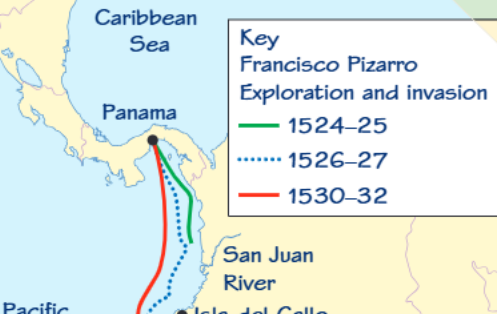
The expedition made steady progress along the Pacific coast. They reached as far south as the Colombian San Juan River, where Pizarro's navigator, Bartolomé Ruiz, made a remarkable discovery. Ruiz captured a raft belonging to indigenous traders, and the contents amazed the Spanish explorers. The raft contained silver, gold, emeralds, and other precious materials that provided concrete evidence of the wealth that existed in the southern territories.
Despite facing serious challenges, including dwindling supplies, Pizarro demonstrated remarkable determination. In 1527, when circumstances became difficult, Pizarro made a crucial decision that would become legendary. Rather than returning to Panama, he chose to continue the expedition with only 13 of his most loyal companions, who became known as "The Famous Thirteen." This small group decided to stay and explore the area further, showing incredible courage in the face of uncertainty.
Important
"The Famous Thirteen" represents one of the most celebrated examples of determination in Spanish exploration history. This small group's decision to continue despite dangerous conditions became a symbol of conquistador courage and persistence.
Their persistence paid off when they travelled further southward on an improvised vessel. The expedition discovered clear evidence of the fabulous wealth that existed in northern Peru, including substantial amounts of gold and silver. This discovery confirmed the stories they had heard and provided the proof Pizarro needed to justify larger-scale expeditions. The group finally returned to Panama in late 1527, carrying with them the evidence that would change the course of Spanish colonisation.
Appeal to Charles I of Spain
Upon returning to Panama in 1527, Pizarro faced a significant obstacle. The governor of Panama refused to grant him permission to launch a third, larger expedition to conquer the territories he had discovered. Recognising that local authorities would not support his ambitious plans, Pizarro made the bold decision to appeal directly to the Spanish Crown.
In 1528, Pizarro returned to Spain carrying concrete evidence of Inca wealth, including llamas, silver, and gold that he had obtained during his second expedition. This physical proof was crucial in convincing the Spanish authorities of the potential value of conquest. Pizarro presented himself to Charles I of Spain and made a compelling case, promising to "extend the empire of Castile" through conquest of these new territories.
His appeal proved successful. In July 1529, Charles I granted Pizarro the Capitulación de Toledo, a formal license that gave him royal authorisation to conquer Peru. This document was essentially a contract that provided Pizarro with the legal authority and royal backing necessary to launch his conquest. The license represented the Spanish Crown's recognition that Pizarro's discoveries were valuable enough to merit official support and investment.
Note
The Capitulación de Toledo was a typical example of Spanish colonial contracts, which formalised the relationship between the Crown and conquistadors by granting specific rights and responsibilities for conquest and colonisation.
Timeline of major events
- 1513: Pizarro joins Balboa's expedition that reaches the Pacific Ocean
- 1524-25: Pizarro's first expedition reaches Colombia but makes limited progress
- November 1526: Pizarro begins his second expedition with 180 men and two ships
- 1527: Pizarro and "The Famous Thirteen" discover evidence of Inca wealth in northern Peru
- Late 1527: Expedition returns to Panama with proof of golden civilisation
- 1528: Pizarro travels to Spain with evidence of Inca wealth
- July 1529: Charles I grants Pizarro the Capitulación de Toledo, authorising conquest of Peru
- 1530-32: Pizarro launches his third expedition, leading to the conquest of the Inca Empire
Summary
Key Points to Remember:
-
Pizarro's expeditions from Panama between 1524-1527 were crucial in establishing Spanish contact with the Inca Empire and demonstrating the civilisation's immense wealth.
-
The second expedition (1526-27) was particularly significant because it provided concrete evidence of Inca gold and silver, which Pizarro used to secure royal support for conquest.
-
"The Famous Thirteen" represents Pizarro's determination and the small group of loyal men who chose to continue exploring despite dangerous conditions and dwindling supplies.
-
The Capitulación de Toledo granted in July 1529 was the legal foundation that authorised Pizarro's conquest of Peru, showing how Spanish colonial expansion required both exploration and formal royal approval.
-
Pizarro's success in Panama laid the groundwork for one of the most significant conquests in Spanish colonial history, demonstrating how early exploration expeditions could lead to major imperial expansion.