The voyage of Magellan (Edexcel GCSE History): Revision Notes
📚Revision Notes
The voyage of Magellan
Ferdinand Magellan's historic expedition between 1519-1522 represents one of the most significant maritime achievements in world history. This ambitious voyage not only proved that the Earth was round but also opened up entirely new trade routes across the Pacific Ocean, fundamentally changing global commerce and expanding the Spanish Empire's reach.
Note
Magellan's expedition was one of the most dangerous and ambitious voyages ever attempted, requiring crews to navigate completely uncharted waters with limited navigation technology and supplies.
The quest for the Spice Islands
In 1518, the newly crowned Charles I of Spain commissioned Ferdinand Magellan to lead an extraordinary mission. The Spanish king placed Magellan in command of five ships with a clear objective: to discover a westward route to the valuable Spice Islands, which formed part of the East Indies.
The Spice Islands held immense economic importance due to their abundant production of highly sought-after spices including mace, nutmeg, and pepper. These commodities were incredibly valuable in European markets, making control of spice trade routes extremely profitable. However, the existing eastern routes were largely controlled by Portugal and other competing powers.
Important
The Treaty of Tordesillas had created uncertainty about whether the Spice Islands belonged to Spain or Portugal, giving Charles I additional motivation to reach these territories first and establish Spanish claims.
The Spanish crown was particularly eager for Magellan to establish Spanish claims to these islands and develop profitable spice trading relationships that would benefit the empire's treasury.
Magellan's journey across uncharted waters
Magellan's expedition began in 1519 when he set sail westward from Spain, leading his fleet across the Atlantic Ocean. His plan involved finding a passage through the Americas that would allow access to the Pacific Ocean, which remained largely unexplored by Europeans at that time.
The journey proved incredibly challenging from the start. After crossing the Atlantic, Magellan successfully located and navigated through a narrow strait at the southern tip of South America. This passage, which would later bear his name as the Strait of Magellan, provided the crucial link between the Atlantic and Pacific Oceans that he had been seeking.
Example
Journey Stages: Magellan's Route
Stage 1: Spain → Atlantic Ocean crossing (1519)
Stage 2: South America → Discovery of the Strait of Magellan (1520)
Stage 3: Pacific Ocean crossing → Philippines (1521)
Stage 4: Westward journey home → Only Victoria returns to Spain (1522)
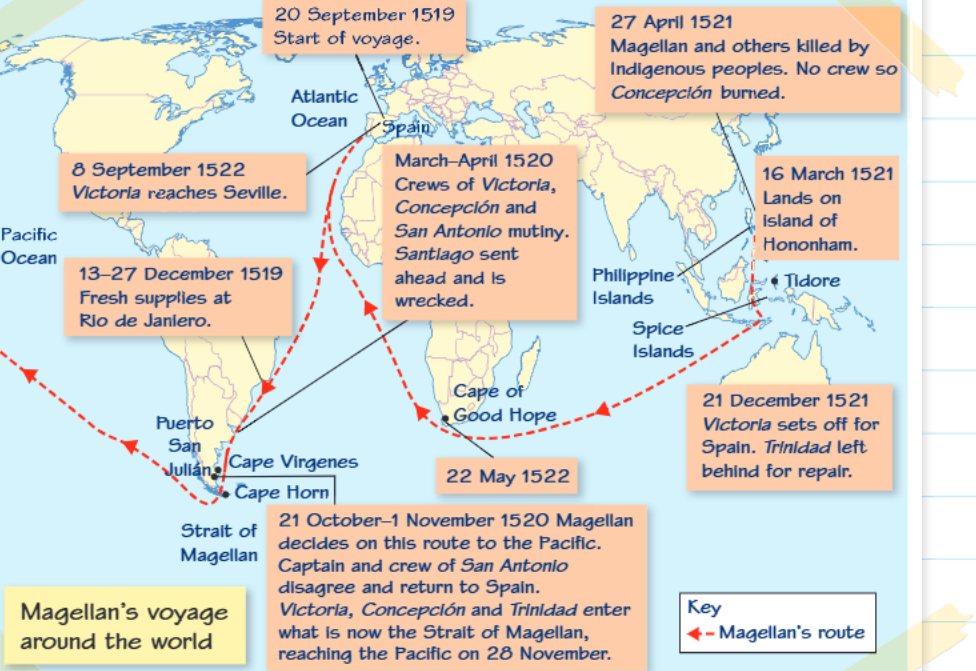
Once in the Pacific, Magellan continued westward across this vast ocean, eventually reaching the Philippines in 1521. Upon arrival, he immediately claimed these islands for Spain, adding them to the growing Spanish Empire. However, this triumph would be short-lived, as Magellan was killed in 1521 during conflicts with Indigenous inhabitants of the Philippines.
Following Magellan's death, the surviving members of his expedition faced the daunting task of completing their journey home. In 1522, after sailing westward across the Indian Ocean and around Africa, only one ship called the Victoria managed to reach Spain. Of the original 270 crew members who had begun this epic voyage in 1519, merely 18 returned, with many having died from disease, starvation, and various hardships encountered during their travels.
Why was Magellan's voyage so significant?
Magellan's expedition achieved several groundbreaking accomplishments that had lasting global impact. First and most importantly, it provided definitive proof that the Earth was round, confirming Columbus's earlier theories about reaching the East Indies by sailing westward.
The voyage successfully opened up the Pacific Ocean for future exploration and trade. This development was revolutionary because it created new possibilities for reaching the East Indies and the Philippines directly from Europe. Spanish ships could now sail up the Pacific coast, which led to the exploration and eventual colonisation of places along the western coast of North America, including areas that would later become California.
Note
The Pacific Ocean was so named by Magellan himself, who called it "Mar Pacífico" (peaceful sea) because of the calm waters his expedition encountered after the turbulent passage through the strait.
Perhaps most significantly for Spain's imperial ambitions, the expedition established Spanish control over the Philippines. This territorial gain, combined with Spain's existing empire in the Americas, positioned the Spanish crown to dominate world trade by the 1540s. The Spanish Empire now controlled vast networks of trade routes, with tobacco, spices, silver, and gold being transported by Spanish vessels across the globe.
The economic benefits for the Spanish government were enormous, as gold, silver, and taxes from these expanded trade networks flowed directly into the royal treasury, funding further expansion and consolidation of Spanish power worldwide.
Timeline of major events
- 1518: Charles I of Spain commissions Magellan to find a westward route to the Spice Islands
- September 1519: Magellan departs Spain with five ships and 270 crew members
- December 1519: Expedition stops in Rio de Janeiro for supplies
- March-April 1520: Crew mutinies in South America; Magellan maintains control
- October-November 1520: Discovery and navigation of the Strait of Magellan
- March 1521: Magellan reaches the Philippines and claims them for Spain
- April 1521: Magellan is killed by Indigenous inhabitants in the Philippines
- September 1522: The Victoria returns to Spain with only 18 survivors
Summary
Key Points to Remember:
- Magellan's voyage (1519-1522) achieved the first circumnavigation of the Earth, proving the world was round
- The expedition discovered the Strait of Magellan, connecting the Atlantic and Pacific Oceans
- Only 18 of the original 270 crew members survived the complete journey, highlighting the extreme dangers of early ocean exploration
- Spain gained control of the Philippines through this voyage, significantly expanding the Spanish Empire's reach
- The opening of Pacific trade routes enabled Spain to dominate global commerce by the 1540s, bringing immense wealth to the Spanish treasury