The government of the empire (Edexcel GCSE History): Revision Notes
📚Revision Notes
The government of the empire
Spain developed a sophisticated governmental system to manage its vast American territories from the homeland in Castile. This administrative structure was built around two crucial institutions that worked together to regulate colonial trade, collect taxes, and maintain royal control over the distant colonies.
Note
This dual-institution system represented one of the most complex administrative structures of the early modern period, allowing Spain to maintain control over territories spanning from present-day California to Argentina.
Casa de Contratación (House of Trade)
The Casa de Contratación represented Spain's first major attempt to systematically control colonial trade and navigation. Queen Isabella established this institution in 1503, recognising the need for centralised oversight of the growing American commerce.
Functions and responsibilities
The Casa served multiple critical functions in managing Spain's colonial empire. It collected all colonial taxes and duties, most notably implementing a 20 percent tax on precious metals known as the 'royal fifth'. This taxation system provided the Spanish crown with enormous wealth, enabling it to fund military campaigns against other European powers, particularly France.
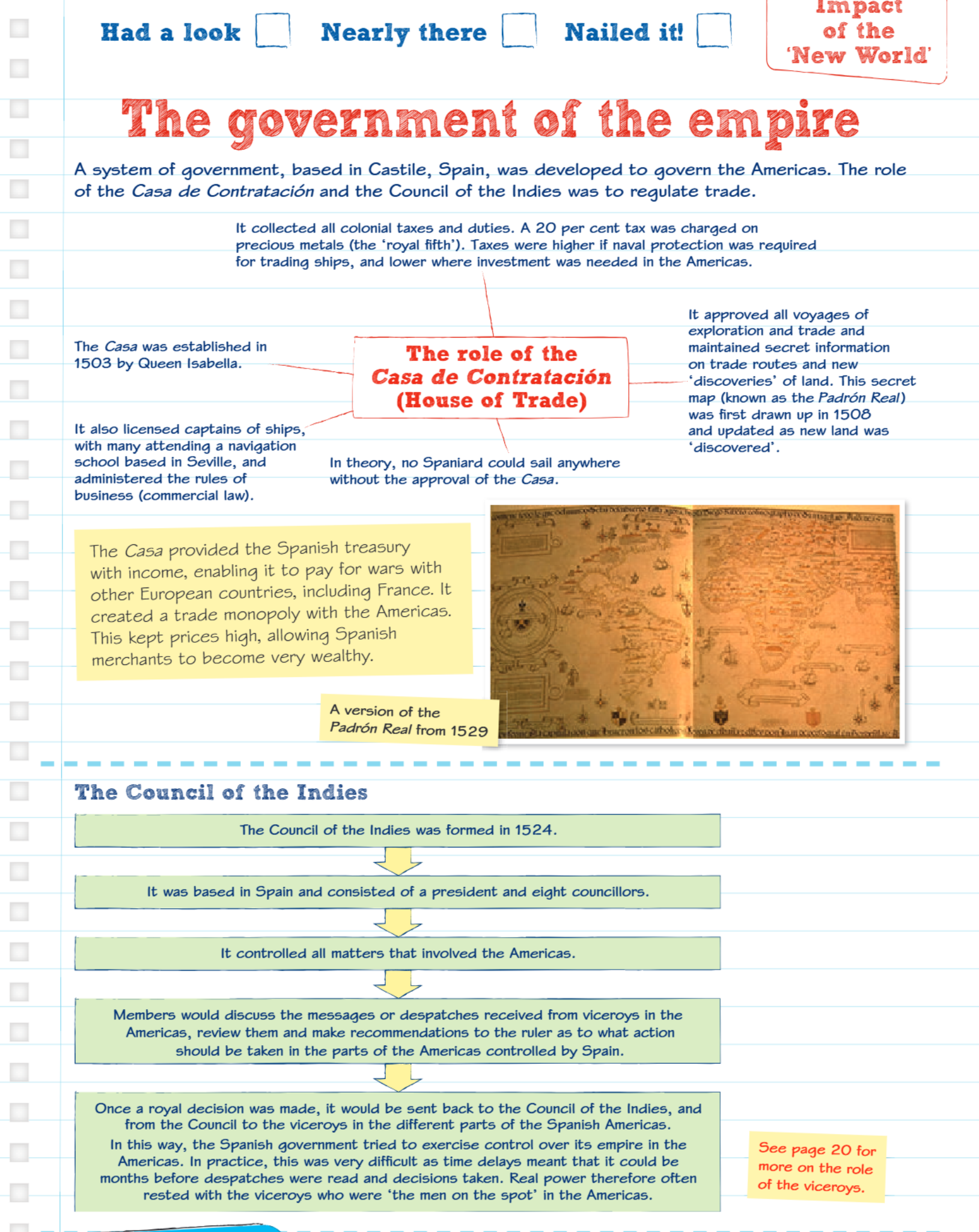
The institution also held exclusive authority over approving voyages of exploration and trade. No Spanish citizen could legally sail to the Americas without obtaining permission from the Casa. This control extended to maintaining detailed records of trade routes and geographical discoveries through a secret map called the Padrón Real, first created in 1505 and regularly updated as new territories were explored.
Regulatory powers
Beyond taxation and voyage approval, the Casa operated comprehensive regulatory systems. It licensed ship captains and established a navigation school in Seville to train qualified sailors and navigators. The institution also administered commercial law, ensuring that business practices in colonial trade followed Spanish legal standards.
Important
The Casa's control was so complete that it created an illegal but thriving black market trade, as merchants sought to avoid the heavy taxation and restrictive regulations imposed by this monopolistic system.
Economic impact
The Casa's most significant achievement was creating a complete trade monopoly with the Americas. By controlling all legal commerce between Spain and its colonies, the institution kept prices artificially high, allowing Spanish merchants to accumulate substantial wealth. This monopolistic system funnelled colonial riches directly into the Spanish treasury, transforming Spain into Europe's wealthiest nation during this period.
Council of the Indies
While the Casa de Contratación focused primarily on trade regulation, the Council of the Indies served as the supreme governing body for all colonial affairs. Established in 1524, this council represented the highest level of colonial administration outside the monarchy itself.
Structure and composition
The Council operated from Spain and consisted of a president and eight councillors who deliberated on all matters concerning the American territories. This centralised structure meant that even minor colonial decisions required approval from officials thousands of miles away from the actual territories.
Administrative functions
The Council exercised comprehensive control over colonial governance. It reviewed all messages and dispatches from viceroys (the king's representatives in different regions of the Americas) and provided detailed recommendations to the monarch about appropriate responses and policies. Every significant administrative decision affecting the colonies required the Council's consideration and approval.
Note
Viceroys were essentially the king's alter ego in the colonies, wielding enormous power but always subject to oversight and approval from the Council of the Indies back in Spain.
Communication challenges
The Council faced substantial practical difficulties in governing the distant territories effectively. Once royal decisions were made, they had to be transmitted back through the Council to the viceroys in various parts of Spanish America. This communication process often took months, creating significant delays between policy decisions and their implementation.
The system frequently broke down in practice because colonial officials needed to respond quickly to local situations. Viceroys, who were described as "the men on the spot", often had to make important decisions before receiving official guidance from Spain, creating tension between central control and practical governance needs.
Important
This communication delay created a fundamental paradox: while Spain sought absolute control over its colonies, the practical realities of distance and time often forced colonial officials to act independently, potentially undermining the very centralised authority the system was designed to maintain.
Timeline of key developments
- 1503: Queen Isabella establishes the Casa de Contratación
- 1505: First version of the Padrón Real (secret map) created
- 1524: Council of the Indies formed to oversee colonial administration
- 1529: Updated version of Padrón Real reflects expanding geographical knowledge
Summary
Key Points to Remember:
- The Casa de Contratación (1503) controlled all colonial trade and created Spain's American trade monopoly
- The 'royal fifth' tax collected 20% of all precious metals, providing enormous wealth to fund Spanish wars
- The Council of the Indies (1524) made all major colonial policy decisions from Spain
- Communication delays between Spain and the colonies created practical governing challenges
- Both institutions worked together to maintain royal control over the vast American territories