Conflict on the Plains (Edexcel GCSE History): Revision Notes
📚Revision Notes
Conflict on the Plains: Lawlessness in the American West
Understanding lawlessness in the West
When we talk about lawlessness in the American West, this doesn't mean there were no laws at all. Rather, it means that law enforcement was incredibly weak and couldn't effectively prevent crime or catch criminals. As frontier towns and settlements expanded rapidly, criminal activity became much more widespread and common.
Note
The term "lawlessness" in the context of the American West refers specifically to the breakdown of effective law enforcement systems, not the complete absence of legal frameworks.
The main reason for this lawlessness was simple: the population grew so quickly that the existing law enforcement systems simply couldn't keep up with demand.
Causes of lawlessness
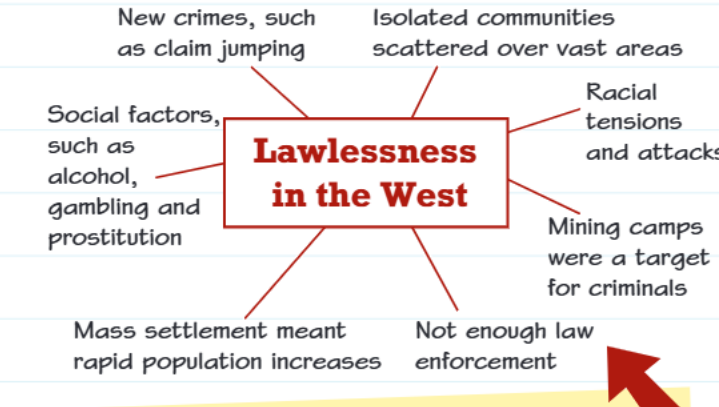
Several key factors contributed to the breakdown of law and order in the American West:
Insufficient law enforcement was the most critical problem. There simply weren't enough sheriffs, marshals, or other officers to patrol the vast frontier territories and growing settlements.
Mass settlement and rapid population increases meant that communities grew from small outposts to bustling towns almost overnight, overwhelming any existing systems of order.
Isolated communities scattered over vast areas made it difficult for law enforcement to respond quickly to crimes or coordinate efforts across different settlements.
Social problems flourished in frontier communities, particularly issues with alcohol consumption, gambling, and prostitution, which often led to violence and disorder.
New types of crime emerged that were specific to the frontier experience, such as claim jumping (stealing someone else's mining claim).
Mining camps became prime targets for criminals who knew miners often carried gold and valuables.
Racial tensions and attacks increased as different ethnic groups competed for the same opportunities, leading to violence and discrimination.
Important
The rapid pace of westward expansion meant that legal institutions couldn't be established quickly enough to maintain order, creating a perfect environment for criminal activity to flourish.
Common problems in mining communities
Mining camps faced particular challenges with maintaining order. These settlements were typically very isolated in mountainous regions, far from any official law enforcement. The vast majority of residents were men, and the combination of alcohol, gambling, and competition over women frequently led to fights and violence.
Chinese migrants and other ethnic minorities faced serious prejudice and attacks, which increased overall crime rates in these communities. Outlaws and confidence tricksters specifically targeted miners because they knew these men often carried significant amounts of gold and were vulnerable to scams promising false fortunes.
A new crime called "claim jumping" became common, where someone would take over a promising mining claim that belonged to someone else. Sometimes miners' courts were established to help settle these disputes fairly.
Note
Mining communities were particularly vulnerable to lawlessness due to their isolation, transient populations, and the presence of valuable gold and precious metals that attracted criminal activity.
Case study: San Francisco gangs (1849-1851)
Example
Case Study: San Francisco During the Gold Rush
San Francisco provides an excellent example of how rapid growth led to lawlessness. During the California Gold Rush, the city's population exploded from just 1,000 people to 25,000 by 1849.
However, very few prospectors actually found gold, leaving San Francisco filled with unemployed and disappointed migrants. As more Chinese people arrived in the city, racial tensions increased significantly.
By 1851, organised gangs had gained control of much of San Francisco. The few local law enforcement officers couldn't cope with the situation, and many had been bribed by gang members. Murder, violence, and theft became everyday occurrences.
Chinese discrimination and the gold rush
A terrible famine in China led to a massive increase in Chinese migration to San Francisco - around 20,000 people arrived in 1852 alone. Chinese people were banned from working new mining claims, but when their hard work helped them find gold that had been overlooked by others, white Americans would often steal it from them. The courts actively discriminated against Chinese people, making it nearly impossible for them to seek justice.
Important
Chinese migrants faced systematic discrimination and violence, with courts refusing to protect their rights or property. This institutional racism contributed significantly to the overall atmosphere of lawlessness in frontier communities.
Community responses to lawlessness
With no effective official law enforcement available, the citizens of San Francisco created a vigilance committee in 1851 to control gang violence. This idea quickly spread to mining camps across the West, where communities took law enforcement into their own hands.
Miners also established their own courts to settle disputes over claims, typically choosing a respected older miner to serve as judge.
Key terms
Vigilance committee (vigilantes): A group of ordinary citizens who decided to punish suspected criminals themselves, rather than relying on the official justice system, usually because that system wasn't working properly.
Miners' courts: Informal courts set up by mining communities to settle disputes over mining claims, with cases typically decided by a respected older miner chosen by the community.
Claim jumping: The crime of taking over someone else's mining claim illegally.
Timeline of major events
- 1849: California Gold Rush begins; San Francisco's population grows from 1,000 to 25,000
- 1851: Gangs gain control of San Francisco; first vigilance committee established
- 1852: 20,000 Chinese migrants arrive in San Francisco in one year
- 1850s-1860s: Mining camps spread across the West, each facing similar lawlessness problems
Remember!
Summary
Key Points to Remember:
- Lawlessness in the West was caused primarily by rapid population growth that overwhelmed existing law enforcement systems
- Mining communities were particularly vulnerable due to their isolation, male-dominated populations, and the presence of gold and valuables
- San Francisco's experience during the Gold Rush demonstrates how quickly lawlessness could take hold in frontier communities
- Chinese migrants faced severe discrimination and violence, which contributed to overall crime and tension
- Communities responded by creating vigilance committees and miners' courts to enforce their own version of justice when official systems failed