Changes in the cattle industry (Edexcel GCSE History): Revision Notes
📚Revision Notes
Changes in the cattle industry
The boom that led to bust
During the 1870s, cattle ranching became incredibly profitable in the American West. The success of the open range system meant that huge amounts of money poured into the industry. However, this economic boom created serious problems that would eventually destroy the very system that made it possible.
As ranchers became wealthy from their cattle operations, they reinvested their profits by purchasing more cattle and breeding larger herds. This seemed like a smart business decision at the time, but it set in motion a chain of events that would devastate the industry.
Note
The open range system allowed cattle to graze freely on public lands without the need for fenced enclosures. This system worked well initially because there was abundant grassland and relatively few cattle, but it contained the seeds of its own destruction.
The consequences of overstocking
The success of cattle ranching in the 1870s created a dangerous cycle that ultimately led to the industry's near-collapse. This process can be understood through several interconnected problems:
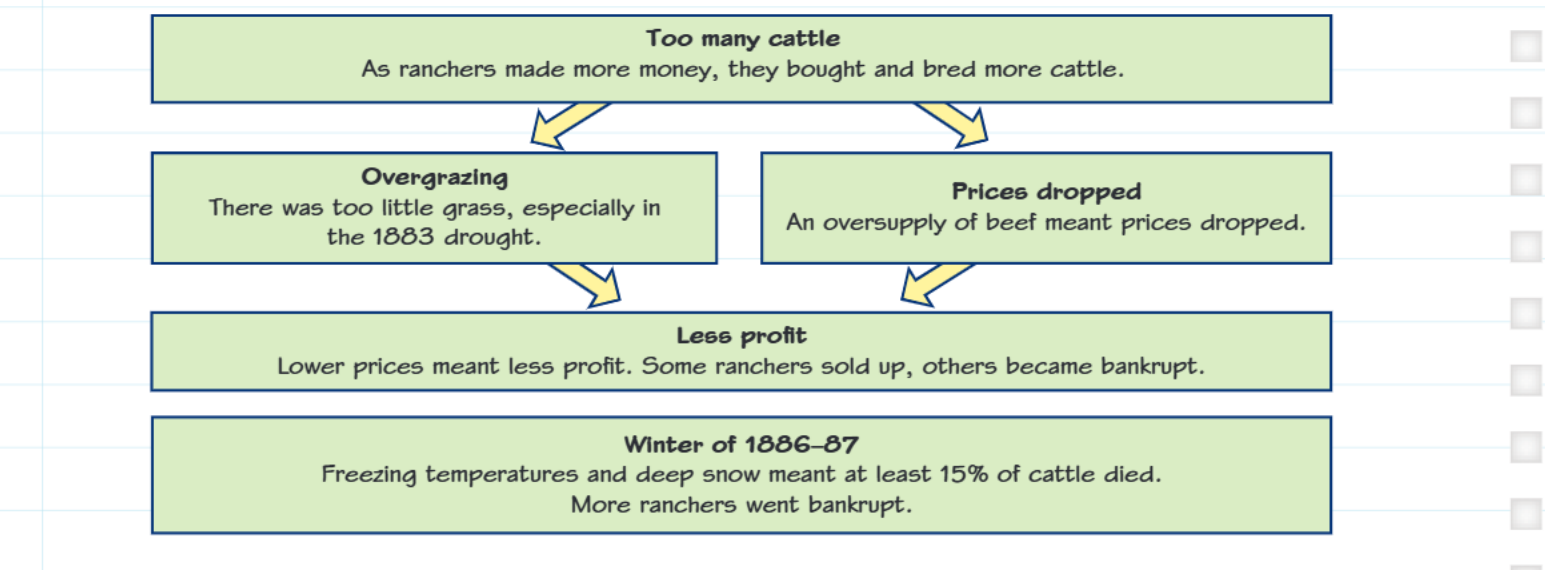
The diagram above shows how ranchers' initial success created a cascade of problems. When ranchers made money, they naturally wanted to expand their operations by buying and breeding more cattle. However, this led to two critical issues that would prove devastating.
Overgrazing became a major problem when there were simply too many cattle for the available grassland. The situation became particularly severe during the drought of 1883, when there wasn't enough grass to feed the massive herds that now roamed the open range. The land couldn't support the number of animals that ranchers had placed on it.
Beef prices plummeted because the market became flooded with cattle. When everyone had the same idea to increase their herds, the oversupply of beef meant that prices dropped significantly. What had once been a profitable business suddenly became much less lucrative.
These two problems combined to create a situation where ranchers were earning much less profit than before. Lower prices meant less money coming in, while the costs of maintaining large herds remained high. Some ranchers were forced to sell their operations, while others declared bankruptcy and lost everything.
Important
The cattle industry's boom-and-bust cycle demonstrates a classic economic principle: when success leads to overproduction, it can destroy the market conditions that created the original success. This pattern would repeat in many other industries throughout American history.
The winter of 1886-87: The final blow
The cattle industry was already struggling when nature delivered a devastating final blow. The winter of 1886-87 was exceptionally harsh, with freezing temperatures and deep snow that lasted for months. The cattle, already weakened by overgrazing and poor conditions, were unable to survive these extreme conditions.
At least 15% of all cattle died during this terrible winter, though some estimates suggest the losses were even higher. Many ranchers who had managed to survive the earlier economic problems were now forced into bankruptcy. The winter essentially marked the end of the open range cattle industry as it had existed.
Important
The winter of 1886-87 became known as the "Great Die-Up" and represented the final collapse of the open range system. The combination of economic pressures and natural disaster created perfect conditions for industry-wide failure.
The end of the open range
After the disasters of the 1880s, the cattle ranchers who remained in business had to completely change their approach. The days of letting huge herds roam freely across the open range were over.
Smaller, more manageable operations became the new norm. Ranchers moved to smaller herds that could be properly cared for and didn't put excessive strain on the grassland. These smaller herds were easier to manage and could be brought under shelter during bad winter weather.
Fenced pastures replaced the open range. Ranchers began fencing in their land to create enclosed pastures where they could control their cattle more effectively. This also helped protect their animals from cattle rustlers who had taken advantage of the chaos of the open range system.
Better quality cattle became important as ranchers focused on breeding high-quality animals that would produce better meat. Rather than quantity, the emphasis shifted to quality. These superior animals were kept separate from other breeds so that their calves would also be high quality.
Market recovery began as the smaller number of cattle reduced the oversupply of beef. With less beef available, prices started to rise again, making cattle ranching profitable once more. The higher quality cattle could also be sold at better prices.
Note
The transformation of the cattle industry from quantity-focused to quality-focused operations represented a fundamental shift in business strategy. This change made the industry more sustainable and profitable in the long term, even though it employed fewer people and used less land.
Impact on homesteaders
The collapse of open range ranching had unexpected benefits for homesteaders. Many of the areas that had been used for open-range cattle operations were now available for farming. Homesteaders moved into these regions and established their own farms and crops.
However, the surviving cattle ranches needed to protect their remaining operations from homesteaders' animals. This led to demands that homesteaders fence their land to prevent their animals from interfering with cattle operations.
Note
The relationship between cattle ranchers and homesteaders was often tense, as both groups competed for the same land resources. The collapse of the open range system actually helped reduce this conflict by making more land available for farming.
Consequences for cowboys
The changes in the cattle industry had profound effects on the lives of cowboys, transforming their work and lifestyle completely.
The end of the cowboy's adventurous lifestyle came with the collapse of the open range. Many cowboys lost their lives during the harsh winter of 1886-87, trying desperately to find and rescue cattle in the deep snow and freezing conditions. The romantic image of the cowboy riding freely across the open range became a thing of the past.
New types of work replaced the exciting cattle drives and range riding that cowboys had previously done. Cowboys now found themselves doing much more mundane tasks like:
- Branding cattle
- Removing horns
- Dipping animals for disease prevention
- Looking after horses and fixing equipment
- Mending barbed wire fences
- Repairing buildings
- Checking grass conditions in fenced fields
- Harvesting hay to feed cattle during winter
Living conditions changed dramatically as cowboys moved from sleeping under the stars to living in bunkhouses. These buildings were often poorly constructed and uncomfortable, with:
- Leaking roofs
- Thin walls
- Beds full of lice
- Strict schedules and rules
- Bans on carrying firearms
Employment opportunities decreased significantly as the smaller ranches required far fewer workers. Many cowboys found themselves out of work as the industry contracted and required less labour.
Example
The Transformation of Cowboy Work
Before 1887: A cowboy might spend months on cattle drives, sleeping under stars, riding freely across thousands of acres, and earning relatively good wages for adventurous work.
After 1887: The same cowboy would live in a cramped bunkhouse, follow strict daily schedules, spend days mending fences or harvesting hay, and compete with many others for fewer available jobs.
Timeline of key events
- 1870s: Cattle ranching boom begins, massive profits lead to overinvestment
- 1883: Severe drought worsens overgrazing problems
- 1880s: Beef prices drop due to oversupply, rancher bankruptcies begin
- 1886-87: Devastating winter kills at least 15% of cattle, more ranchers go bankrupt
- After 1887: Transition to smaller, fenced ranches with higher quality cattle
Summary
Key Points to Remember:
- The success of 1870s cattle ranching led to overstocking, which created overgrazing and falling beef prices
- The winter of 1886-87 was the final disaster that ended the open range system, killing at least 15% of cattle
- Ranchers who survived moved to smaller, fenced operations with higher quality cattle rather than large herds
- Cowboys lost their adventurous lifestyle and had to adapt to more mundane ranch work with strict rules
- The collapse of open range ranching opened up land for homesteaders to establish farms and crops