Indigenous peoples: survival on the Plains (Edexcel GCSE History): Revision Notes
📚Revision Notes
Indigenous peoples: survival on the Plains
The challenging environment of the Great Plains
The Great Plains presented an extremely harsh environment for survival. This vast region experienced severely dry conditions, with scorching hot summers and bitterly cold winters. The extreme weather conditions meant that Indigenous peoples had to develop specialised survival strategies. They became completely dependent on the land and animals around them, particularly buffalo, which became the foundation of their entire way of life.
Important
Unlike other Indigenous groups who could rely on farming or coastal resources, Plains peoples had to become expert hunters and develop a nomadic way of life that followed the natural patterns of the animals they depended upon.
The Plains Indians, as they became known, had to adapt every aspect of their lifestyle to survive in this demanding environment. This adaptation required incredible ingenuity and deep understanding of their environment's natural cycles.
The central role of buffalo and horses
Buffalo: the foundation of Plains life
Buffalo were absolutely essential to the survival of Plains Indigenous peoples. These massive animals provided virtually everything needed for daily life on the Plains. The relationship between Plains peoples and buffalo went far beyond simple hunting - it was a complete dependence that shaped every aspect of their culture.
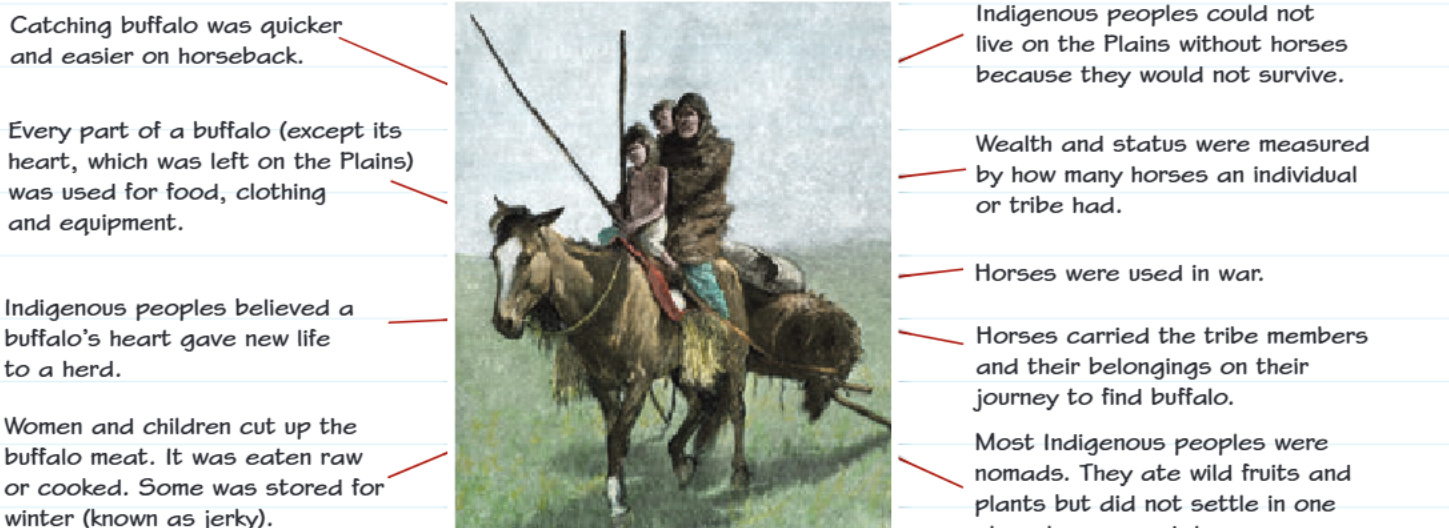
Example
Worked Example: Buffalo Utilization
Every part of the buffalo was carefully used, demonstrating the resourcefulness required for Plains survival:
- Meat: Primary food source, processed as fresh meat or dried into jerky for winter storage
- Thick hides: Converted into clothing, blankets, and tipi covers
- Bones: Carved into tools and weapons for daily use
- Sinew: Used as thread for sewing clothing and equipment
This complete utilisation demonstrates how Plains peoples developed sustainable practices that allowed them to thrive in their environment.
Every part of the buffalo was carefully used, demonstrating the resourcefulness required for Plains survival. The meat provided the primary food source, with women and children processing it in various ways. Fresh meat could be eaten immediately after a hunt, but much of it was cut into strips and dried to create jerky, which could be stored through the harsh winter months when hunting was difficult or impossible.
Beyond food, buffalo provided the materials for clothing and equipment. The thick hides became clothing, blankets, and the covers for their portable homes. Bones were carved into tools and weapons, while sinew became thread for sewing.
Note
The spiritual connection to buffalo was equally important. Plains peoples believed that a buffalo's heart could give new life to an entire herd, showing their deep understanding of the natural cycles that governed their survival. This spiritual relationship helped maintain respectful hunting practices that ensured buffalo populations could continue to support the tribes.
Horses: the key to survival
Horses, originally introduced by Spanish colonists, became absolutely crucial for Plains survival. Indigenous peoples quickly recognised that
survival on the Plains was impossible without horses
. These animals transformed every aspect of Plains life, from hunting methods to social organisation.
Horses made buffalo hunting far more effective and safer. Mounted hunters could chase buffalo herds across the open Plains, getting close enough to use spears and later firearms effectively. The speed and mobility that horses provided meant hunters could follow buffalo migrations and return to camp with much larger quantities of meat.
Note
Beyond hunting, horses served as symbols of wealth and social status within tribes. The number of horses a person or family owned directly reflected their success and standing in the community. Horses were also essential for warfare, giving Plains warriors significant advantages in conflicts with other tribes or later with American settlers.
For the nomadic lifestyle that Plains peoples adopted, horses were indispensable for transportation. Families could pack their belongings and move camp quickly to follow buffalo herds or escape harsh weather. Without horses, the constant movement required for Plains survival would have been nearly impossible.
Nomadic lifestyle and seasonal patterns
Plains Indigenous peoples developed a sophisticated nomadic lifestyle that followed the natural migration patterns of buffalo herds. During summer and autumn months, entire bands would travel across the Plains, following the buffalo as they moved to find fresh grazing areas.
This nomadic way of life required specialised housing that could be quickly assembled and dismantled. Tipis, made from wooden poles and covered with buffalo hide, were perfectly designed for Plains life. Their cone shape provided excellent protection against the strong winds that constantly swept across the Plains, while flaps at the top allowed for ventilation during hot summers. The entire structure could be taken down and packed away within minutes when the band needed to move.
Example
Worked Example: Seasonal Movement Patterns
Summer/Autumn Strategy:
- Follow buffalo herds across open Plains
- Use portable tipis for quick camp setup and breakdown
- Take advantage of abundant hunting opportunities
Winter Strategy:
- Move to sheltered valleys for weather protection
- Construct permanent wooden lodges with soil insulation
- Focus on survival during harshest season while preparing for next year's hunting
During winter months, bands would move to more sheltered valleys where they could find protection from severe weather. Here they would construct more permanent wooden lodges, insulated with thick layers of soil to provide warmth during the extremely cold winter months. These winter camps allowed Plains peoples to survive the harshest season while preparing for the next year's buffalo hunting.
Social organisation and survival strategies
Plains Indigenous societies organised themselves into flexible social units called bands. These bands were specifically designed to adapt to the challenging conditions of Plains life, particularly the
constant uncertainty about food availability
.
The size of bands changed depending on how much food was available in the area. When buffalo were plentiful, larger bands could stay together, sharing resources and providing mutual support. However, when food became scarce, bands would deliberately split into smaller groups and spread out across different areas. This strategy increased everyone's chances of finding enough food to survive by reducing competition for limited resources.
Important
This flexible social organisation had important consequences for Plains survival. When food shortages occurred, bands often had to move outside their traditional hunting territories and enter areas controlled by other tribes. Sometimes this movement led to peaceful agreements and trade relationships with neighbouring tribes. However, it could also result in conflicts over hunting rights and territorial boundaries.
Inter-tribal raiding became a common part of Plains life, partly as a survival strategy. Tribes would raid each other for horses, food, and people, which were all valuable resources for survival on the Plains. While these raids created tensions between different Indigenous groups, they were also part of the complex ways in which Plains peoples adapted to their challenging environment.
Timeline of key developments
- c1500s: Spanish colonists introduce horses to North America
- c1600s-1700s: Plains Indigenous peoples acquire and master horse riding
- c1800-1835: Plains peoples develop fully nomadic lifestyle following buffalo herds
- c1835-1862: Peak periodof traditional Plains Indigenous life before major disruption
Summary
Key Points to Remember:
- The Great Plains environment was extremely harsh, with scorching summers and bitter winters that required specialised survival strategies
- Buffalo provided everything Plains peoples needed - food, clothing, shelter materials, tools, and spiritual connection to the natural world
- Horses were absolutely essentialfor survival, transforming hunting, transportation, warfare, and social status on the Plains
- The nomadic lifestyle following buffalo migrations was a sophisticated adaptation that included flexible social organisation and seasonal movement patterns
- Plains peoples developed complex survival strategies including flexible band sizes, territorial movement, and inter-tribal relationships that helped them thrive in one of North America's most challenging environments