The California Gold Rush of 1849 (Edexcel GCSE History): Revision Notes
📚Revision Notes
The California Gold Rush of 1849
What was the California Gold Rush?
The California Gold Rush was a major event that began when gold was discovered in California in 1848. This discovery triggered one of the largest migration movements in American history, fundamentally changing the development of the American West. The rush had massive consequences not only for California but for the entire United States, affecting everything from the economy to relationships with Indigenous peoples.
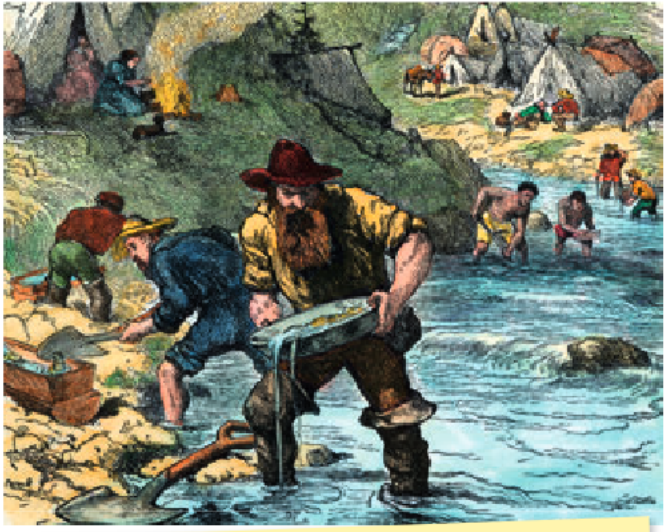
The discovery led to a huge increase in migration to the West and had significant consequences for Indigenous peoples of the Plains, who had previously used the land for law, order, settlement, and farming.
Note
The California Gold Rush represents one of the most dramatic examples of how a single discovery can reshape an entire region and nation's destiny.
The discovery and its impact
Gold was first discovered in California in 1848, but it was in 1849 that the real "rush" began. News of the discovery spread rapidly across America and around the world, creating what historians call "gold fever". This excitement drew people from all walks of life who hoped to strike it rich in the California goldfields.
The timing was crucial - this discovery came during a period when many Americans already believed in "Manifest Destiny", the idea that white Americans had the right to expand across the entire continent. The Gold Rush accelerated this westward movement dramatically.
Note
Manifest Destiny was the belief that the more migration to and settlement in the West, the more white Americans believed they had the "right" to all the land. This ideology justified westward expansion but had devastating consequences for Indigenous peoples.
Who were the Gold Rush migrants?
The people who came to California during the Gold Rush were known as "49ers" because most arrived in 1849. These migrants came from incredibly diverse backgrounds and locations:
American migrants
From 1849 onwards, hundreds of thousands of people travelled to California hoping to find gold. Between 1836 and 1846, only about 5,000 migrants had used the Oregon Trail. However, from 1849 onwards, tens of thousands used the Oregon Trail specifically hoping to find gold in the West.
International migrants
The Gold Rush attracted people from around the world. Thousands came by ship from various countries, all converging on San Francisco. One particularly significant group was the Chinese migrants - a famine in China led to approximately 20,000 Chinese people migrating to California in 1852 alone.
The reality for most migrants
Despite the dreams of striking it rich, most migrants did not actually find gold. The easiest gold to find (surface gold in streams and rivers) was quickly exhausted. Professional miners with proper equipment and expertise were more successful at underground mining, and most of the gold extraction moved to large-scale operations through the 1850s.
Example
Understanding Prospecting Methods
Prospectors were people who looked for gold on the surface, especially in streams and river beds using a technique called placer mining or panning. They would:
- Fill a pan with gravel and sand from a stream
- Swirl water through the pan to wash away lighter materials
- Gold, being heavier, would settle at the bottom
- This method only worked for surface deposits and was quickly exhausted
Consequences of the California Gold Rush
The Gold Rush had wide-reaching effects that shaped California and the broader American West:
Population boom and statehood
The massive influx of people transformed California almost overnight. The population grew so rapidly that California became a state in 1850, just two years after the initial discovery. By 1855, California had a population of 300,000 people - a dramatic increase from its pre-Gold Rush numbers.
Economic impact
The California Gold Rush provided a significant boost to the US economy. The gold extracted from California helped fund railroad construction and other major infrastructure projects. This economic boom had national implications, strengthening the United States' position economically.
Note
The economic benefits of the Gold Rush extended far beyond California. The influx of gold helped stabilise the national economy and provided capital for major infrastructure projects that would connect the East and West coasts.
Farming boom
While many came seeking gold, the population boom also created demand for food and supplies, leading to a farming boom in California. This agricultural development would prove more lasting than the gold mining itself.
Lawlessness in mining camps
The rapid growth of mining camps often outpaced the establishment of proper law enforcement. Many mining camps experienced significant lawlessness, with disputes over claims and resources sometimes leading to violence.
Racism and attacks
The diverse population led to significant racial tensions. There were racist attacks by white migrants and settlers, particularly targeting Chinese migrants and other non-white groups. These tensions reflected broader American attitudes about race and belonging during this period.
Important
The Gold Rush period saw intense racial violence and discrimination. Chinese migrants, despite contributing significantly to California's development, faced severe persecution including discriminatory laws, violent attacks, and exclusion from many mining areas.
Devastating impact on Indigenous peoples
Perhaps the most tragic consequence was the impact on Indigenous Californians. The massive increase in migration along the Oregon Trail created tension with Indigenous peoples whose lands were being crossed and settled. Even more severely, there were large-scale massacres of Indigenous Californians by white migrants and settlers. Some historians describe what happened to Indigenous Californians as genocide - the deliberate killing of large numbers of people, usually because of their ethnicity. This represents one of the darkest aspects of westward expansion.
Important
Critical Historical Impact
The treatment of Indigenous Californians during the Gold Rush represents one of the darkest chapters in American history. The rapid influx of settlers led to:
- Systematic displacement from traditional lands
- Large-scale massacres and violent attacks
- What some historians classify as genocide
- Near-complete destruction of Indigenous California societies
This devastating impact must be remembered alongside the economic and social changes of the Gold Rush period.
Key timeline
- 1848: Gold discovered in California
- 1849: The main Gold Rush begins - hundreds of thousands travel to California
- 1850: California becomes a state due to rapid population growth
- 1852: Peak year for Chinese migration to California (20,000 migrants)
- 1850s: Most easily accessible gold exhausted; mining becomes more professional and industrial
Summary
Key Points to Remember:
-
The California Gold Rush began with the discovery of gold in 1848, but the main rush occurred in 1849, giving migrants the nickname "49ers"
-
The Gold Rush dramatically accelerated westward migration, with tens of thousands using the Oregon Trail compared to only 5,000 in the previous decade
-
California's population boom was so rapid that it became a state in 1850, just two years after gold was discovered
-
While the Gold Rush brought economic benefits and helped fund national development like railroads, it had devastating consequences for Indigenous Californians, including massacres and what some historians call genocide
-
The Gold Rush attracted diverse international migrants, including 20,000 Chinese people in 1852 alone, but also led to significant racial tensions and violence in the mining camps