The Montgomery Bus Boycott, 1955 (Edexcel GCSE History): Revision Notes
📚Revision Notes
The Montgomery Bus Boycott, 1955

Background
On December 1, 1955, an African American woman named Rosa Parks made a decision that would spark one of the most significant protests in American civil rights history. When riding a bus in Montgomery, Alabama, Parks refused to give up her seat to a white passenger, directly challenging the city's segregation laws. Her arrest and subsequent fine became the catalyst for a mass boycott that would last over a year and transform the civil rights movement.
Note
The Montgomery Bus Boycott became a pivotal moment in the American civil rights movement, demonstrating how individual acts of courage could spark massive social change. It established the template for non-violent resistance that would define the movement for years to come.
Causes of the boycott
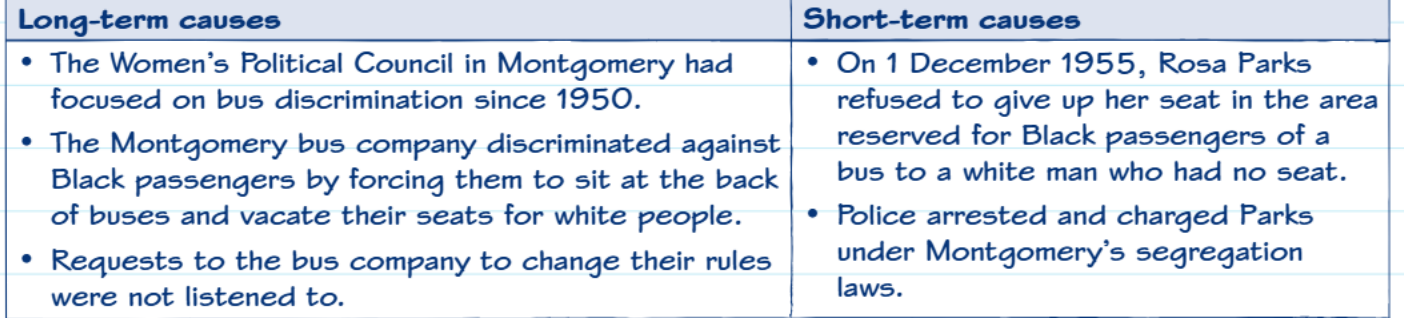
Understanding why the Montgomery Bus Boycott happened requires examining both the long-standing problems and the immediate trigger that sparked action.
Long-term causes
The foundations for the boycott had been building for years before Rosa Parks' arrest. Since 1950, the Women's Political Council in Montgomery had been actively focusing on the discriminatory treatment of Black passengers on city buses. The Montgomery bus company had established deeply unfair policies that forced African American passengers to sit at the back of buses and required them to give up their seats whenever white passengers needed them.
Important
These discriminatory practices created daily humiliation for Black citizens who relied on public transportation. The bus company's refusal to reform these degrading rules despite years of requests from civil rights groups demonstrates the systematic nature of segregation and why organised resistance became necessary.
These discriminatory practices created daily humiliation for Black citizens who relied on public transportation. Despite ongoing requests from civil rights groups to change these degrading rules, the bus company consistently refused to listen to their concerns or make any meaningful reforms.
Short-term causes
The immediate spark came on December 1, 1955, when Rosa Parks was travelling home from work. When the bus driver ordered her to move from the section reserved for Black passengers to make room for a white passenger, Parks courageously refused. The police were called, and she was arrested and charged under Montgomery's segregation laws for her act of defiance.
This arrest provided civil rights activists with the perfect opportunity to challenge the entire system of bus segregation through organised protest.
Events of the boycott, 1955-56
The boycott that followed Parks' arrest became a masterclass in organised, non-violent resistance that lasted 381 days.
December 1955: Organisation begins
Just four days after Parks' arrest, on December 5, 1955, civil rights activists in Montgomery gathered to plan their response. They formed the Montgomery Improvement Association (MIA) and elected Martin Luther King Jr. as their leader, marking his emergence as a major figure in the civil rights movement.
On December 9, the MIA met with officials from the bus company, who refused to change their segregation policies. In response, the MIA made the crucial decision to continue their boycott until they achieved their goals, calling on every African American in Montgomery to avoid using the bus service.
Sustaining the boycott
The success of the boycott depended on providing alternative transportation for the thousands of Black workers who needed to travel around the city. The MIA organised meetings with church groups and other community organisations to establish car-sharing schemes.
Example
Organizational Success: The Car Pool System
The MIA's car pool operation became a model of community organisation:
Step 1: By December 12, the first car pools were operational Step 2: The system eventually involved over 300 vehicles Step 3: Black taxi drivers negotiated reduced fares matching regular bus ticket costs Step 4: Church groups and community organisations coordinated the logistics
This innovative approach ensured that financial hardship wouldn't force people to break the boycott.
Facing opposition and violence
As the boycott continued into 1956, it faced increasing resistance from white supremacists. On January 30, 1956, Martin Luther King Jr.'s home was bombed in an attempt to intimidate the movement's leadership. However, King's response was to call for peaceful protest and refuse any retaliation, demonstrating the movement's commitment to non-violent resistance.
Important
The movement's unwavering commitment to non-violent principles, even when facing violence like the bombing of King's home, was crucial to gaining national sympathy and support. This principled stance distinguished the civil rights movement from its violent opponents.
Media attention and national impact
The violence directed at peaceful protesters actually helped the civil rights cause by attracting widespread media coverage. News reports were largely sympathetic to the civil rights campaigners, helping to build national support for their cause. This media attention established non-violent direct action as an effective and morally powerful approach to challenging injustice.
Significance of Rosa Parks
Rosa Parks became much more than just the person who started the boycott - she became a powerful symbol of dignified resistance to segregation.
Several factors made Parks particularly significant to the success of the Montgomery Bus Boycott. As a married, middle-aged woman, it was difficult for critics to attack her character or claim she was behaving inappropriately. She had already been involved in campaigns for Black voter registration, showing her commitment to civil rights wasn't just a spontaneous decision.
Note
Rosa Parks' strategic importance to the movement went beyond her individual act of defiance. Her background as secretary of the Montgomery NAACP meant she had organisational experience and connections that proved invaluable to sustaining the campaign. Her understanding of non-violent principles made her an ideal representative for the movement's peaceful approach.
Parks also understood and believed in the principles of non-violent direct action, making her an ideal figure to represent the movement's peaceful approach. Additionally, her role as secretary of the Montgomery NAACP meant she had organisational experience and connections that proved valuable to the campaign.
Her refusal to accept segregation on Montgomery's buses triggered a successful desegregation campaign that inspired other civil rights activities across the country, making her arrest a pivotal moment in American history.
Timeline of major events
- December 1, 1955: Rosa Parks arrested for refusing to give up her bus seat
- December 5, 1955: Montgomery Improvement Association formed with MLK as chairman
- December 9, 1955: MIA meets with bus company officials who refuse to change segregation
- December 12, 1955: First car pools begin operation
- January 30, 1956: Martin Luther King Jr.'s home bombed
- December 1956: Boycott ends after 381 days when buses are desegregated
Summary
Key Points to Remember:
- Rosa Parks' arrest on December 1, 1955, sparked the 381-day Montgomery Bus Boycott, one of the most successful civil rights protests in American history
- The boycott had both long-term causes (years of discrimination by the bus company) and a short-term trigger (Parks' arrest)
- The Montgomery Improvement Association, led by Martin Luther King Jr., organised alternative transportation including car pools and reduced taxi fares to sustain the boycott
- The movement's commitment to non-violent direct action, even when facing violence like the bombing of King's home, gained national media support
- Rosa Parks became a powerful symbol because of her character, experience in civil rights work, and understanding of non-violent principles, making the boycott a catalyst for the broader civil rights movement