Political developments in 1932 (Edexcel GCSE History): Revision Notes
📚Revision Notes
Political developments in 1932
The road to Hitler's chancellorship
The year 1932 marked a crucial turning point in German politics that would ultimately lead to Hitler's appointment as Chancellor in January 1933. The political developments during this period demonstrate how a combination of weak leadership, economic crisis, political miscalculation, and the underestimation of Hitler's ambitions created the perfect conditions for the Nazi rise to power.
Note
The events of 1932 show how democracy can collapse not through revolution, but through the failure of democratic leaders to defend democratic institutions and their willingness to make deals with extremist parties.
Key political figures
The two most important figures in Hitler's path to power were President Hindenburg and his political ally Franz von Papen, both of whom would play decisive roles in the events that unfolded.
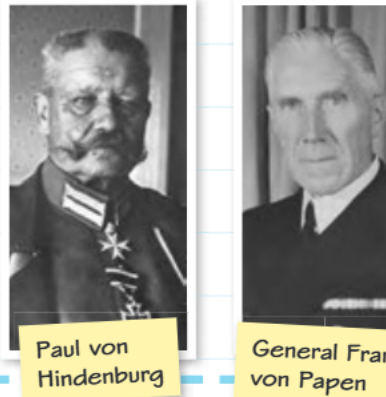
Paul von Hindenburg had served as President of the Weimar Republic since 1925. Despite his prestigious military background from the First World War, he had become increasingly unpopular with the German people. Crucially, Hindenburg never fully embraced or supported the concept of a democratic republic, which weakened his ability to defend Germany's democratic institutions when they came under threat.
Franz von Papen represented the conservative right-wing of German politics and maintained a close friendship with President Hindenburg. Von Papen believed strongly in authoritarian government controlled by a small elite of wealthy and powerful individuals rather than democratic rule. This political philosophy would prove instrumental in the events that followed.
Important
The Fatal Miscalculation
Both men made a critical error in judgement that would have devastating consequences for Germany and the world. They severely underestimated Adolf Hitler's political cunning and determination, believing they could use him for their own purposes and then control him once the Nazis were in power. This miscalculation would prove to be one of the most catastrophic political mistakes in modern history.
Timeline of critical events
Example
April 1932: The presidential election
The political crisis began with Hindenburg's campaign for re-election as President. Although he successfully secured re-election with 53% of the vote, the results revealed troubling trends. Hitler's support had grown significantly, capturing 36% of the vote and establishing himself as a major political force. During this period, Chancellor Brüning attempted to maintain order by introducing unpopular policies, including a ban on the SA (Storm troopers), but these measures only increased political tensions.
Example
May 1932: A new chancellor emerges
On 30 May, Chancellor Brüning resigned under pressure, and President Hindenburg appointed Franz von Papen as the head of a new right-wing coalition government. This appointment marked a significant shift towards conservative politics, though the coalition lacked a majority in the Reichstag. Importantly, Hindenberg was persuaded to govern using presidential decrees when necessary, bypassing normal democratic processes.
Example
July 1932: Nazi electoral breakthrough
The Reichstag elections held in July 1932 produced shocking results that demonstrated the growing political instability in Germany. Widespread street fighting erupted between communist and Nazi paramilitary groups, creating an atmosphere of violence and chaos. The Nazi Party achieved a massive electoral breakthrough, increasing their share of the vote from just 18% in 1930 to 38%, making them the largest single party in the Reichstag.
Following this electoral success, Hitler made a bold demand that he be appointed Chancellor, but President Hindenburg refused this request. This refusal would prove to be temporary, as the political situation continued to deteriorate.
Example
November 1932: Political deadlock
New Reichstag elections were called, but they failed to resolve the political crisis. The results showed that no single party could command a majority, creating a dangerous political deadlock. During this period, Army General von Schleicher issued a stark warning to Hindenburg, claiming that if von Papen remained as Chancellor, Germany would descend into civil war. Under this pressure, Hindenburg reluctantly instructed von Papen to resign from his position.
Example
December 1932: Desperate measures
By December, President Hindenburg was struggling desperately to form a stable government capable of governing effectively. In a controversial move, he approached von Schleicher and appointed him as the new Chancellor, hoping this would provide the strong leadership Germany appeared to need.
Example
January 1933: The fatal compromise
The final act of this political drama unfolded in January 1933. Von Schleicher quickly discovered that he lacked both public support and Nazi backing, making it impossible for him to govern effectively. Recognising his impossible position, he asked Hindenburg to grant him the powers of a military dictator, but Hindenburg refused this extreme request.
At this critical moment, Franz von Papen made the suggestion that would change the course of history. He persuaded President Hindenburg to appoint Adolf Hitler as Chancellor, arguing this would prevent the establishment of a military dictatorship. Von Papen also proposed that he should become Vice-Chancellor, believing this arrangement would allow him to maintain control over Hitler and limit Nazi power.
On 30 January 1933, President Hindenburg made the decision that sealed Germany's fate: he appointed Adolf Hitler as Chancellor of Germany.
The significance of these developments
The political developments of 1932 reveal several crucial factors that enabled Hitler's rise to power. The weakness of the Weimar Republic's democratic institutions became apparent when leaders increasingly relied on presidential decrees rather than parliamentary democracy. The conservative politicians' belief that they could use and control Hitler proved to be a fundamental miscalculation that had devastating consequences.
Note
The economic crisis and political instability created conditions where extremist parties could gain support, while the threat of civil war and violence was used as justification for appointing Hitler to power. Most importantly, the democratic process was ultimately abandoned in favour of behind-the-scenes political deals that prioritised short-term stability over long-term democratic principles.
The events of 1932 demonstrate how democracy can be destroyed from within when its defenders lose faith in democratic processes and attempt to make deals with anti-democratic forces. The conservative politicians' fatal miscalculation in believing they could control Hitler once in power shows the danger of underestimating extremist movements and their leaders.
Summary
Key Points to Remember:
-
Presidential weakness: Hindenberg's lack of commitment to democracy and his susceptibility to political pressure from conservative allies created opportunities for extremist parties to gain power through non-democratic means.
-
Conservative miscalculation: Von Papen and other conservative politicians fatally underestimated Hitler, believing they could use him for their own purposes and then control him once in power.
-
Electoral breakthrough: The July 1932 elections made the Nazis the largest party in the Reichstag with 38% of the vote, but Hitler still became Chancellor through political deals rather than democratic victory.
-
Political deadlock: The inability to form stable coalition governments created a crisis atmosphere that was exploited to justify appointing Hitler as a solution to Germany's political problems.
-
The fatal appointment: Hitler became Chancellor on 30 January 1933 not because he won a democratic election, but because conservative politicians chose to appoint him in a desperate attempt to maintain their own political influence.