Geometry Problems (Edexcel GCSE Maths): Revision Notes
📚Revision Notes
Geometry problems
Geometry problems require a systematic approach and understanding of key angle relationships. The most effective strategy is to work through all geometric rules methodically until you find the solution you need.
Problem-solving strategy
When faced with geometry problems, developing a methodical approach is essential for success. Rather than guessing or working randomly, follow this proven strategy:
Note
The Key to Success: Systematic Problem-Solving
Don't focus only on the target angle - Instead of concentrating solely on the angle you need to find, identify all angles in the diagram in whatever order becomes clear to you. This broader perspective often reveals hidden relationships that lead to the solution.
- Don't focus only on the target angle - Instead of concentrating solely on the angle you need to find, identify all angles in the diagram in whatever order becomes clear to you.
- Apply all geometric rules systematically - Work through every rule of geometry, including parallel line properties, one by one. Apply each rule in as many ways as possible until one leads to your answer.
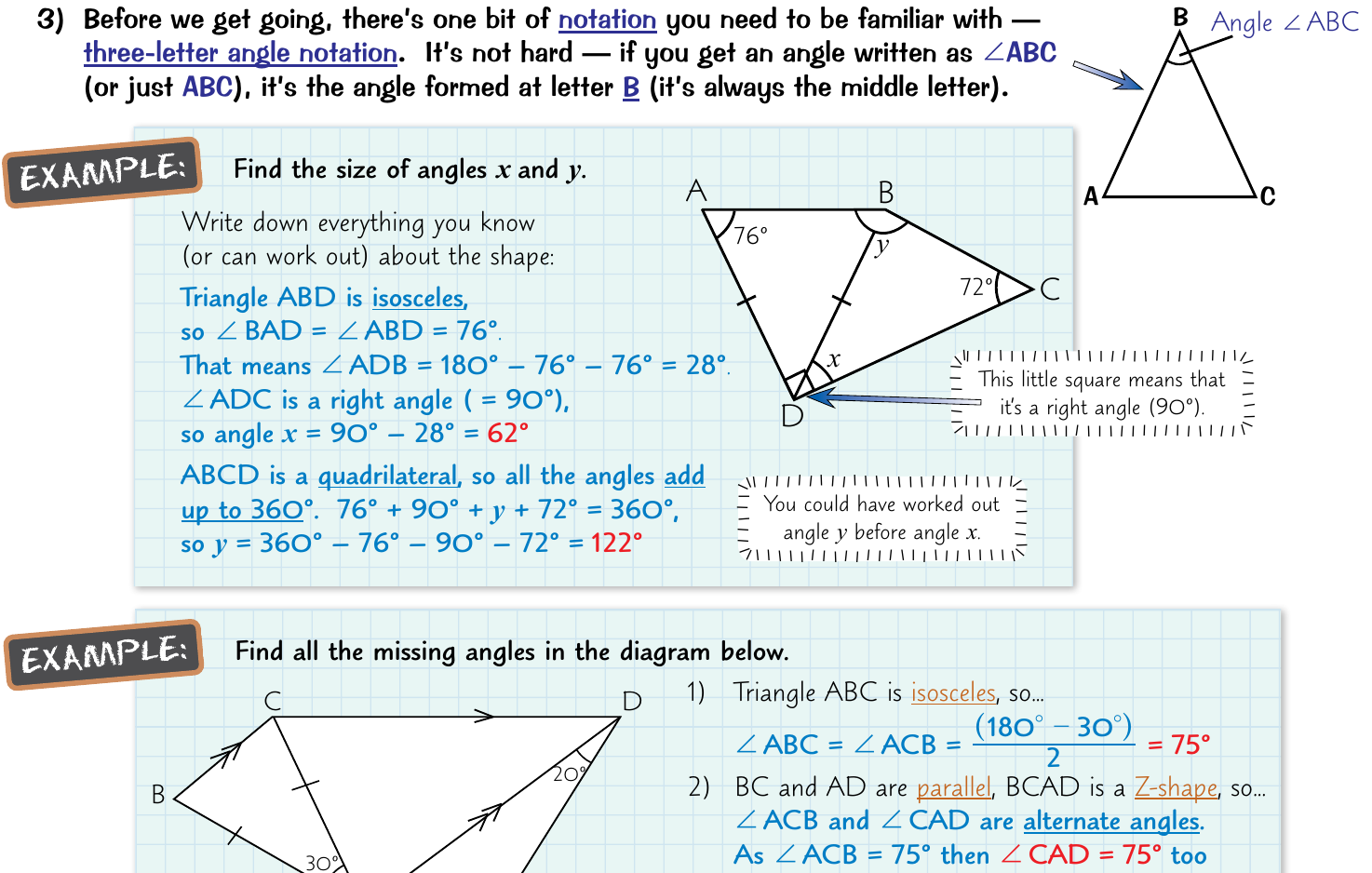
- Use proper notation - Familiarise yourself with three-letter angle notation before starting. When you see an angle written as , remember that it represents the angle formed at letter B, which is always the middle letter.
Key angle relationships
Understanding these fundamental angle relationships is essential for solving geometry problems. These rules form the foundation of geometric problem-solving:
Important
Essential Angle Properties
Master these three fundamental rules - they appear in virtually every geometry problem:
- Straight line angles: Always sum to 180°
- Triangle angles: Always sum to 180°
- Quadrilateral angles: Always sum to 360°
Angles on a straight line
When angles are arranged along a straight line, they always sum to 180°. This property is frequently used in calculations and serves as a key function in many geometric proofs.
For example, if you have angles of 25°, 30°, and 75° on a straight line, the remaining angle would be:
Angles in triangles and parallel lines
When dealing with triangles and parallel lines, several important relationships come into play that are essential for problem-solving:
Important
Critical Parallel Line Property
When parallel lines are cut by a transversal, alternate angles are equal. Look for Z-shape patterns in diagrams - these often provide the key to solving complex problems.
Triangle angle sum: All angles in any triangle add up to 180°.
Parallel line properties: When parallel lines are cut by a transversal, alternate angles are equal, creating useful relationships for problem-solving.
Working through examples
Let's examine how to approach typical geometry problems systematically. These worked examples demonstrate the step-by-step process:
Example
Worked Example: Isosceles Triangle Problem
When working with an isosceles triangle, remember that two angles are equal. If triangle ABD is isosceles with , then:
Step 1: Apply the triangle angle sum rule
Step 2: For quadrilateral ABCD where is a right angle (90°) All angles in the quadrilateral sum to 360°
Step 3: Set up the equation
Step 4: Solve for y
Example
Worked Example: Parallel Lines and Alternate Angles
When identifying parallel lines in a diagram, look for alternate angles (equal angles in a Z-shape pattern). This relationship helps you find missing angles by:
Step 1: Identify which lines are parallel Look for markings or given information indicating parallel lines
Step 2: Find alternate angle pairs Search for Z-shape patterns formed by the parallel lines and transversal
Step 3: Use the fact that alternate angles are equal Apply this relationship to find unknown angles
Step 4: Apply angle sum properties in triangles Use the 180° rule to find any remaining angles
Problem-solving tips
Successful geometry problem-solving requires both knowledge and strategy. These tips will help you approach problems more effectively:
Note
Look for Hidden Relationships
Geometry problems often contain isosceles triangles or parallel lines that aren't immediately obvious. These can provide the key to finding missing angles. Train yourself to spot these patterns quickly.
Write down what you know: Start by listing all the information given in the problem and any angles you can immediately identify.
Work systematically: Don't expect inspiration to strike. Instead, methodically apply each geometric rule until you find the solution.
Check your work: Verify that your answers make sense by checking if angle sums equal 180° for triangles or 360° for quadrilaterals.
Summary
Key Points to Remember:
- Use the systematic approach: try all geometric rules one by one until you find the solution
- Three-letter angle notation uses the middle letter as the vertex ( has vertex at B)
- Angles on a straight line sum to 180°
- Angles in any triangle sum to 180°
- Look for isosceles triangles and parallel lines as they often provide key relationships for solving problems