Parallel Lines (Edexcel GCSE Maths): Revision Notes
📚Revision Notes
Parallel Lines
What are parallel lines?
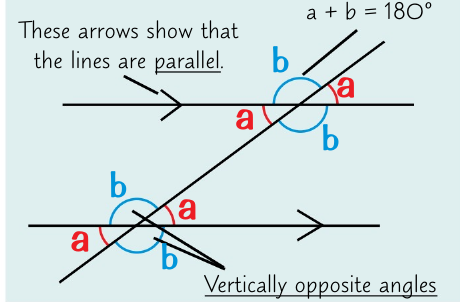
Parallel lines are straight lines that never meet, no matter how far you extend them. They always remain the same distance apart and run in exactly the same direction. In diagrams, parallel lines are often shown with small arrows to indicate they are parallel to each other.
Note
When you see arrows on lines in a diagram, this is the standard way to show that those lines are parallel. Always look for these arrows as they're crucial for identifying when you can use parallel line angle rules.
Angles formed by parallel lines
When a straight line (called a transversal) crosses two parallel lines, it creates several interesting angle relationships. These relationships are incredibly useful for solving geometry problems and finding unknown angles.
Important
The key thing to remember is that when parallel lines are cut by a transversal, only two different angle sizes are actually created. These angles appear in pairs at different positions, and understanding these patterns will help you solve problems much more easily.
Vertically opposite angles
Before we look at the special parallel line relationships, remember that vertically opposite angles (angles directly across from each other when two lines intersect) are always equal. This is true whether the lines are parallel or not.
Note
Vertically opposite angles are a fundamental concept that applies to any two intersecting lines, not just parallel lines. This property will be useful when working with parallel line problems.
The three main angle relationships
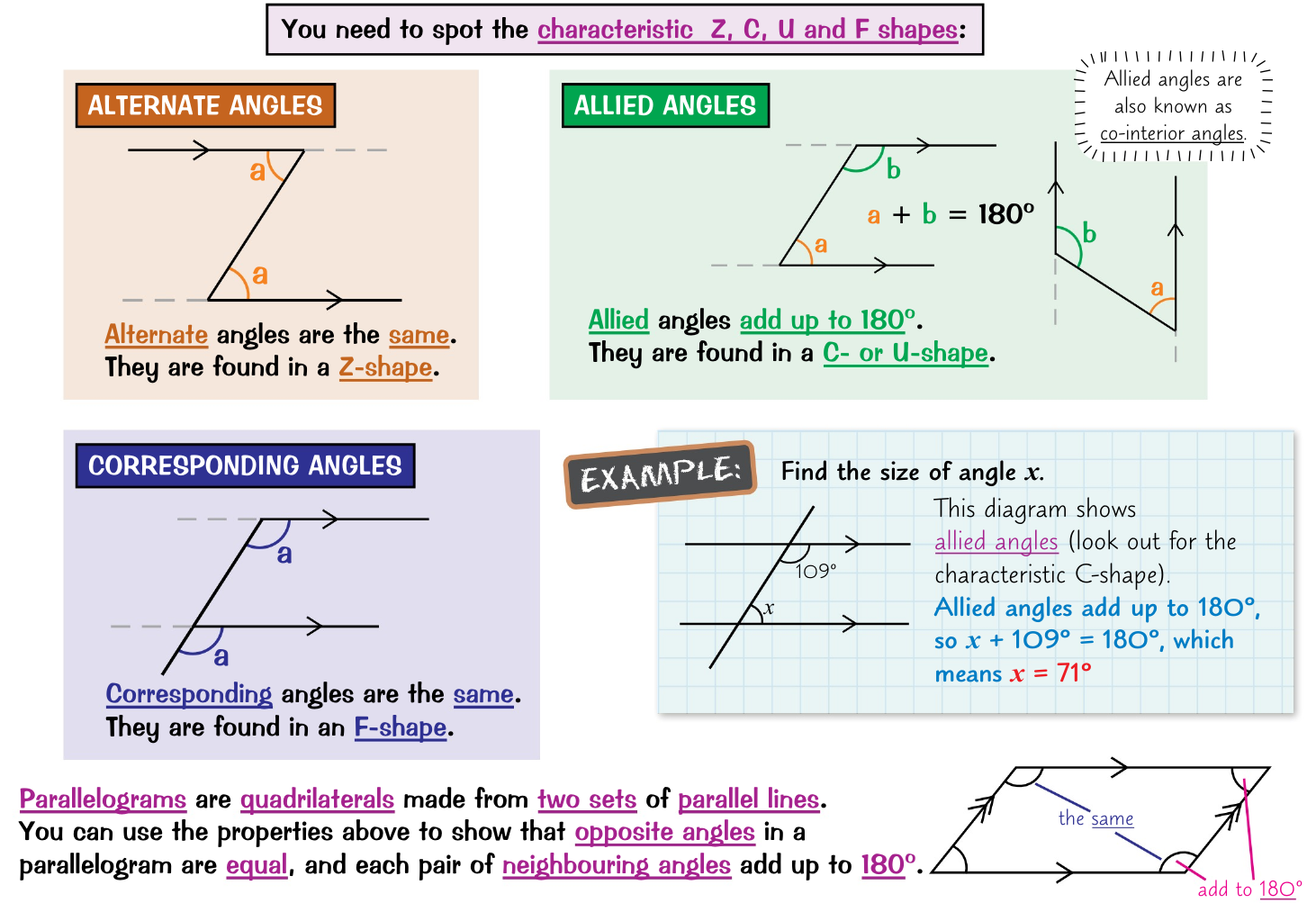
When parallel lines are cut by a transversal, three special angle relationships are created. Each relationship has a characteristic shape that helps you identify it quickly.
Alternate angles (Z-shape)
Alternate angles are found when you can trace a "Z" shape through the parallel lines and transversal. These angles are always equal to each other. The word "alternate" means they switch sides of the transversal - one angle is on the left of the transversal, and its equal partner is on the right (or vice versa).
To spot alternate angles, look for the Z-shape pattern. The angles sit at opposite ends of the Z, and they're always the same size.
Example
Worked Example: Identifying Alternate Angles
When you see two parallel lines cut by a transversal, trace a Z-shape with your finger. If you can connect two angles by drawing a Z, then those angles are alternate angles and must be equal.
If one alternate angle measures , then its partner also measures .
Allied angles (C-shape and U-shape)
Allied angles are also called co-interior angles or same-side interior angles. These special angle pairs always add up to , making them supplementary angles. You can identify allied angles by looking for C-shaped or U-shaped patterns formed by the parallel lines and transversal.
The key rule for allied angles is: allied angles add up to
This means if you know one allied angle, you can find its partner by subtracting from .
Example
Worked Example: Finding Allied Angles
If one allied angle measures , you can find its partner:
- Allied angles add up to
- Partner angle =
Always check: ✓
Corresponding angles (F-shape)
Corresponding angles are found when you can trace an "F" shape through the parallel lines and transversal. These angles are in the same relative position at each intersection point, and they're always equal to each other.
Think of corresponding angles as being in "corresponding" (matching) positions - if one angle is at the top-left of its intersection, its corresponding angle will be at the top-left of the other intersection.
Working with examples
Let's look at how these rules work in practice. When you're given a problem with parallel lines, start by identifying which type of angle relationship you're dealing with by looking for the characteristic shapes.

Example
Worked Example: Problem-Solving Strategy
Step 1: Identify the parallel lines (look for arrows) Step 2: Locate the transversal Step 3: Find the characteristic shape (Z, C, U, or F) Step 4: Apply the appropriate rule:
- Z-shape → alternate angles → equal
- C/U-shape → allied angles → add to
- F-shape → corresponding angles → equal
For instance, if you see allied angles (forming a C-shape), you know they must add up to . If you see alternate angles (forming a Z-shape), you know they must be equal.
Parallelograms and parallel lines
Parallelograms are quadrilaterals made from two pairs of parallel lines. The angle properties of parallel lines apply directly to parallelograms:
- Opposite angles in a parallelogram are equal
- Adjacent (neighbouring) angles add up to
This makes sense because adjacent angles in a parallelogram are actually allied angles formed by parallel lines!
Note
Understanding parallel lines helps you understand parallelograms better. The angle rules you learn for parallel lines directly explain why parallelograms have their special properties.
Tips for success
When working with parallel line problems, it's helpful to use the letter shapes (Z, C, U, F) to quickly identify which rule applies. However, in your exam answers, make sure to use the proper mathematical names: alternate angles, allied angles, and corresponding angles.
Look for the arrows or other indicators that show which lines are parallel - this is crucial information for applying the angle rules correctly.
Note
Memory Aid for Shapes:
- Z for alternate (Z-shape)
- C and U for allied (C-shape and U-shape)
- F for corresponding (F-shape)
Use these shapes to quickly identify the relationship, but always use the proper names in your answers.
Summary
Key Points to Remember:
- Alternate angles are equal - look for the Z-shape pattern
- Allied angles add up to - look for C-shape or U-shape patterns
- Corresponding angles are equal - look for the F-shape pattern
- Only two different angle sizes are created when a transversal cuts parallel lines
- Vertically opposite angles are always equal, regardless of whether lines are parallel
- Always look for arrows to identify which lines are parallel
- Use shape patterns (Z, C, U, F) to identify relationships quickly