Unit Conversions (Edexcel GCSE Maths): Revision Notes
📚Revision Notes
Unit conversions
Unit conversions are a fundamental skill in mathematics and science. This guide will help you understand how to convert between different units of measurement confidently and accurately.
Understanding metric and imperial units
There are two main systems of measurement you'll encounter: metric and imperial. Each system has its own units for measuring length, area, volume, weight, and speed.
Metric units
The metric system is based on powers of 10, making it straightforward to convert between units. Here are the main metric units you need to know:
- Length: millimetres (mm), centimetres (cm), metres (m), kilometres (km)
- Area: square millimetres (mm²), square centimetres (cm²), square metres (m²), square kilometres (km²)
- Volume: cubic millimetres (mm³), cubic centimetres (cm³), cubic metres (m³), millilitres (ml), litres
- Weight: grammes (g), kilogrammes (kg), tonnes
- Speed: kilometres per hour (km/h), metres per second (m/s)
Note
The metric system's base-10 structure makes conversions much simpler than imperial conversions. Each unit is typically 10, 100, or 1000 times larger than the next smaller unit.
Imperial units
The imperial system uses different relationships between units, which you need to memorise. Here are the key imperial units:
- Length: inches, feet, yards, miles
- Area: square inches, square feet, square miles
- Volume: cubic inches, cubic feet, gallons, pints
- Weight: ounces, pounds, stones, tonnes
- Speed: miles per hour (mph)
Important
Unlike the metric system, imperial units have irregular relationships (like 12 inches = 1 foot, 3 feet = 1 yard, 8 pints = 1 gallon, 14 pound = 1 stone, 16 ounces = 1 pound). These relationships must be memorised as they don't follow a consistent pattern.
Key conversion facts to memorise
To work effectively with unit conversions, you need to memorise these essential facts:
Metric conversions
Approximate metric-imperial conversions
These are the conversions you'll be given in exams when needed:
- (or )
Note
These metric-imperial conversions are approximate values. In exams, you'll be provided with the conversion factors you need, so focus on understanding the method rather than memorising exact values.
Converting between metric and imperial units
When converting between different measurement systems, you need to multiply or divide by the conversion factor. The key is to set up your calculation correctly and always check that your answer makes sense.
Example
Worked Example: Converting Pounds to Kilograms
Convert 10 pounds to kilogrammes.
Step 1: Identify the conversion factor
Step 2: Decide whether to multiply or divide Since we're going from a smaller unit (lb) to a larger unit (kg), we divide.
Step 3: Perform the calculation
Step 4: Check your answer Since kilogrammes are heavier than pounds, we expect fewer kilogrammes than pounds. Our answer of 4.5 kg < 10 lb makes sense.
The conversion method follows these steps:
- Identify the conversion factor you need
- Decide whether to multiply or divide
- Perform the calculation
- Check your answer is reasonable
Important
Always verify your answer makes sense in context. If you're converting to a larger unit, you should get a smaller number. If you're converting to a smaller unit, you should get a larger number.
Converting speed units
Speed conversions require a two-step process because speed involves both distance and time. You need to convert the distance unit and the time unit separately.
To convert speeds, remember that:
- Therefore,
Example
Worked Example: Converting km/h to m/s
Convert 56 km/h to m/s.
Step 1: Convert the distance unit (km to m)
Step 2: Convert the time unit (h to s)
Check: Since m/s gives smaller numbers than km/h for the same speed, our answer makes sense.
Converting area and volume measurements
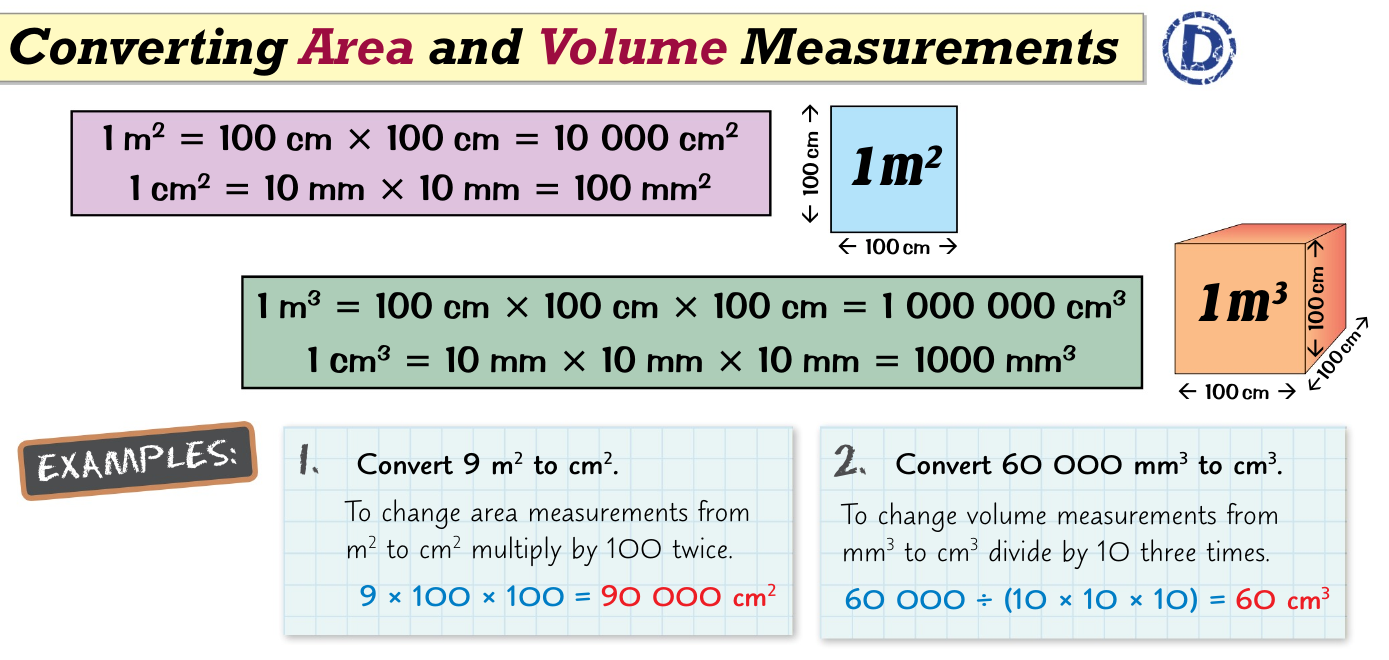
Area and volume conversions can be tricky because they involve squared and cubed relationships. Understanding these relationships is crucial for avoiding common mistakes.
Area conversions
When converting area measurements, remember that you're dealing with two dimensions:
To convert from m² to cm², multiply by 10,000. To convert from cm² to m², divide by 10,000.
Volume conversions
Volume conversions involve three dimensions:
To convert from m³ to cm³, multiply by 1,000,000. To convert from cm³ to m³, divide by 1,000,000.
Important
Common mistake: Don't just multiply by 100 when converting m² to cm². You need to multiply by 10,000 because area involves two dimensions (100 × 100). Similarly, for volume conversions, multiply by 1,000,000 because volume involves three dimensions (100 × 100 × 100).
Using conversion graphs
Conversion graphs are powerful tools for solving complex problems involving multiple conversions. They're particularly useful when you need to convert between different currencies or when dealing with rates.
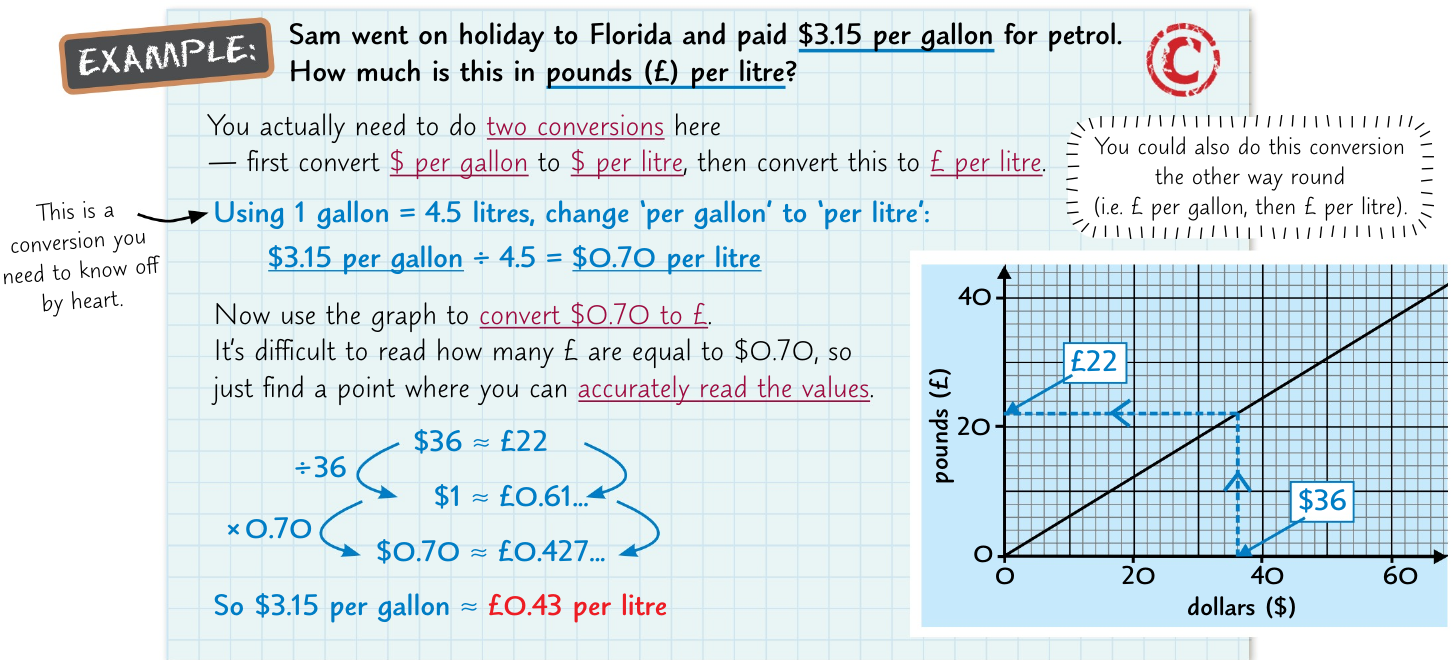
To use a conversion graph effectively:
- Draw a line from a value on one axis
- Continue until you reach the conversion line
- Change direction and go straight to the other axis
- Read the converted value from this axis
Note
This method is especially helpful when you need to perform multiple conversions in sequence, such as converting currency and then changing units of measurement. The graph eliminates the need for complex calculations.
Summary
Key Points to Remember:
- Always memorise the key metric conversion facts (, , etc.)
- For metric-imperial conversions, you'll be given the conversion factors in exams
- Speed conversions require two steps: convert distance, then convert time
- Area conversions involve squaring the conversion factor
- Volume conversions involve cubing the conversion factor
- Always check that your final answer makes sense in the context of the problem