Fractions and Recurring Decimals (Edexcel GCSE Maths): Revision Notes
📚Revision Notes
Fractions and recurring decimals
Understanding recurring and terminating decimals
When you convert a fraction to a decimal, you'll get one of two types: a terminating decimal or a recurring decimal. Understanding which type you'll get depends on the prime factors in the denominator of your fraction.
Recurring decimals have a pattern of numbers that repeats forever. For example, becomes The repeating part is usually shown with dots or a bar above the repeating digits.
Note
It's important to note that it doesn't have to be just one digit that repeats - you could have patterns like where the whole sequence "142857" repeats.
Terminating decimals are finite - they come to an end. For example, becomes , which stops there.
The key to predicting which type you'll get lies in examining the prime factors of the denominator when your fraction is in its simplest form.
Important
If the denominator only contains the prime factors 2 and 5, you'll get a terminating decimal. If the denominator contains any other prime factors, you'll get a recurring decimal.
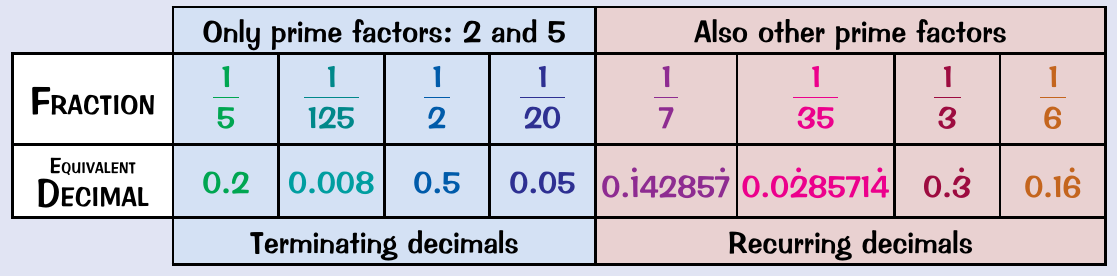
This relationship exists because our decimal system is based on powers of 10, and . Only fractions whose denominators divide evenly into powers of 10 will terminate.
Converting recurring decimals to fractions
Converting recurring decimals back to fractions requires a clever algebraic approach. There are two main scenarios you'll encounter.
Basic method (recurring starts immediately)
When the recurring pattern starts immediately after the decimal point, use this method:
Example
Worked Example: Converting 0.234̄ to a fraction
Step 1: Let
Step 2: Multiply by 1000 (to move past the three-digit repetition):
Step 3: Subtract the original equation:
Step 4: Solve for r:
The process involves:
-
Name your decimal (let's call it r)
-
Multiply r by a power of 10 to move the decimal point past one complete repetition
-
Subtract the original equation to eliminate the decimal part
-
Solve for r and simplify if possible
Trickier method (non-repeating part first)
When there's a non-repeating part before the recurring section begins, you need to account for this:
The process involves:
-
Name your decimal
-
Multiply by a power of 10 to move past the non-repeating part
-
Multiply again to move past one complete repetition of the recurring part
-
Subtract to eliminate the decimal part
-
Solve for r and simplify
This method handles decimals like where the 1 doesn't repeat but the 6 does.
Quick method for exams
For converting recurring decimals to fractions quickly, you can use the "Just Learning the Result" method:
Note
-
The recurring part goes on top
-
The same number of 9s goes on the bottom
-
But this only works if the recurring part starts immediately after the decimal point
Converting fractions to recurring decimals
You might encounter questions asking you to convert fractions to recurring decimals. There are two approaches:
Method 1: Equivalent fraction approach
Find an equivalent fraction with all 9s in the denominator. The numerator will tell you the recurring part.
Example
Worked Example: Converting 8/33 to a recurring decimal
Step 1: Find equivalent fraction with 9s in denominator:
Step 2: The numerator shows the recurring part:
Method 2: Long division
Simply divide the numerator by the denominator using long division. The pattern will eventually repeat, giving you the recurring decimal directly.
The first method is often quicker for simple fractions, while long division is more reliable for complex cases or when using a calculator.
Summary
Key Points to Remember:
-
Fractions with denominators containing only prime factors 2 and 5 give terminating decimals
-
All other fractions produce recurring decimals
-
To convert recurring decimals to fractions, multiply by appropriate powers of 10 and subtract to eliminate the decimal part
-
The "number of 9s" method works quickly for basic recurring decimals that start immediately
-
You can convert fractions to recurring decimals using equivalent fractions with 9s in the denominator or by long division