3D Trigonometry (Edexcel GCSE Maths): Revision Notes
📚Revision Notes
3D Trigonometry
Introduction to 3D trigonometry
Working with trigonometry in three dimensions might seem daunting at first, but the good news is that you're still using the same fundamental rules you've already learned! The key is knowing how to break down complex 3D problems into manageable 2D triangles that you can solve using familiar methods.
Note
The main challenge in 3D trigonometry is visualising the problem and identifying which triangles to work with. Once you've done that, you can apply the same trigonometric ratios and rules you've been using in 2D problems.
Finding angles between lines and planes
One of the most common 3D trigonometry problems involves finding the angle between a line and a plane. This might sound complicated, but there's a systematic 3-step method that makes it much more manageable.
The 3-step method
Important
This reliable approach will help you tackle any line-to-plane angle problem and should be your go-to method for these types of questions.
Step 1: Create a right-angled triangle Start by constructing a right-angled triangle that connects the line to the plane. This triangle should include the line you're interested in, a line on the plane, and a perpendicular line between them.
Step 2: Draw a 2D sketch Take your right-angled triangle and draw it as a simple 2D diagram. Mark on the lengths of the two sides you can calculate (you might need to use Pythagoras' theorem to find one of them).
Step 3: Use trigonometry Apply the appropriate trigonometric ratio (sine, cosine, or tangent) to find the angle you need.
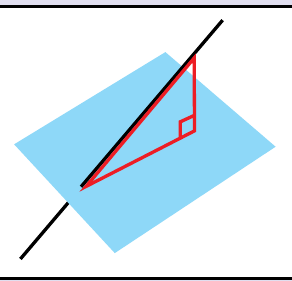
Let's look at a practical example of this method in action.
Working with pyramids
Consider a square-based pyramid where you need to find the angle an edge makes with the base. You would start by identifying the relevant right-angled triangle, then calculate the necessary side lengths using Pythagoras' theorem, and finally use trigonometry to find the angle.
Example
Worked Example: Pyramid Edge Angle
For a pyramid with a square base of 8 cm, you would:
- Identify the right-angled triangle formed by the edge, base, and height
- Calculate the diagonal of the base using Pythagoras' theorem
- Use trigonometry to find the angle
This systematic approach leads to a clear numerical answer like 64.8°, demonstrating how the 3-step method provides concrete results.
Using sine and cosine rules in 3D
When you're working with triangles inside 3D shapes that aren't right-angled, you can still use the sine and cosine rules. These work exactly the same way as they do in 2D problems - you just need to identify the correct triangle within the 3D shape.
The cosine rule in 3D contexts
The cosine rule is particularly useful when you know two sides of a triangle and the angle between them, or when you know all three sides and need to find an angle. In 3D problems, you might need to use Pythagoras' theorem first to find the lengths of the sides of your triangle.
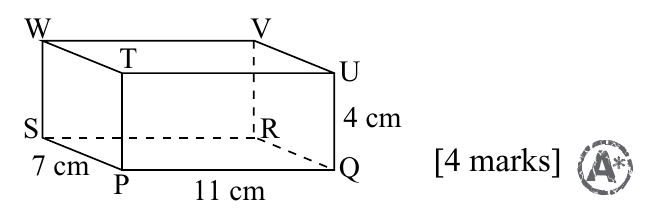
For example, when working with a rectangular prism (cuboid) like the one shown, you might need to find the angle between two edges or faces. You would identify the relevant triangle, calculate the side lengths using the given dimensions, and then apply the cosine rule.
Note
Systematic approach for 3D problems:
When faced with a 3D trigonometry problem, follow these steps:
- Identify the triangle you need to work with
- Calculate the side lengths using the dimensions given and Pythagoras' theorem if necessary
- Apply the appropriate rule (sine rule, cosine rule, or basic trigonometric ratios)
- Solve for the unknown angle or side length
Working with cuboids
Cuboids are common in 3D trigonometry problems because their regular structure makes it easier to identify right-angled triangles and calculate distances. When working with a cuboid, you can use the given dimensions to find diagonal lengths, then use these in your trigonometric calculations.
Example
Worked Example: Cuboid Calculations
The rectangular prism shown has clear dimensions marked, making it straightforward to:
- Calculate diagonal lengths using
- Find angles between edges using trigonometric ratios
- Apply the cosine rule when working with non-right-angled triangles within the shape
Key techniques and formulas
Remember that all the standard trigonometric formulas apply in 3D:
Note
Essential Formulas for 3D Trigonometry:
- Pythagoras' theorem: (for finding diagonal lengths)
- Sine rule:
- Cosine rule:
- Basic ratios: , ,
The skill lies in identifying which triangle to work with and which formula to apply.
Summary
Key Points to Remember:
- 3D trigonometry uses the same fundamental rules as 2D trigonometry - don't be intimidated!
- The 3-step method (create right-angled triangle → sketch in 2D → use trigonometry) is your go-to approach for line-to-plane angles
- You can use sine and cosine rules in 3D shapes just like in 2D triangles
- Pythagoras' theorem is often needed to find side lengths before applying trigonometric ratios
- Always identify the correct triangle within the 3D shape before starting your calculations