The Sine and Cosine Rules (Edexcel GCSE Maths): Revision Notes
📚Revision Notes
The sine and cosine rules
Introduction
While basic trigonometry using SOH CAH TOA works perfectly for right-angled triangles, you'll encounter many problems involving triangles that don't have a right angle. This is where the sine and cosine rules become essential tools for solving any triangle, regardless of its angles.
Note
The sine and cosine rules are fundamental tools in trigonometry that extend your problem-solving capabilities beyond right-angled triangles. Mastering these rules opens up solutions to a wide variety of triangle problems you'll encounter in mathematics and real-world applications.
Labelling triangles correctly
Before you can apply either rule effectively, you must understand how to label triangles using the standard mathematical convention. This step is crucial for getting the correct answers.
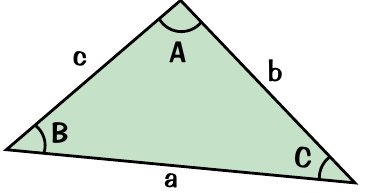
The labelling system follows a simple pattern: use lowercase letters for the sides and uppercase letters for the angles. Each side is given the same letter as the angle opposite to it. So side 'a' sits opposite angle A, side 'b' sits opposite angle B, and side 'c' sits opposite angle C.
Important
Critical Labelling Rule: Each side must be labelled with the same letter as the angle opposite to it. This consistency is essential for applying the sine and cosine rules correctly. Getting this wrong will lead to incorrect answers.
You have flexibility in choosing which sides to call a, b, and c, but once you make this choice, you must label the angles consistently to match their opposite sides.
The three key formulas
The sine rule
The sine rule establishes a relationship between the sides and angles of any triangle:
In practice, you rarely need to use all three parts of this equation. Instead, you select the two portions that contain the information you know and the value you want to find. For example, you might use:
- , or
The cosine rule
The cosine rule comes in two useful forms depending on what you're trying to find:
For finding a side:
For finding an angle:
Note
The second form is simply the first equation rearranged to make finding angles easier. Notice how similar this looks to Pythagoras' theorem - the cosine rule is actually a generalisation of Pythagoras' theorem for all triangles, not just right-angled ones.
Area of a triangle
When you know two sides and the angle between them, you can calculate the area using:
This formula is particularly useful when you can't easily determine the height of the triangle using traditional methods.
When to use each rule
Understanding when to apply each rule is crucial for success. There are four main scenarios you'll encounter:
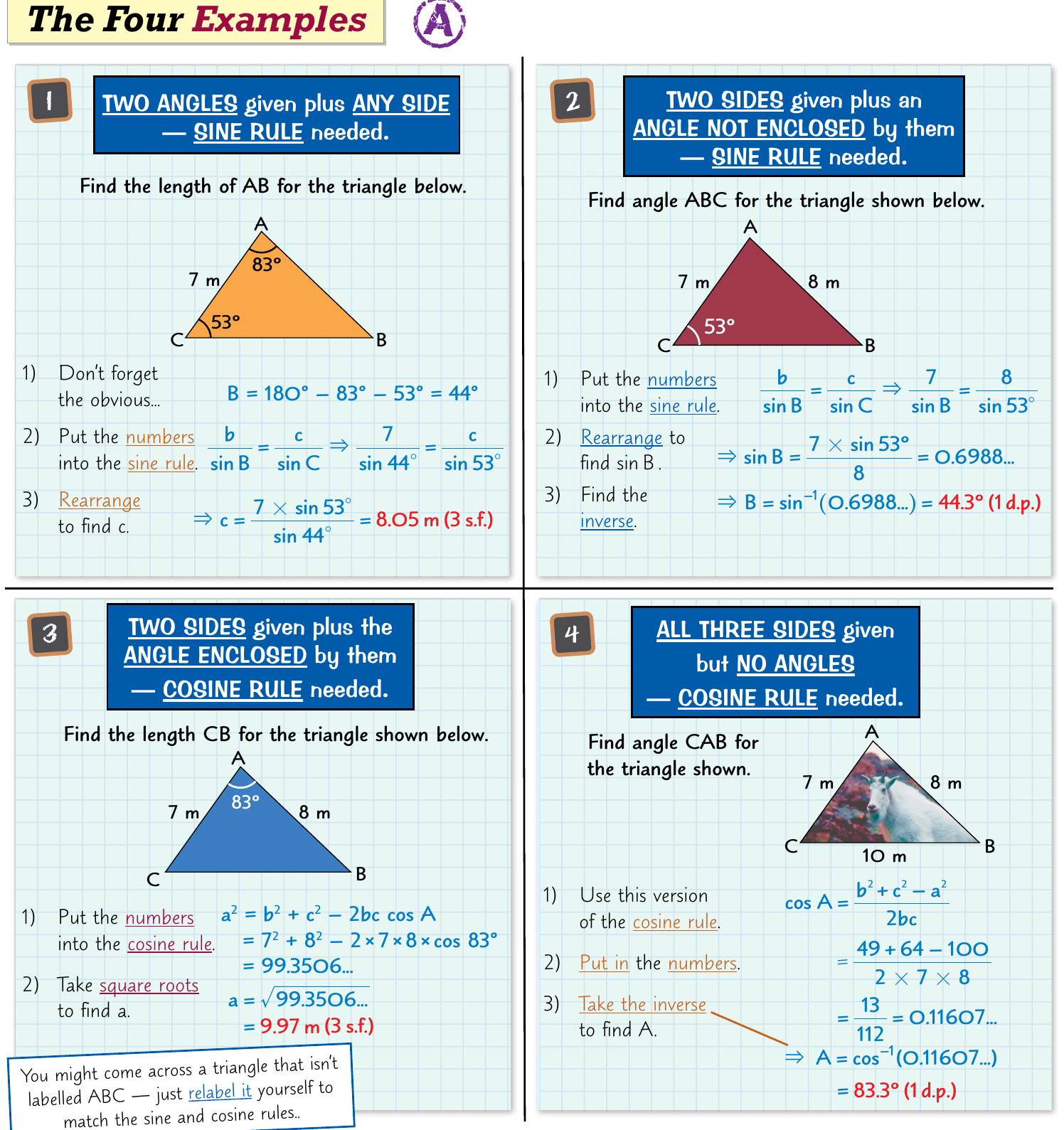
Scenario 1: Two angles and any side → Use sine rule
When you know two angles and any side length, the sine rule will help you find the remaining sides. Since you know two angles, you can easily calculate the third angle (remembering that all angles in a triangle sum to 180°).
Note
This scenario is often the most straightforward because once you know two angles, the third angle is automatically determined. The sine rule then becomes a simple proportion to solve.
Scenario 2: Two sides and a non-enclosed angle → Use sine rule
If you have two sides and an angle that is not between those two sides, the sine rule is your best choice. This scenario requires careful attention to ensure you're using the angle that's opposite to one of the known sides.
Important
Watch out for ambiguous cases! When using the sine rule with two sides and a non-enclosed angle, you might sometimes get two possible solutions. Always check if both solutions are valid by considering the context of the problem.
Scenario 3: Two sides and the enclosed angle → Use cosine rule
When you know two sides and the angle between them (the enclosed angle), the cosine rule is the most direct approach. This scenario is perfect for the standard form of the cosine rule.
Scenario 4: All three sides but no angles → Use cosine rule
If you know all three side lengths but need to find angles, use the rearranged form of the cosine rule. This allows you to work backwards from the sides to determine any angle.
Worked examples
Let's examine how these rules work in practice:
Example
Worked Example 1 - Finding a side with sine rule:
Given a triangle with angles 83° and 53°, and a side of 7m, you can find the missing side length.
Step 1: Calculate the third angle 180° - 83° - 53° = 44°
Step 2: Apply the sine rule using the appropriate portions of the equation Use the two angle-side pairs you know to set up the proportion and solve.
Example
Worked Example 2 - Finding an angle with sine rule:
When you have two sides (7m and 8m) and a non-enclosed angle (53°), you can find the unknown angle.
Step 1: Set up the sine rule equation
Step 2: Rearrange to solve for the unknown angle Use inverse sine to find the angle value.
Example
Worked Example 3 - Finding a side with cosine rule:
With two sides (7m and 8m) and the enclosed angle (83°), substitute directly into the cosine rule formula.
Step 1: Use the formula Step 2: Substitute the known values Step 3: Calculate to find the third side length
Example
Worked Example 4 - Finding an angle with cosine rule:
Given all three sides (7m, 8m, and 10m), use the rearranged cosine rule to find any angle.
Step 1: Use Step 2: Calculate the value inside the cosine function Step 3: Use the inverse cosine to find the angle
Problem-solving strategy
To become proficient with these rules, develop a systematic approach that will help you tackle any triangle problem with confidence:
- Always start by labelling your triangle correctly
- Identify what information you have and what you need to find
- Determine which of the four scenarios applies to your problem
- Choose the appropriate rule and formula
- Substitute your values carefully and solve
- Check that your answer makes sense in the context
Note
Following this systematic approach will help you avoid common mistakes and ensure you're using the most efficient method for each problem type.
Summary
Key Points to Remember:
- Proper triangle labelling is essential - use lowercase letters for sides and uppercase letters for angles, with each side opposite its corresponding angle
- The sine rule works best when you have angle-side pairs or can easily find them
- The cosine rule is ideal when you have two sides and the included angle, or when you know all three sides
- There are only four main scenarios where you'll need these rules - learn to recognise them quickly
- Always double-check your calculator is in the correct mode (degrees or radians) before calculating
- Practice identifying which rule to use before jumping into calculations