Forces & elasticity (Edexcel GCSE Physics Combined Science): Revision Notes
📚Revision Notes
Forces & elasticity
Springs
Note
Key Points
- To stretch, bend, or compress an object, more than one force must be applied.
- If a single force is applied, the object will move in the direction of the force rather than changing shape.
- To stretch an object, forces must be applied in opposite directions on either side.
- If an object is fixed at one end and a force is applied at the other, the fixed point provides a counteracting force, allowing the object to stretch.
Deformation
Note
Deformation refers to a change in the shape of an object due to the application of forces.
Types of Deformation
- Elastic Deformation:
- The object returns to its original shape after the force is removed.
Example
Example: An elastic band stretches when pulled and returns to its original shape once the pulling force is removed.
- Plastic Deformation:
- The object does not return to its original shape after the force is removed, leading to a permanent change.
Example
Example: A spring that has been stretched too far and does not return to its original length.
Stretching, Compressing, and Bending Transfers Energy
- When a force is applied to stretch, compress, or bend an object, energy is transferred.
- To change the shape of an object, more than one force is needed; otherwise, the object will just move rather than deform.
Elastic Distortion and Elastic Limit
- Elastically Distorted: An object is elastically distorted if it returns to its original shape and length after the force is removed.
- Elastic Limit: This is the point beyond which an object will no longer return to its original shape, instead distorting inelastically (permanently).
Work Done and Energy Transfer
Work is done when a force stretches or compresses an object, transferring energy to its elastic potential energy store.
- If the object is elastically distorted, all of the energy is transferred to the elastic potential energy store.
Extension and Force Relationship
- Direct Proportionality: For springs, the extension (how much it stretches) is directly proportional to the force applied. This means if you double the force, the spring stretches twice as much. This relationship is called Hooke's Law.
- This applies when a spring is supported at the top and a force pulls it at the bottom.
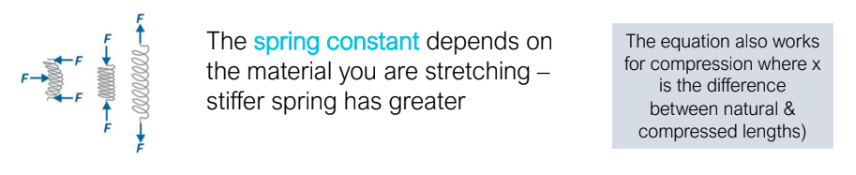
- This applies when a spring is supported at the top and a force pulls it at the bottom.
Limit of Proportionality
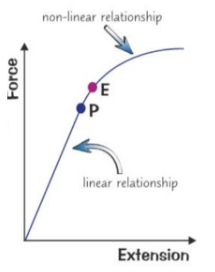
- There is a limit to the amount of force you can apply to a spring while still maintaining proportionality. This is called the limit of proportionality.
- Non-linear Relationship: Once this limit is reached, the spring stretches more than expected for the amount of force applied. At this point, the object cannot return to its original shape and is permanently stretched.
- Elastic Limit: Point "E" in the diagram shows the elastic limit, after which the spring will not return to its original length.