Specific heat capacity (Edexcel GCSE Physics Combined Science): Revision Notes
📚Revision Notes
Specific heat capacity
Specific Heat Capacity
Note
Specific heat capacity (c) refers to how well a substance stores heat.
Note
It is the amount of energy needed to raise the temperature of 1 kg of a substance by 1°C.
Note
This depends on the material of the substance, its mass, and the energy added. The formula for calculating the change in thermal energy is: change in thermal energy = mass × specific heat capacity × temperature change
Note
Where ∆E is the change in thermal energy, in joules J, specific heat capacity, c in joules per kilogramme per degree Celcius , mass m in kilogrammes kg and temperature change ∆T in degrees Celcius °C.
Note
Rearranged Formula:

Key Points
- Heating a substance increases its internal energy, which is the energy in its thermal store or the kinetic energy of its particles.
- In kinetic theory, temperature measures the average internal energy of the particles in a substance.
- Materials that require a lot of energy to heat up also release a lot of energy when they cool down.
- The temperature change of a substance is related to its specific heat capacity, which is the energy needed to raise the temperature of 1 kg of a substance by 1°C.
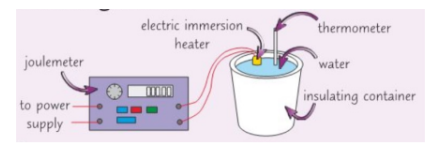
Finding the specific heat capacity of water/liquid
- Use a balance to measure the mass of the insulating container
- Set up an experiment (make sure joule metre reads zero & place a lid on the container)
- Measure the temp of the water then turn on the power
- Watch the thermometer as when it has increased by (e.g.. 10°C) stop the experiment and record the energy on the joule metre and increase in temperature
- You can then calculate the specific heat capacity of the water by rearranging the equation (do the experiment 3 times to get an average specific heat capacity)