Eukaryotes & Prokaryotes (OCR GCSE Biology A (Gateway Science Suite)): Revision Notes
📚Revision Notes
1.1.1 Eukaryotes & Prokaryotes
Note
All living organisms are made up of cells. Cells can be classified into two main types: Eukaryotic and Prokaryotic cells.
Eukaryotic Cells:
- Eukaryotes include all plants, animals, fungi, and protists.
- These cells are more complex and usually larger than prokaryotic cells.
Note
Key features:
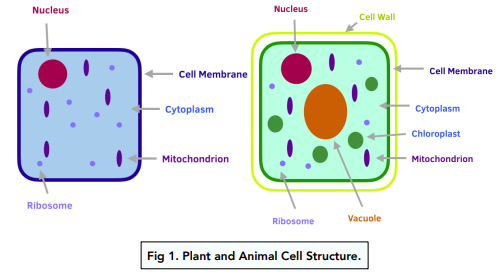
- Nucleus: Contains the cell's genetic material (DNA) enclosed within a nuclear membrane.
- Cell membrane: Controls the movement of substances in and out of the cell.
- Cytoplasm: Gel-like substance where most chemical reactions happen.
- Mitochondria: Where aerobic respiration occurs, providing energy for the cell.
- Ribosomes: Sites of protein synthesis.
- Chloroplasts (in plant cells): Site of photosynthesis, contains chlorophyll.
- Cell wall (in plant cells): Made of cellulose, strengthens the cell.
Prokaryotic Cells:
- Prokaryotes include bacteria and archaea.
- These cells are simpler and generally smaller than eukaryotic cells.
Note
Key features:
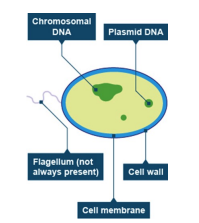
- No true nucleus: Genetic material (DNA) is not enclosed within a membrane; instead, it is a single loop of DNA found in the cytoplasm.
- Plasmids: Small rings of DNA that can replicate independently of chromosomal DNA.
- Cell membrane: Similar function to eukaryotes, controlling the movement of substances.
- Cytoplasm: Contains ribosomes, but they are smaller than those in eukaryotes.
- Cell wall: Provides structure and protection, but it is not made of cellulose.
- Flagella (in some bacteria): Tail-like structures that help the cell move.
Differences Between Eukaryotic and Prokaryotic Cells:
- Size: Eukaryotic cells are generally larger (10-100 micrometres) compared to prokaryotic cells (0.1-5 micrometres).
- Nucleus: Eukaryotes have a nucleus; prokaryotes do not.
- Organelles: Eukaryotes have membrane-bound organelles (e.g., mitochondria, chloroplasts); prokaryotes do not.
- DNA Structure: Eukaryotes have linear DNA associated with proteins (histones); prokaryotes have circular DNA without histones.
- Reproduction: Eukaryotic cells divide by mitosis or meiosis; prokaryotic cells divide by binary fission.
Note
Importance of Understanding:
- The classification helps in understanding the complexity and functionality of different organisms.
- Knowledge of these differences is essential for studies in genetics, microbiology, and cell biology.