Hormones in Human Reproduction (OCR GCSE Biology A (Gateway Science Suite)): Revision Notes
📚Revision Notes
5.3.1 Hormones in Human Reproduction
Note
During puberty, reproductive hormones begin to be released. These causes secondary sexual characteristics to develop in men and women and eggs to mature in women.
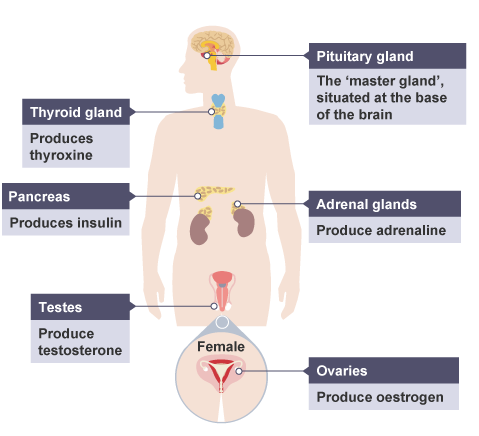
The main male reproductive hormone is testosterone .
-
Produced by the testes
-
Stimulates sperm production The main female reproductive hormone is oestrogen .
-
Produced in the ovary
-
Produces physical changes and is involved in the menstrual cycle
The menstrual cycle is the process the body undergoes each month to prepare for a potential pregnancy.
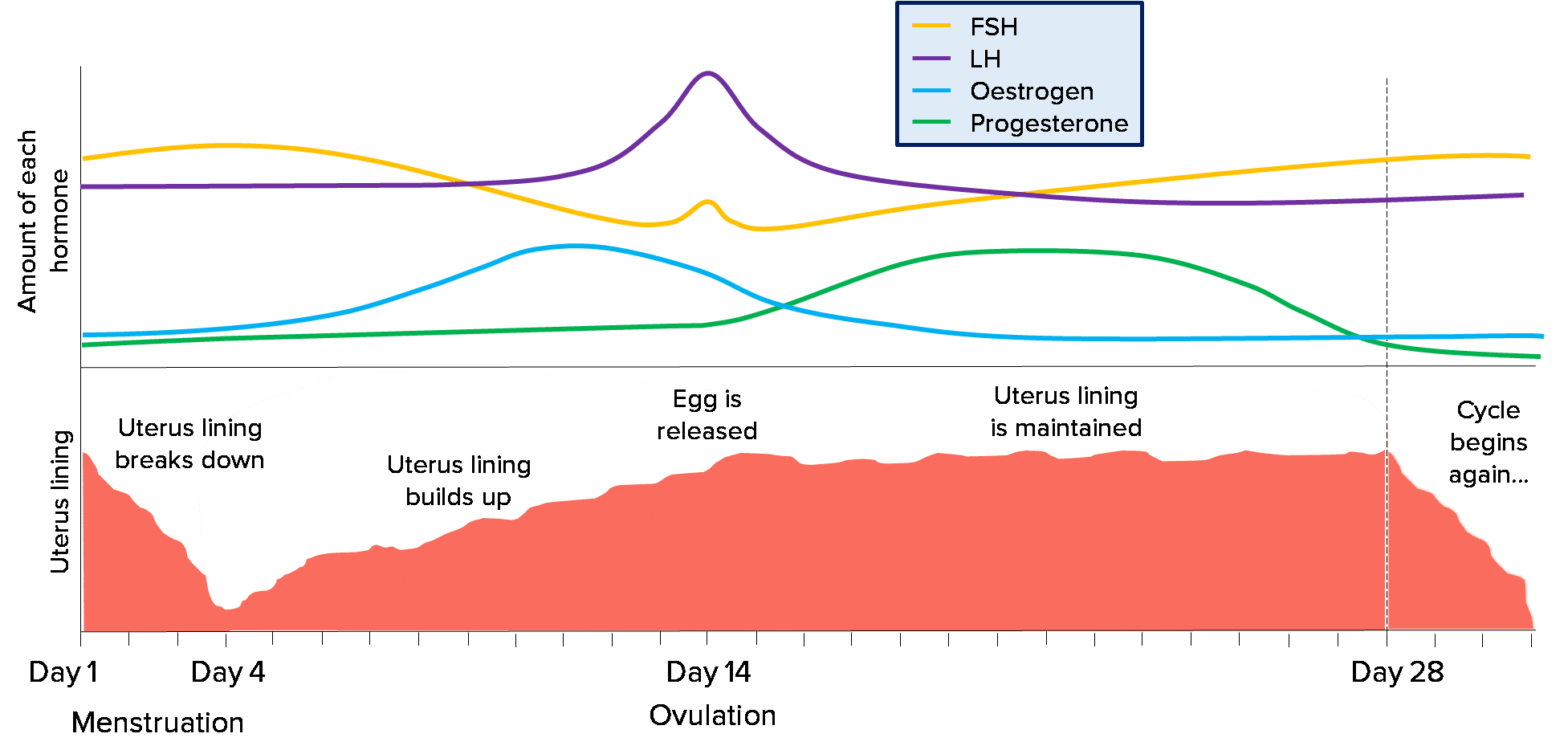
It begins with the lining of the uterus breaking down, and the woman has her period. The layer then builds up again, until ovulation (day 14) occurs- an egg is released from the ovary and moves to the uterus via the fallopian tube.
If a fertilised egg has not been embedded in the lining after 28 days, it begins to break down and the cycle continues.
The events of the cycle are controlled by four hormones.
- Follicle stimulating hormone (FSH) causes the maturation of an egg in the ovary, within a structure called a follicle
- Produced in the pituitary gland
- Stimulates the ovaries to produce oestrogen
- Oestrogen causes the lining of the uterus to grow again
- Produced in the ovaries
- Secreted as a result of FSH
- Stimulates the production of LH and inhibits the secretion of more FSH
- Luteinising hormone (LH)
- Produced in the pituitary gland
- Produced as a result of the hormone oestrogen
- Its release results in ovulation
- Progesterone
- Produced in the ovaries and secreted from the egg follicle.
- Maintains the lining of the uterus, and supports a pregnancy if the egg is fertilised
- Inhibits the release of both FSH and LH