Extinction (OCR GCSE Biology A (Gateway Science Suite)): Revision Notes
📚Revision Notes
6.3.6 Extinction
Note
Extinction occurs when an entire species has died out, meaning no individuals of that species remain alive. This is a natural part of evolutionary history, though the rate of extinction can be influenced by various factors.
Factors Contributing to Extinction:
- Environmental Changes:
- Rapid or significant changes in the environment, such as climate shifts, can occur faster than a species can adapt, leading to extinction.
- New Predators:
- The evolution or migration of new predators into an area can lead to the decline and eventual extinction of species that are unable to defend themselves or escape.
- Emergence of New Diseases:
- The introduction of new diseases can be devastating if a species lacks genetic diversity and does not have alleles that confer resistance, leading to widespread mortality.
- Competition:
- When a species faces competition from another species with advantageous mutations, particularly for the same food source, it may be outcompeted and driven to extinction.
- Catastrophic Events:
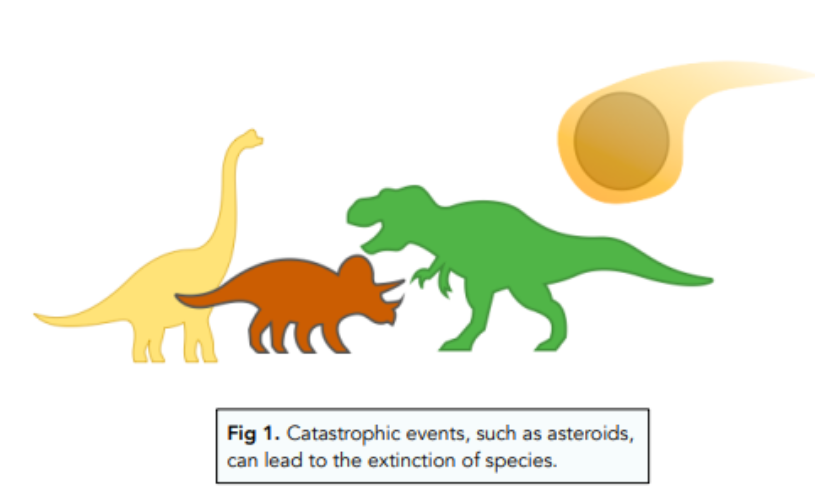
- Natural disasters such as volcanic eruptions, earthquakes, tsunamis, or asteroid impacts can instantly wipe out entire species, particularly those in localised areas.
- Habitat Destruction:
- Human activities or natural processes that lead to the destruction of a species' habitat can result in extinction if the species cannot migrate or adapt to a new environment.