Sources of finance (OCR GCSE Business): Revision Notes
📚Revision Notes
5.2 Sources of finance
Internal finance: Owners' Capital
🔗 Using personal savings to finance the business
Advantages
-
Safe, low-risk approach, not a form of equity, no shares given up, keep full control of business, maintain all decision-making power, more motivated, more commitment
-
No financial cost, not a form of debt, no interest must be paid, benefit from lower costs Disadvantages
-
Likely to be limited, leading to early financial pressures if the business doesn't initially make a profit, loss of well-being, & another source of finance may be needed in order to grow faster
-
Won't benefit from added expertise
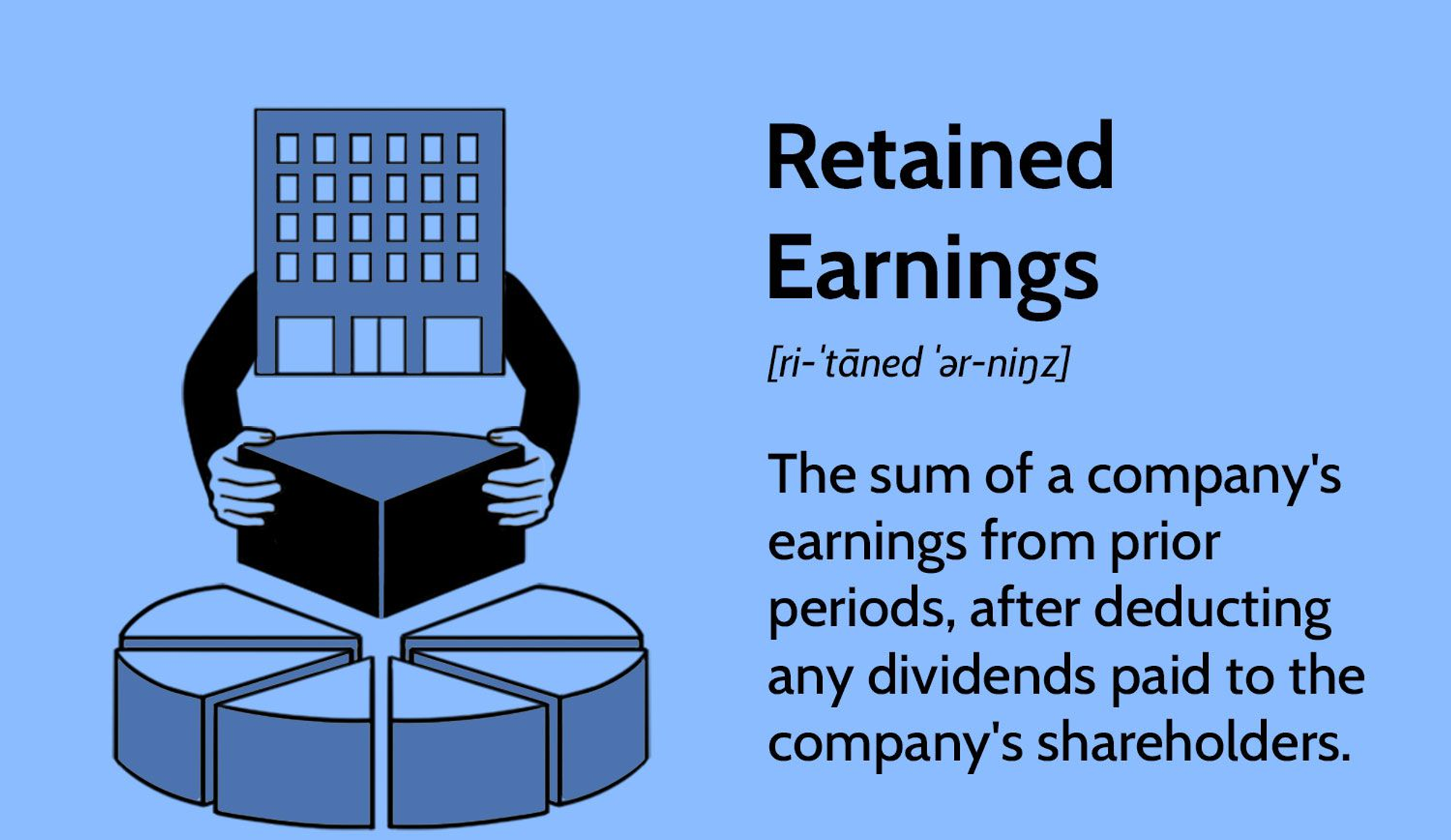
Retained Profit
🔗 Re-investing historical profits into the business (not available to start-ups)
Advantages
-
Safe, low-risk approach, not a form of equity, no shares given up, keep full control of business, have all decision-making power, more motivated, more commitment
-
No financial cost, not a form of debt, no interest must be paid, benefit from lower costs Disadvantages
-
There's an opportunity cost, sacrificing dividends, may create conflict with shareholdersWon't benefit from added expertise
-
Likely to be limited, another source of finance may be needed in order to grow faster
Sale of Assets
🔗 Selling surplus assets 📝 (e.g., spare machines or vehicles) to raise finance
Advantages
-
Safe, low-risk approach, not a form of equity, no shares given up, keep full control of business, maintain all decision-making power, more motivated, more commitment
-
No financial cost, not a form of debt, no interest must be paid, benefit from lower costs
-
Quick way to raise finance and free up space, providing you can find a buyer quickly Disadvantages
-
Can only be used a finite number of times, only able to sell surplus assets, will eventually come to an end.
-
Opportunity cost, assets could have been used for the business.
-
May not receive full market value for the product, likely to have depreciated
External finance: Overdrafts
🔗 When a business withdraws more cash from the bank than they own
- Safe, low-risk approach, not a form of equity, no shares given up, keep full control of business, maintain all decision-making power, more motivated, more commitment
- As it is a form of short-term debt, not involved in gearing ratio
- There is a financial cost, a form of debt, interest must be paid, higher costs
- Seen as riskier to banks as repayments aren't agreed upon 📝 (like a loan for example), charged a higher interest rate to mitigate the level of risk
- Unreliable as the bank can ask for money back at any time 📝 (only likely to happen if the business has had persistent financial problems)
Trade Credit
🔗 Suppliers give business supplies and agree to let them pay later
- Safe, low-risk approach, not a form of equity, no shares given up, keep full control of business, maintain all decision-making power, more motivated, more commitment
- As it is a form of short-term debt, not involved in gearing ratio
- Helps business meet a demand spike, immediate replenishment in resources, higher customer satisfaction, higher market share
- Can build trust and a relationship between business and supplier
- Risk of relationship with supplier deteriorating if credit terms are not met, abuse relationship, supplier no longer supplies to you, long-term consequences, may not have another supplier.
- Late payments could affect PR of the business, tarnish reputation.
Taking on a new partner
🔗 The new partner invests some of their savings into the business
- The partner may bring new skills that can help the business grow and increase profitability
- There is no interest to pay on the finance the partner invests
- The existing owners will have to give up some of their decision-making power by allowing the new partner to have a say in the running of the business
- Profits must be shared with the new partner, reducing the profits for the previous owners
Bank Loan
🔗 Allows a business to borrow a sum of money and pay it back with interest over an agreed period of time
- Safe, low-risk approach, not a form of equity, no shares given up, keep full control of business, maintain all decision-making power, more motivated, more commitment
- Can get a fixed interest loan with the ability to decide repayment terms, easier to plan for repayments, facilitate budgeting
- Always making repayments can improve credit score, allow for borrowing with a lower interest rate in the future, facilitate getting further sources of finance in the future
- There is a financial cost, a form of debt, interest must be paid, higher costs
- Potential to lose assets if they don't make repayments (good to have limited liability), can also lower credit score, could limit sources of finance
- Lacks flexibility, must keep to repayment terms
Share issue
🔗 Money invested by shareholders in exchange for equity
- No financial cost, not a form of debt, no interest must be paid, benefit from lower costs
- Benefit from added expertise, shareholders' perspectives could be useful, allowing for more lucrative decisions to be made
- Form of equity, no repayments have to be made
- Form of equity, shares are given up, don't keep full control of the business, lose some decision-making power, increased risk of a takeover, less motivated, less commitment
- Dividends will be paid to appease shareholders, retained profits will be reduced, potential stakeholder conflict
Crowdfunding
🔗 Raising finance from a large number of people e.g., GoFundMe pages
- No financial cost, not a form of debt, no interest must be paid, benefit from lower costs
- Potential to reach a large wider audience, excellent exposure for business, good promotion, helps to build brand image immediately
- May lose reputation if your business fails
- Won't benefit from added expertise | Short-term sources of finance (up to 1 year) | Medium-term sources of finance (1-5 years) | Long-term sources of finance (5 years+) | |---|---|---| | Owners' capital | Owners' capital | Owners' capital | | Sale of assets | Sale of assets | Sale of assets | | Trade credit | Retained profit | Retained profit | | | Bank loan | Bank loan | | | Crowdfunding | Crowdfunding | | | | Taking on a new partner | | | | Share issue |
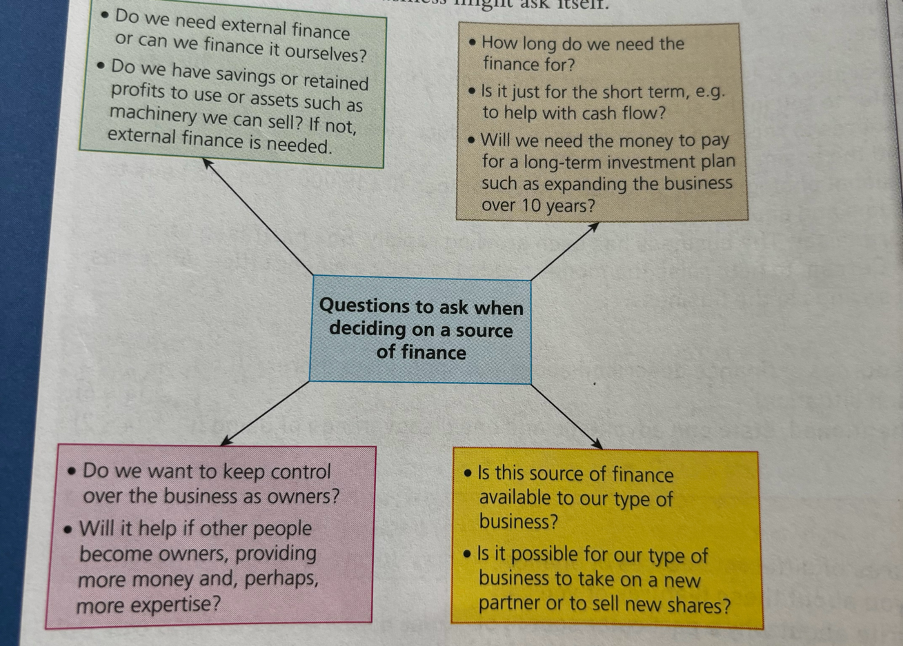
**How and why different sources of finance are suitable for
new and established businesses:**
Businesses need to evaluate the advantages and disadvantages of using internal and external finance. They can do this by asking a series of questions and use the answers to make a decision.