Condensation Polymerisation (OCR GCSE Chemistry A (Gateway Science Suite)): Revision Notes
📚Revision Notes
7.3.2 Condensation Polymerisation
Note
Condensation polymerisation is a process used to form polymers, but unlike addition polymerisation, it involves monomers with different functional groups. This type of polymerisation typically occurs between a di-alcohol (a molecule with two alcohol functional groups) and a di-acid (a molecule with two carboxylic acid functional groups).
Note
How It Works: Monomers with Different Functional Groups: In condensation polymerisation, the monomers each have different functional groups, such as an alcohol group (-OH) and a carboxylic acid group (-COOH).
Formation of Polymer Chain: When these monomers react, they form a large polymer chain. For each new bond formed between the monomers, a small molecule, usually water, is also produced.
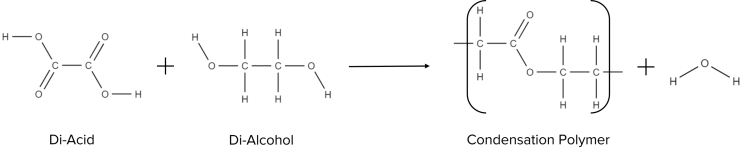
Key Points:
- Two Products: Unlike addition polymerisation, which only produces one product, condensation polymerisation produces two products: a polymer and a small molecule (like water).
- Water Formation: The production of water occurs because the OH group from the acid and an H atom from the alcohol group are removed and combined to form a water molecule.
- Complex Monomers: While many condensation reactions involve two simple monomers, some, like those in natural polymers such as DNA, involve more complex molecules with multiple functional groups.