The Haber Process (OCR GCSE Chemistry A (Gateway Science Suite)): Revision Notes
📚Revision Notes
10.4.1 The Haber Process
The Haber Process
Note
The Haber Process is an industrial method used to produce ammonia, which is a key ingredient in various products, particularly fertilisers. This process exploits the equilibrium between nitrogen gas, hydrogen gas, and ammonia.
Note
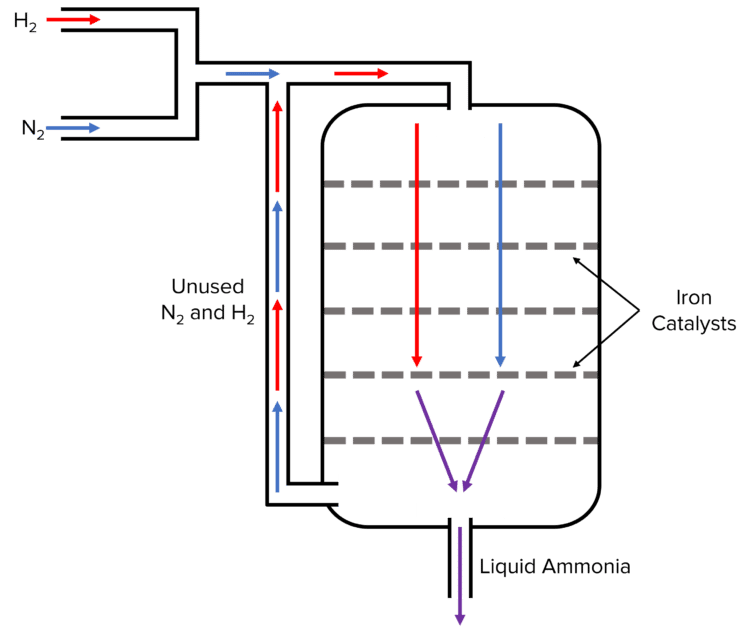
What is the Haber Process? The Haber Process, named after Fritz Haber, involves the formation of ammonia from nitrogen (N₂) and hydrogen (H₂) gases. During the process:
- Nitrogen and hydrogen gases are fed into a reactor.
- The gases are passed over iron catalysts, which accelerate the reaction and help the system reach equilibrium more quickly.
- The forwards reaction in this equilibrium produces ammonia (NH₃), which can be liquefied, collected, and used in various applications.
Note
Since the reaction is reversible, hydrogen and nitrogen gases are also continually produced by the reverse reaction. Instead of being wasted, these gases are recycled back into the reactor to form more ammonia.
The ammonia produced is used in the manufacturing of fertilisers, explosives, and cleaning products. The Haber Process is cost-effective because the raw materials—nitrogen and hydrogen—are abundant. Nitrogen, which makes up about 78% of the Earth's atmosphere, is easily extracted, while hydrogen can be produced by reacting steam with methane.