Natural Hazards (OCR GCSE Geography A (Geographical Themes)): Revision Notes
📚Revision Notes
1.1.1 Natural Hazards
What is a Natural Hazard?
Note
An event becomes a hazard when it affects people.
- A natural hazard is a natural process which could cause death, injury, or disruption to humans, or destroy property and possessions.
- A natural disaster is an event that has actually happened.
What are the Main Types of Hazards?
- Geological Hazards:
- Caused by land and tectonic processes.
- Examples: volcanoes, earthquakes, landslides.
- Meteorological Hazards:
- Caused by weather and climate.
Example
Examples: tropical storms, flooding due to extreme weather.
What Affects a Country's Ability to Cope?
- Vulnerability:
- The more people in areas exposed to natural hazards, the greater the probability they will be affected.
- Example: People living at the base of a volcano in Naples, Italy are vulnerable to eruptions.
- Capacity to Cope: 3. Natural hazards have to affect human activities to count as a hazard. The better a population can cope with an extreme event, the lower the threat. 4. Example: High-Income Countries (HICs) are better able to cope with earthquakes as they can build earthquake-proof buildings and repair damage afterwards.
Hazard Risk
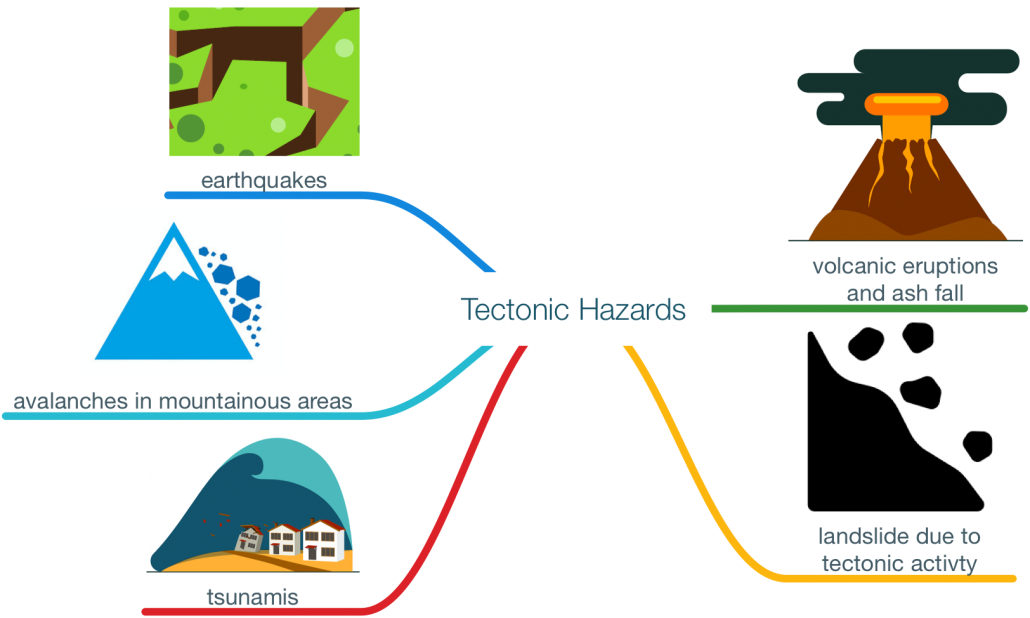
Techtonic Hazards
- The probability that a natural hazard occurs.
- Three main factors affecting risk: 5. Type: The hazard risk from some hazards is greater than others (e.g., tropical storms can be predicted but earthquakes can't). 6. Frequency: Some natural disasters occur more often than others (e.g., flooding). 7. Magnitude: More severe natural hazards cause greater effects than less severe events (e.g., a magnitude 5 earthquake compared to a magnitude 8).
Tectonic Plates
- Structure:
- The inner core is solid and outer liquid.
- Around the core is the mantle - semi-molten rock moving slowly.
- The outer layer is the crust, divided into slabs called tectonic plates.
- Types of Plates:
- Plates can be continental or oceanic.
- The meeting point is called a plate boundary/margin.
- Movement:
- Plates move due to convection currents in the mantle.