Why Volcanoes Erupt (OCR GCSE Geography B (Geography for Enquiring Minds)): Revision Notes
📚Revision Notes
Why Volcanoes Erupt
Understanding volcanic eruptions
Volcanoes form and erupt due to the movement of tectonic plates beneath Earth's surface. The type of volcano that develops and how it erupts depends on where the plates meet and how they interact. There are two main types of volcano you need to understand: shield volcanoes and composite volcanoes.
Shield volcanoes
Shield volcanoes form at constructive plate boundaries, where tectonic plates move away from each other. As the plates separate, mantle material rises upward to fill the gap. This creates volcanic activity at the surface.
These volcanoes can also develop at hotspots. Hotspots are locations where magma plumes rise through the mantle and break through thin areas of the Earth's crust. The Hawaiian Islands are a famous example of hotspot volcanism.
Note
The Hawaiian Islands demonstrate hotspot volcanism perfectly - as the Pacific plate moves over a stationary hotspot in the mantle, a chain of volcanic islands forms. Each island represents a different stage in the volcanic lifecycle, with the Big Island of Hawaii currently sitting over the active hotspot.
Eruption characteristics
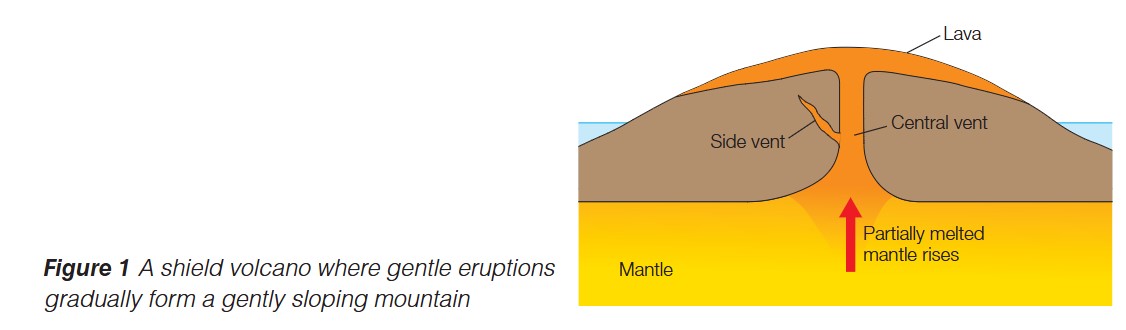
Shield volcanoes erupt gently and calmly. This happens because the lava is runny (low viscosity), allowing it to flow quickly and easily across the surface. The fast-moving lava spreads out over a wide area before cooling and solidifying.
Physical features
The gentle, flowing eruptions create a distinctive shape. Shield volcanoes have:
- Broad, wide bases
- Gently sloping sides
- A low, dome-like profile (similar to a warrior's shield lying on the ground)
- Both central vents and side vents where lava can emerge
Composite volcanoes
Composite volcanoes, also called stratovolcanoes, form at destructive plate boundaries. At these locations, subduction occurs when one tectonic plate is forced beneath another plate. This process can trigger both volcanic eruptions and earthquakes.
How subduction creates volcanoes
When an oceanic plate subducts beneath a continental plate, it descends into the hotter mantle below. The descending plate begins to melt partially, creating magma. This semi-molten magma is less dense than the surrounding rock, causing it to rise toward the surface.
Magma characteristics
The magma at destructive boundaries has very different properties from that at constructive boundaries:
- It is viscous (thick and sticky)
- It contains trapped sea water from the subducted oceanic plate
- It contains hot gases that build up pressure
Important
The key difference between shield and composite volcanoes lies in their magma properties. Shield volcanoes have runny, low-viscosity lava that flows easily, while composite volcanoes have thick, sticky, viscous magma containing trapped water and gases. This fundamental difference determines everything else about these volcanoes - from their eruption style to their shape.
Eruption characteristics
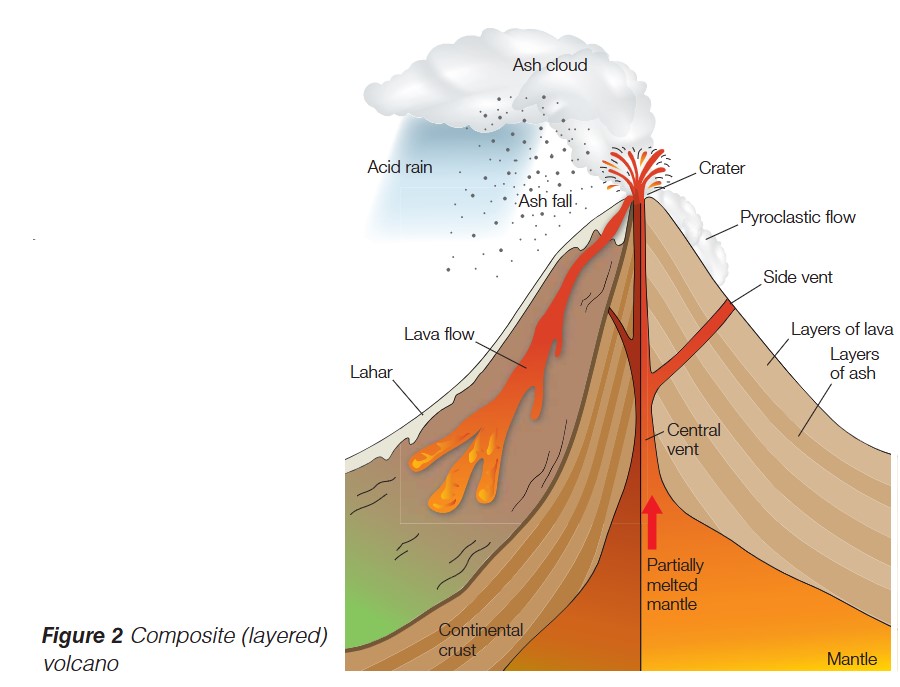
Because the magma is sticky and gas-rich, composite volcanoes erupt explosively and violently. The trapped gases and steam burst out with tremendous force, creating multiple volcanic hazards:
- Ash clouds that rise high into the atmosphere
- Pyroclastic flows (fast-moving currents of hot gas and volcanic matter)
- Lava flows moving down the slopes
- Lahars (volcanic mudflows triggered when volcanic material mixes with water)
- Acid rain caused by volcanic gases mixing with atmospheric moisture
Physical structure
The sticky lava cools quickly after eruption, which creates steep-sided slopes. Over many eruptions, alternating layers of solidified lava and ash build up, creating the characteristic composite volcano structure. These volcanoes typically have:
- Steep, cone-shaped sides
- A crater at the summit
- A central vent running through the volcano
- Possible side vents on the flanks
- Distinct layers of lava and ash visible in cross-section
The layered structure gives these volcanoes their alternative name: stratovolcanoes (from "strata" meaning layers).
Exam guidance
Note
Tips for Exam Success:
When describing volcanic eruptions in exam answers:
- Always link the eruption style to the plate boundary type
- Explain why the lava has different characteristics (runny vs viscous)
- Use correct geographical terminology (e.g., subduction, magma plumes, composite)
- For "explain" questions, give reasons for the differences between volcano types
When comparing shield and composite volcanoes:
- Shield = constructive boundaries/hotspots, runny lava, gentle eruptions, gently sloping
- Composite = destructive boundaries, viscous lava, explosive eruptions, steep-sided
Summary
Key Points to Remember:
- Shield volcanoes form at constructive plate boundaries and hotspots, where plates pull apart or magma plumes rise through the mantle
- Shield volcanoes have gentle eruptions with runny, fast-flowing lava that creates broad, gently sloping volcanic mountains
- Composite volcanoes form at destructive plate boundaries through subduction, where one plate is forced beneath another
- Composite volcanoes have explosive eruptions because the magma is thick and sticky, containing trapped water and gases
- Composite volcanoes are built from alternating layers of lava and ash, creating steep-sided, cone-shaped mountains with multiple volcanic hazards