Dynamic Development (OCR GCSE Geography B (Geography for Enquiring Minds)): Revision Notes
📚Revision Notes
Bottom Up Development in Zambia
What is bottom-up development?
Bottom-up development represents a contrasting approach to top-down development strategies. This type of development is funded and implemented by non-governmental organisations (NGOs), working in close partnership with local communities. Rather than decisions being made by governments or large organisations far from the affected areas, bottom-up development ensures that local people have a voice in projects that directly impact their lives.
Note
The key distinction between these approaches lies in where decisions are made. In top-down development, governments and large organisations make decisions centrally, while bottom-up development empowers local communities to identify their own needs and participate in designing solutions.
The key characteristic of this approach is community involvement. Local communities help identify their own needs and participate in designing and carrying out development projects. This makes the projects more likely to succeed because they address real local issues and build on local knowledge and resources.
Case study: Room to Read in Zambia
Room to Read operates as an NGO with a specific focus on improving literacy rates and promoting gender equality in Zambia. This organisation demonstrates how bottom-up development strategies work in practice by addressing critical educational challenges in partnership with local communities.
Zambia faces significant educational challenges, particularly concerning female students. The country experiences substantially higher rates of girls leaving school early compared to boys. This gender gap in education represents a major barrier to Zambia's overall development, as it limits opportunities for half the population and reduces the country's human capital.
Important
The drop-out rate among female students in Zambia is significantly higher than among male students. This gender disparity in education has far-reaching consequences for the country's development, affecting health outcomes, economic productivity, and social equality.
Barriers to girls' education in Zambia
Multiple interconnected factors contribute to the high drop-out rates among female students in Zambia. Understanding these barriers is essential for developing effective interventions.
Cultural expectations place domestic responsibilities primarily on girls. Families often expect daughters to take on household chores such as cooking, cleaning, and caring for younger siblings. These responsibilities consume time and energy that could otherwise be devoted to education, making it difficult for girls to attend school regularly or complete homework.
Economic pressures create another significant barrier. Many girls must leave school to earn money and support their families financially. When households face poverty, girls are often the first to be withdrawn from education because families may not see the same economic value in educating daughters as sons. This reflects deeper attitudes about gender roles in society.
Parental attitudes towards education differ markedly between sons and daughters. Some parents do not value education for girls as highly as they do for boys, believing that girls will marry and their education will therefore not benefit the family in the same way. This mindset perpetuates gender inequality and limits girls' opportunities.
Early marriage and pregnancy force many girls to leave school permanently. Girls may be pushed into marriage at a young age or become pregnant, ending their education prematurely. These factors are interconnected, as girls who leave school to work or help at home may face increased vulnerability to early marriage.
Note
Understanding the Interconnected Barriers
These four barriers don't operate in isolation. They reinforce each other in a cycle that perpetuates gender inequality:
- Girls withdrawn for domestic duties may fall behind academically
- Economic pressures are worsened by cultural attitudes that prioritize boys' education
- Girls out of school are more vulnerable to early marriage
- Early marriage often results from the combination of limited educational opportunities and economic hardship
Literacy performance in Zambia
When compared with other African countries, Zambia's literacy performance reveals concerning trends. Data on Grade 6 pupils (aged approximately 11 years) shows that Zambian students perform poorly relative to their peers in other African nations.
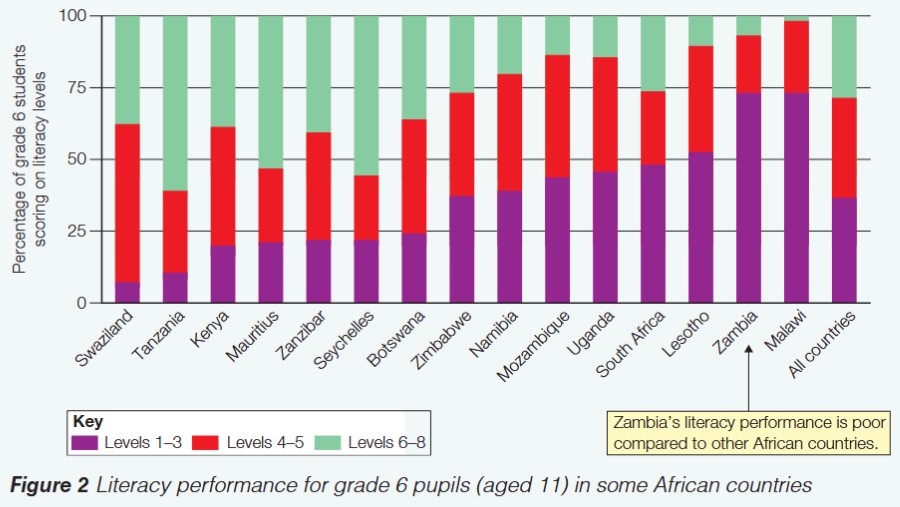
The literacy assessment measures students across different proficiency levels, from basic skills (Levels 1-3) through intermediate abilities (Levels 4-5) to advanced literacy (Levels 6-8). Zambia shows a higher proportion of students at lower literacy levels compared to many other African countries in the study, including Swaziland, Tanzania, Kenya, and others. This lower performance reflects the educational challenges the country faces, including the barriers preventing girls from completing their education.
The poor literacy rates have significant implications for Zambia's development prospects. A population with limited literacy skills faces reduced opportunities for economic advancement, lower health outcomes, and diminished ability to participate fully in democratic processes.
The importance of literacy for development
Former UN Director-General Kofi Annan articulated the crucial role of literacy in development:
Important
Kofi Annan on Literacy:
"Literacy unlocks the door to learning throughout life, is essential for development and health and opens the way for democratic participation and active citizenship."
This statement captures why literacy forms such a fundamental element of development. Literacy enables people to access information about health, allowing them to make better decisions about disease prevention, nutrition, and healthcare for themselves and their families. When populations have higher literacy rates, countries typically see improvements in health indicators such as lower infant mortality and increased life expectancy.
Literacy also connects directly to economic development. People with strong literacy skills can access better employment opportunities, understand contracts and financial information, and participate more effectively in economic activities. At a national level, a more literate workforce attracts investment and enables economic diversification.
Furthermore, literacy supports democratic participation and active citizenship. Citizens who can read and write can access information about government policies, understand their rights, and participate more fully in political processes. This includes voting, engaging with local government, and holding leaders accountable. Literacy thus strengthens democratic institutions and governance.
Example
How Literacy Drives Development: A Practical Example
Consider a mother in rural Zambia who gains literacy skills through a community programme:
Health benefits: She can now read health information pamphlets, understand medicine labels, and follow written medical advice. This leads to better health outcomes for her children.
Economic opportunities: She can read market prices, understand loan agreements, and potentially start a small business using written records and calculations.
Democratic participation: She can read about government policies, understand ballot papers, and make informed decisions in local elections.
This single intervention - improving literacy - creates a cascade of positive development outcomes across multiple areas of life.
The Room to Read initiative in Zambia addresses these development challenges through a bottom-up approach. By working directly with communities to improve literacy, particularly among girls, the project tackles multiple development goals simultaneously. Improved female literacy rates lead to better health outcomes for women and children, enhanced economic opportunities, and stronger democratic participation. This demonstrates how targeted, community-based interventions can generate broad development benefits.
Remember!
Summary
Key Points to Remember:
- Bottom-up development involves NGOs working together with local communities to identify and address development needs, contrasting with top-down approaches where decisions are made centrally
- Room to Read operates in Zambia to improve literacy rates and gender equality through community-based programmes
- Girls in Zambia face multiple interconnected barriers to education: domestic responsibilities, economic pressures, undervaluation of female education, and early marriage
- Zambia's Grade 6 literacy performance lags behind many other African countries, indicating significant educational challenges
- Literacy serves as a foundation for broader development, enabling improvements in health, economic opportunities, and democratic participation
Key Terms:
- Bottom-up development: Development strategies funded and carried out by NGOs together with local communities
- NGO: Non-Governmental Organisation - independent organisations that work on development projects
- Literacy rate: The percentage of the population who can read and write
- Drop-out rate: The proportion of students who leave school before completing their education
- Democratic participation: The ability of citizens to engage actively in political processes and governance
Critical Concepts:
- Bottom-up development empowers local communities rather than imposing solutions from above
- Gender inequality in education creates long-term development challenges
- Multiple interconnected factors contribute to educational barriers - they reinforce each other
- Literacy enables access to health information, economic opportunities, and political participation
- Community-based approaches can address multiple development goals simultaneously