Defining Development (OCR GCSE Geography B (Geography for Enquiring Minds)): Revision Notes
📚Revision Notes
Defining Development
What is development?
Development refers to improving people's quality of life by using resources more effectively. When geographers talk about development, they are describing how countries achieve better living standards for their populations. This improvement comes from making smarter use of the resources available to them, whether these are natural resources, human skills, or technology.
Geographers classify countries into different categories based on how developed they are. This classification helps us understand the economic and social differences between nations and why some countries are wealthier than others.
Classification of countries by development level
Countries around the world sit at different stages of development. Understanding these categories is essential for studying global inequality and development patterns.
Note
Geographers use this three-tier classification system to analyze global development patterns and understand why different regions face different challenges and opportunities. This framework helps identify which countries need support and which can provide assistance to others.
Advanced countries (ACs) are nations that have achieved high levels of economic prosperity. These countries possess substantial wealth and offer their citizens a diverse range of employment opportunities across many different sectors and industries. They also provide extensive services, including healthcare, education, and infrastructure, to support their populations.
Emerging and developing countries (EDCs) represent nations in transition. These countries are currently moving from lower development levels towards becoming advanced countries. They are experiencing economic growth and social change as they develop their industries, services, and infrastructure. This transition period can bring both opportunities and challenges as these nations work to improve living standards.
Low-income developing countries (LIDCs) are nations facing significant development challenges. These countries have limited economic wealth and offer their citizens a restricted variety of jobs and services. Many people in LIDCs work in agriculture or basic industries, and access to education, healthcare, and other essential services may be limited.
Aspects of development
Development is not simply about wealth creation. While economic factors are important, true development encompasses multiple dimensions that affect people's lives. Geographers examine different aspects to build a complete picture of a country's development status.
Important
Understanding all three aspects of development is crucial. Countries cannot achieve true development by focusing on just one aspect - economic growth alone does not guarantee better lives for citizens, and social improvements are unsustainable without economic foundations and environmental protection.
Economic development
Economic development focuses on a country's wealth creation and production capacity. It measures the increase in the total amount of goods and services that a nation produces. When a country experiences economic development, it means its economy is growing, businesses are producing more, and economic activity is expanding. This growth can create jobs, generate income, and provide resources for other types of development.
Social development
Social development centres on improving human welfare and quality of life. It involves enhancing people's access to essential needs such as healthcare, education, clean water, and adequate nutrition. When a country achieves social development, more of its citizens can enjoy better health, longer life expectancy, improved literacy, and greater overall wellbeing. This aspect recognizes that development must benefit people directly, not just increase economic statistics.
Sustainable development
Sustainable development represents a balanced approach that considers economic growth, social progress, and environmental protection together. This type of development aims to meet the needs of people living today whilst also ensuring that future generations will have the resources and environment they need to meet their own needs.
Note
Sustainable development is increasingly recognized as the most important framework for development in the 21st century. It acknowledges that short-term economic gains mean nothing if they destroy the environment or create social inequality that destabilizes societies.
Sustainable development involves three interconnected pillars that must work together:
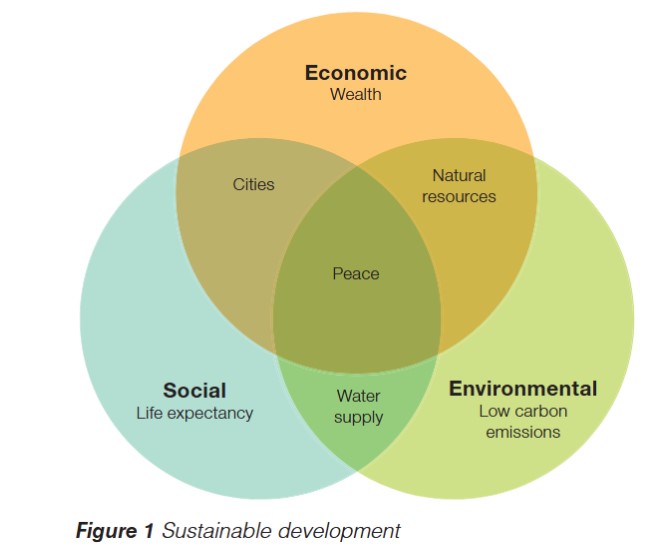
The economic pillar addresses wealth creation and financial prosperity. This includes managing natural resources wisely and developing cities that support economic activity without depleting resources.
The social pillar focuses on human welfare and quality of life. Important indicators include life expectancy and ensuring adequate water supply for all people. Social development must reach everyone in society, not just the wealthy.
The environmental pillar emphasizes protecting our planet for current and future use. This involves actions such as reducing carbon emissions, preserving natural ecosystems, and using resources responsibly.
Important
When these three pillars overlap and work together effectively, they create peace and stability. The diagram shows how cities, natural resources, and water supply exist at the intersections between different pillars, demonstrating that many development issues require balanced solutions across all three areas. True sustainable development only occurs when economic, social, and environmental needs are all addressed simultaneously.
Remember!
Summary
Key Points to Remember:
- Development means enhancing living standards through more effective use of resources, not just economic growth alone.
- Countries are classified as advanced countries (ACs), emerging and developing countries (EDCs), or low-income developing countries (LIDCs) based on their development levels.
- Development has three key aspects: economic (increasing wealth and production), social (improving human welfare), and sustainable (balancing present and future needs).
- Sustainable development requires balancing three pillars - economic, social, and environmental - to create lasting positive change.
- True development benefits people's lives directly through improvements in health, education, income, and environmental quality whilst protecting resources for future generations.