How Uneven Development Happened (OCR GCSE Geography B (Geography for Enquiring Minds)): Revision Notes
📚Revision Notes
How Uneven Development Happened
Introduction
Development levels vary significantly across the world today, with some countries being much wealthier than others. This uneven development has not always existed in the same way. To understand why these differences exist, we need to examine both the physical and human factors that influence development, as well as the crucial role that history has played in shaping the modern world.
Note
The key question to consider is: why are some countries richer than others? While physical factors provide part of the answer, historical processes—particularly colonialism—offer a more complete explanation of today's global development gap.
Factors that influence development
Several physical and human factors can contribute to a country's ability to develop economically and socially. Understanding these factors helps us begin to explain why some nations have progressed more rapidly than others.
Physical and human factors
Countries with certain advantages may find it easier to develop. These include:
- A large population – provides a workforce for industries and services
- Warm climate – can support year-round agriculture and reduce heating costs
- Flat, fertile land – makes farming easier and more productive
- Abundant natural resources – such as minerals, oil, forests, and water
These factors create favorable conditions for economic growth. A large population provides workers and consumers, while natural resources can be exploited for economic benefit. Fertile land supports agriculture, which can feed the population and generate income through exports.
Note
Think of these factors as advantages that can help a country develop. A warm climate means crops can grow year-round, flat land makes building infrastructure easier, and abundant resources provide materials for industries. However, having these advantages doesn't guarantee development.
The limitation of physical factors
However, these factors alone cannot completely account for why certain nations develop while others do not. Many countries possess some or all of these advantages yet remain relatively poor. Conversely, some nations with limited natural resources have become wealthy. This suggests that other factors must be at work.
Important
Critical Understanding: Physical factors like population, climate, land, and resources do NOT fully explain development patterns. Some countries with excellent physical conditions remain poor, while others with limited resources have become wealthy. This tells us we need to look elsewhere for answers—particularly at history.
To fully understand development patterns, we need to examine a country's history. Historical events and processes have had profound and lasting effects on which countries are wealthy today and which remain poor.
The role of history in development
History provides a much better explanation for global development patterns than physical factors alone. The past 500 years of world history, in particular, have fundamentally shaped the economic landscape we see today.
European exploration and trade
Historically, European countries began exploring other parts of the world, establishing trade relationships with distant regions. Initially, this involved exchanging goods and establishing trading posts. However, European nations did not stop at peaceful trade. Over time, they moved beyond trading to conquering and ruling vast territories across Africa, Asia, and the Americas.
Colonialism and its impact
The historical process that most significantly explains uneven development is colonialism. This system had devastating effects on colonized regions while dramatically benefiting European powers.
What is colonialism?
Important
Definition: Colonialism refers to the process by which European countries explored, traded with, and eventually conquered and ruled over other parts of the world. These conquered territories became known as colonies—places under the political and economic control of a foreign power. The colonial period saw European nations establish control over much of Africa, Asia, the Caribbean, and the Americas.
The colonial process
The development of colonialism followed several distinct stages, which can be understood through examining the historical sequence of events:
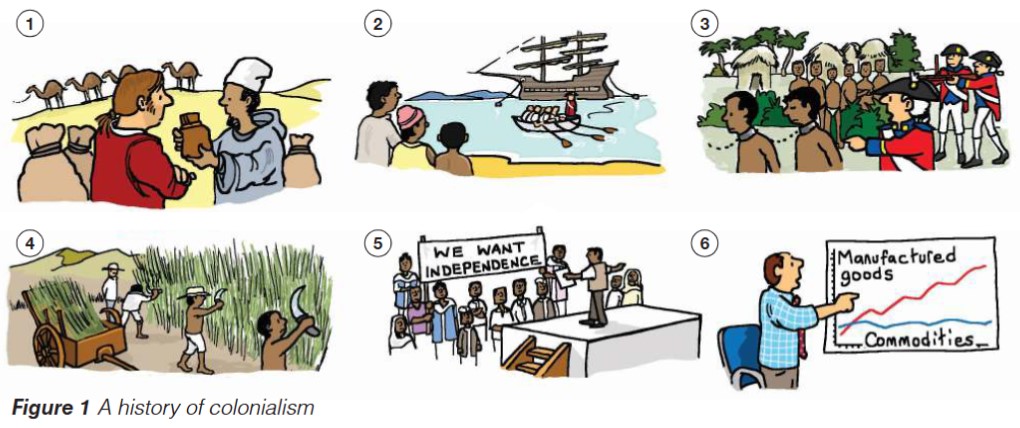
Example
The Six Stages of Colonialism:
The illustration above demonstrates how colonialism developed over time through six key stages:
Stage 1: Early exploration and trade – Europeans first made contact with other regions, establishing trade relationships with indigenous peoples
Stage 2: Arrival of colonial powers – European ships arrived in greater numbers, bringing settlers and military forces
Stage 3: Conquest and control – European military forces met with and often fought against indigenous populations to establish control
Stage 4: Economic exploitation – Colonizers established plantations and forced local populations to work, extracting valuable resources and agricultural products
Stage 5: Independence movements – Colonized peoples organized and fought for their independence, demanding freedom from colonial rule
Stage 6: Economic legacy – Even after independence, an unequal economic relationship persisted, with former colonies exporting commodities while importing more expensive manufactured goods
How colonialism benefited Europe
Colonialism enabled European countries to develop rapidly because it gave them access to valuable commodities—raw materials such as sugar, cotton, rubber, coffee, and minerals. These resources were extracted from colonies, often using forced or cheap labor, and shipped back to Europe.
European nations could then process these raw materials in their factories, creating manufactured goods. This industrialization process generated wealth and technological advancement in Europe. The colonies effectively provided the resources that fueled Europe's Industrial Revolution and economic growth.
Note
The Colonial Economic Cycle:
Colonies provided cheap raw materials → European factories processed them into manufactured goods → These finished products were sold at high prices → Profits stayed in Europe → This wealth funded further European development
Impact on colonized regions
While colonialism accelerated development in Europe, it had the opposite effect in the colonies. Several factors contributed to this:
- Resources were extracted and sent to Europe rather than benefiting local populations
- Economic systems were structured to serve colonial powers, not local development needs
- Infrastructure was built to facilitate resource extraction, not to support local economies
- Local industries were suppressed to prevent competition with European manufacturers
- Wealth generated from resources flowed out of colonies rather than being reinvested locally
This exploitative system meant that colonized regions could not develop at the same rate as Europe. Their resources enriched European nations while their own economies remained focused on producing raw materials for export.
Important
Key Concept: While colonialism helped Europe develop rapidly, it simultaneously slowed development in colonized regions. The same process that built wealth in Europe extracted wealth from colonies. This created the foundation for today's uneven development patterns.
The lasting legacy of colonialism
Although most former colonies gained independence during the 20th century, the influence of colonialism remains visible today. Many former colonies continue to export commodities while importing manufactured goods from wealthier nations. This economic relationship perpetuates the development gap created during the colonial period.
The effects of colonialism help explain why many countries in Africa, Asia, Latin America, and the Caribbean face development challenges today, while former colonial powers in Europe remain wealthy. The historical extraction of resources, suppression of local industries, and creation of economies dependent on raw material exports have had long-lasting consequences that persist even decades after independence.
Note
Understanding the Continuing Impact:
Even though countries gained their independence in the 20th century, the economic structures established during colonialism didn't disappear overnight. Former colonies still often:
- Export raw materials at low prices
- Import expensive manufactured goods
- Lack developed manufacturing industries
- Face debt and economic dependency
This shows how historical events can have effects that last for centuries, shaping the world we live in today.
Remember!
Summary
Key Points to Remember:
-
Physical factors like population, climate, fertile land, and natural resources can influence development, but they do not fully explain why some countries are wealthy and others are poor.
-
History, particularly colonialism, provides a better explanation for uneven development patterns across the world today.
-
Colonialism allowed European countries to develop rapidly by extracting commodities from conquered territories, but this same process slowed development in colonized regions.
-
Even though countries are now independent, the economic relationships and structures established during colonialism continue to influence global development patterns.
-
Understanding historical processes like colonialism is essential for explaining why development remains uneven across the world.