Measuring Development (OCR GCSE Geography B (Geography for Enquiring Minds)): Revision Notes
📚Revision Notes
Measuring development
Why measure development?
Development is a complex process that involves economic, social, and political progress. Countries need ways to compare their level of development and track improvements over time. Different indicators provide different perspectives on a country's development status.
Note
Understanding how to measure development is crucial because it helps governments set priorities, allocate resources, and track progress toward improving their citizens' quality of life. No single measure is perfect, which is why multiple indicators are used.
Wealth as a measure of development
What is GNI per capita?
One common way to measure development is by examining a nation's wealth. This is calculated using gross national income (GNI) per capita, which represents the average wealth per person in a country. To make fair comparisons between countries, economists adjust this figure using purchasing power parity (PPP).
Note
Key term: GNI/capita at PPP – the average wealth per person in a country, adjusted to show what that money can actually buy in terms of goods and services.
When prices vary between countries, PPP allows us to compare the real value of money. For example, $10 might buy more goods in one country than another, so PPP adjusts for these differences.
Limitations of using wealth alone
While wealth provides useful information, relying solely on GNI/capita has significant weaknesses:
- It only shows an average – Many people in a country may be considerably richer or poorer than the mean value suggests. Wealth inequality is hidden by averages.
- Not all wealth is counted – Subsistence farming (growing food for your own family) generates no recorded income, yet provides essential resources. This means some countries appear poorer than they actually are.
- Social factors are ignored – GNI/capita tells us nothing about healthcare quality, education standards, gender equality, or environmental sustainability. A wealthy country might still have poor social development.
Important
Common Exam Mistake to Avoid:
When evaluating wealth as a development indicator, students often forget to provide a balanced answer. Always mention both its usefulness (easy to measure and compare) and its limitations (doesn't show inequality or social factors). Examiners reward critical evaluation!
Human Development Index (HDI)
What is HDI?
The Human Development Index is a composite measure that combines multiple development indicators to give a more complete picture of a country's development level. It was created by the United Nations to address the limitations of using wealth alone.
HDI includes three components:
- Wealth – measured by GDP per capita at PPP
- Health – measured by life expectancy (the average age to which people are expected to live)
- Education – measured by the adult literacy rate (the percentage of adults who can read)
Note
Memory Aid: Remember HDI's three components with WHE:
- Wealth (GDP per capita)
- Health (life expectancy)
- Education (adult literacy rate)
Understanding HDI scores
HDI scores range from 0 (lowest development) to 1 (highest development). Countries are typically classified into four categories:
- Very high (over 0.800)
- High (0.700–0.799)
- Medium (0.550–0.699)
- Low (below 0.549)
Note
Think of the HDI scale like a percentage: 0.800 = 80% developed, 0.500 = 50% developed, and so on. The closer to 1.000, the more developed the country.
Global patterns of HDI
The map below shows HDI values across the world, highlighting the top 10 most developed countries:
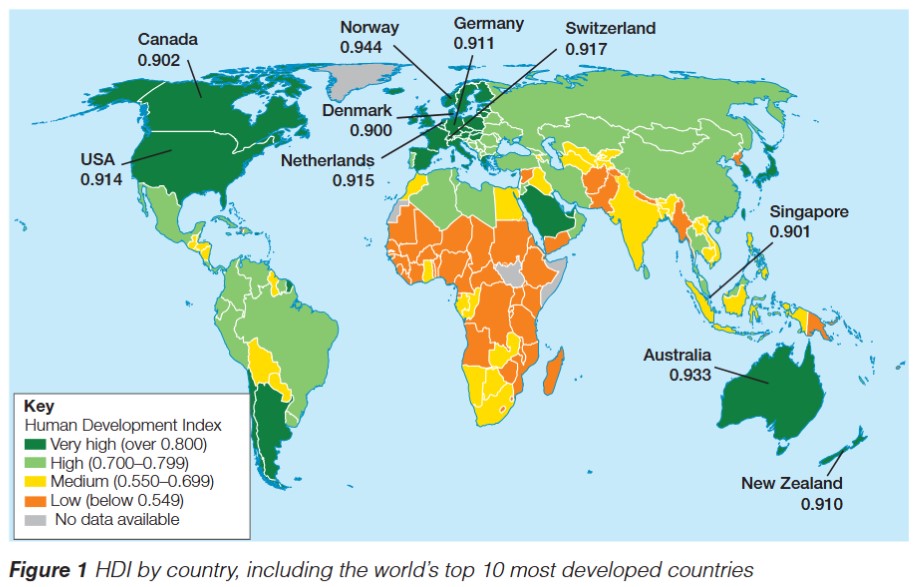
Key patterns visible on the map:
- Very high HDI (dark green) – found in North America, Europe, and Oceania
- High HDI (light green) – parts of South America and Asia
- Medium HDI (yellow) – scattered across Asia, North Africa, and South America
- Low HDI (orange) – concentrated in sub-Saharan Africa
Important
Exam Technique for Maps and Patterns:
Be prepared to describe and explain global development patterns. Use compass directions (e.g., "Northern Europe," "Sub-Saharan Africa") and specific country examples in your answers. Vague statements like "some countries" won't earn marks!
Comparing the measures
Both GNI/capita and HDI are useful development indicators, but HDI provides a more comprehensive view by including social factors alongside economic wealth. However, even HDI has limitations – it doesn't measure environmental sustainability, political freedom, or cultural factors that contribute to quality of life.
Example
Worked Example: Why HDI is More Useful Than GNI Alone
Consider two countries with the same GNI per capita of $20,000:
Country A:
- High life expectancy (80 years)
- High literacy rate (98%)
- Good healthcare and education systems
- HDI: 0.850 (Very High)
Country B:
- Low life expectancy (60 years)
- Low literacy rate (65%)
- Wealth concentrated in small elite
- HDI: 0.620 (Medium)
Both have the same wealth per capita, but HDI reveals that Country A is significantly more developed overall. This shows why combining multiple indicators gives a more accurate picture than wealth alone.
Summary
Key Points to Remember:
-
Wealth is measured by GNI per capita at PPP – this shows average income adjusted for purchasing power
-
GNI/capita has major limitations – it's only an average, excludes subsistence farming, and ignores social development
-
HDI is a composite measure – it combines wealth (GDP/capita at PPP), health (life expectancy), and education (adult literacy rate)
-
HDI scores range from 0 to 1 – with 1 representing the highest level of development
-
HDI provides a more complete picture – by including social factors, not just economic wealth, though it still has limitations
Key terms to remember:
- GNI per capita – average wealth per person
- PPP (Purchasing Power Parity) – adjustment showing what money can actually buy
- HDI (Human Development Index) – composite measure combining wealth, health, and education
- Life expectancy – average age people are expected to live
- Adult literacy rate – percentage of adults who can read