Obstacles to Development Political Unrest (OCR GCSE Geography B (Geography for Enquiring Minds)): Revision Notes
📚Revision Notes
Obstacles to Development Political Unrest
What is political unrest?
Political unrest occurs when large numbers of people in a country are unhappy and dissatisfied with their government. This widespread dissatisfaction can create serious problems that prevent a country from developing economically and socially.
Political unrest typically starts with peaceful street protests, but in some cases it can escalate into a full-scale civil war. When this happens, it severely disrupts development by forcing people to leave their homes, destroying essential services like hospitals and schools, and stopping the production of food and other goods.
Note
Countries with democratic systems, where citizens can vote to change their government peacefully, are less likely to experience severe political unrest. However, in countries without democratic processes, frustration with the government can quickly turn violent.
Causes of political unrest
Several factors can trigger widespread dissatisfaction with a government and lead to political unrest:
Social inequality – When wealth and opportunities are unfairly distributed, with some groups having far more than others, resentment builds among disadvantaged populations.
Poor government or corruption – When government officials are dishonest, take bribes, or misuse public money for personal gain, citizens lose trust in their leaders.
High taxes – If governments demand excessive taxes while failing to provide adequate services in return, people become frustrated and angry.
Lack of government spending – When governments fail to invest in essential services like healthcare, education, roads, and clean water, quality of life suffers.
Rising prices of essential items – Sharp increases in the cost of food, fuel, and other necessities can push people into poverty and create desperation.
Conflict over resource ownership – Disputes about who controls valuable natural resources like oil, diamonds, or fertile land can trigger violence between different groups.
Important
Common Trigger: Research has found that a combination of social inequality and corruption is particularly dangerous. When people see government officials becoming wealthy while they struggle to afford basic necessities, it creates a powerful sense of injustice that can rapidly escalate into violence.
How political unrest disrupts development
Political unrest creates a devastating cycle that blocks development in multiple ways:
Displacement of people – Fighting forces millions of people to flee their homes, creating refugee camps and overwhelming neighbouring countries. Displaced people cannot work productively or contribute to the economy.
Disruption of services – Hospitals, schools, water supplies, and electricity networks are damaged or destroyed. Healthcare workers, teachers, and other professionals flee the violence, leaving communities without essential services.
Stopped production – Factories close, farms are abandoned, and trade routes become dangerous. The economy grinds to a halt as businesses cannot operate safely.
Loss of investment – Foreign companies withdraw their investments and refuse to do business in unstable countries. This cuts off vital sources of income and employment.
Destroyed infrastructure – Roads, bridges, communication networks, and buildings are damaged in fighting, requiring expensive repairs that struggling governments cannot afford.
Note
The Vicious Cycle: Political unrest creates a self-reinforcing cycle. Violence destroys the economy, which makes people more desperate, which fuels more violence. This makes it extremely difficult for countries to break free from conflict and begin rebuilding.
Case study: South Sudan
South Sudan provides a clear example of how political unrest can devastate development.
Example
Case Study: South Sudan's Descent into Conflict
Background – South Sudan became the world's newest country in 2011 when it gained independence from Sudan. This ended Africa's longest-running civil war. The new nation was also one of the poorest countries globally and heavily dependent on oil revenue.
Causes of conflict – One major cause of conflict was disputes over oil. Sudan had most of the oil resources, with the majority located in South Sudan after independence. Different groups within South Sudan also fought each other over control of oil revenues.
The 2013 civil war – Just two years after independence, a new civil war erupted in South Sudan in 2013. The fighting had devastating consequences:
- Thousands of people were killed in the violence
- Over one million people were displaced from their homes
- Oil production almost completely stopped, destroying the country's main source of income
- Many people became cattle herders simply to survive
- Different groups fought violent battles over land ownership
Impact on development – The civil war pushed South Sudan backwards in almost every measure of development. Instead of building schools, hospitals, and infrastructure, resources went to fighting. The population faced hunger, disease, and poverty rather than progress.
Global distribution of political unrest
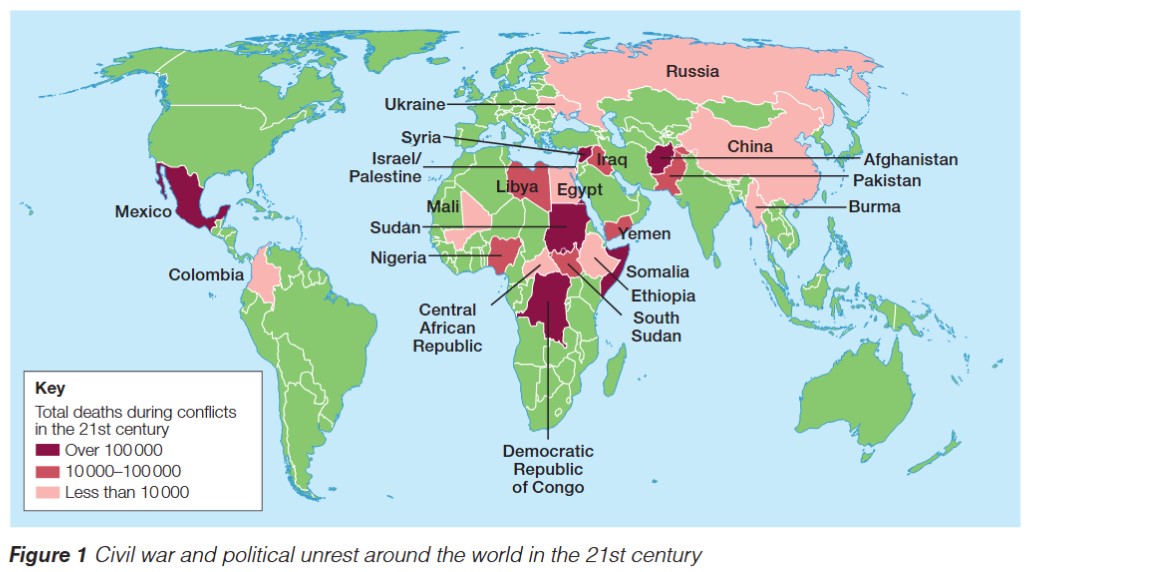
Political unrest in the 21st century has been concentrated in specific regions:
Most affected regions:
- Middle East and North Africa – Countries including Syria, Iraq, Yemen, Libya, and Egypt have experienced severe conflicts
- Sub-Saharan Africa – South Sudan, Somalia, Ethiopia, Central African Republic, Democratic Republic of Congo, Nigeria, and Sudan have all faced significant unrest
- South Asia – Afghanistan and Pakistan have experienced ongoing conflicts
Death tolls – Some countries have experienced catastrophic loss of life, with total deaths during conflicts exceeding 100,000 people. Others have seen death tolls between 10,000 and 100,000, or less than 10,000 but still significant disruption.
Note
Link to development level – The worst political unrest in the 21st century has predominantly occurred in EDCs (Emerging and Developing Countries) and LIDCs (Low Income Developing Countries). Advanced Countries (ACs) have largely avoided such severe internal conflicts, partly because democratic systems provide peaceful ways to resolve disputes.
Exam guidance
When answering questions about political unrest as an obstacle to development:
Describe questions – State what political unrest is and list its key features (violence, protests, civil war, displacement).
Explain questions – Show how political unrest leads to specific development problems. Use linking words like "because", "this leads to", "as a result" to make clear connections.
Evaluate/assess questions – Consider both how serious political unrest is as an obstacle compared to other factors, and whether some countries recover better than others. Use the South Sudan case study as evidence.
Important
Case study tips – Learn specific facts and figures about South Sudan (2011 independence, 2013 civil war, oil conflict, thousands killed, one million displaced). These details demonstrate detailed knowledge in exams and can significantly improve your marks.
Remember!
Summary
Key Points to Remember:
- Political unrest occurs when widespread dissatisfaction with government leads to protests, violence, or civil war
- Main causes include social inequality, corruption, high taxes, poor government spending, rising prices, and resource conflicts
- Political unrest severely disrupts development by displacing people, destroying services, and stopping economic production
- Democratic countries experience less severe political unrest because people can vote for change peacefully
- South Sudan is a key example: gained independence in 2011, descended into civil war in 2013 over oil disputes, resulting in thousands of deaths and over a million displaced
- The worst political unrest in the 21st century has occurred in EDCs and LIDCs, particularly in the Middle East, North Africa, and Sub-Saharan Africa