Obstacles to Development Trade and Debt (OCR GCSE Geography B (Geography for Enquiring Minds)): Revision Notes
📚Revision Notes
Obstacles to Development Trade and Debt
Introduction
Understanding why some countries develop more quickly than others requires examining the economic challenges they face. Two major obstacles that prevent Lower Income Developing Countries (LIDCs) from achieving economic growth are unfair trading patterns and mounting debt burdens.
Trade as an obstacle
Trade allows countries to obtain goods and resources they need while earning money through exports. While trade theoretically helps economic growth, the reality for LIDCs is quite different.
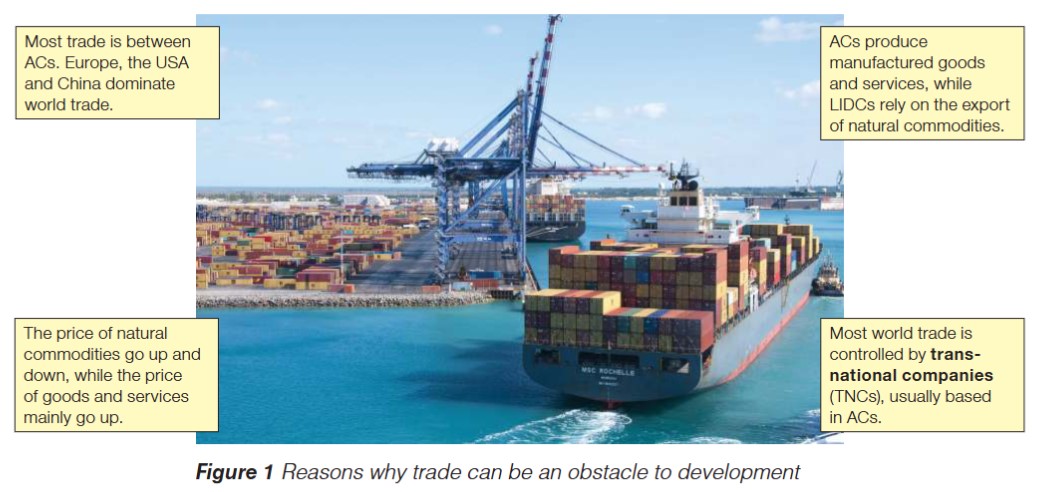
The global trading system often works against the interests of poorer nations. Advanced Countries (ACs) like those in Europe, the USA and China dominate international trade, conducting most business between themselves rather than with LIDCs.
Note
The current global trading system creates an unequal playing field where wealthy nations maintain their advantages by trading primarily amongst themselves, leaving LIDCs at the margins of the most profitable international trade relationships.
Why trade disadvantages LIDCs
There are four key reasons why current trade patterns create obstacles to development:
Market dominance by advanced countries
The majority of global trade occurs between wealthy nations in Europe, North America and Asia. This means LIDCs struggle to access the most profitable markets and trading relationships.
Different types of exports
ACs export high-value manufactured goods and services, which generate significant profit. In contrast, LIDCs primarily rely on exporting natural commodities such as minerals, crops and raw materials. These products are worth far less on the global market.
Price volatility of commodities
The prices of natural resources fluctuate dramatically - sometimes rising sharply but often falling unexpectedly. This makes it extremely difficult for LIDCs to plan their economies or guarantee stable income. Meanwhile, manufactured goods and services maintain steadier, generally increasing prices.
Control by transnational companies
Most international trade is controlled by Transnational Companies (TNCs), which are large corporations usually based in ACs. These companies determine prices, supply chains and market access, giving them enormous power over LIDC economies.
Important
Common Pitfall to Avoid:
Students often assume that trade always benefits all countries equally. However, the type of goods being traded matters enormously. When LIDCs export low-value commodities while importing expensive manufactured goods, trade actually widens the development gap rather than closing it.
The trade value gap
This situation creates an unfair trading relationship. LIDCs work hard to extract and export their natural resources but receive relatively little money in return. They then need to purchase expensive manufactured goods from ACs, spending more than they earn. This trade deficit makes it nearly impossible for poorer countries to accumulate the wealth needed for development.
Example
Worked Example: Understanding the Trade Value Gap
Consider a hypothetical LIDC that exports cocoa beans:
- The country exports $10 million worth of raw cocoa beans annually
- However, it needs to import $15 million worth of manufactured goods (machinery, technology, processed foods)
- Trade deficit: $15 million - $10 million = $5 million shortfall
This means the country loses $5 million each year through trade alone, money that could have been invested in schools, hospitals, or infrastructure. Over a decade, this represents $50 million in lost development opportunities.
Debt as an obstacle
Debt occurs when a country borrows money and must repay it, usually with added interest. While borrowing can fund important development projects, it often becomes a serious barrier to progress for LIDCs.
Impact of debt on LIDCs
Countries with debt face an ongoing challenge: they must continually repay what they owe, which forces governments to reduce spending in other critical areas. For LIDCs with limited financial resources, debt repayment means cutting investment in:
- Healthcare services and facilities
- Education and school resources
- Infrastructure projects like roads and water systems
- Social welfare programmes
Important
The Debt-Development Cycle:
This creates a harmful cycle. LIDCs need to invest in health and education to develop their economies, but debt repayments prevent this investment. Without development, they remain poor and struggle even more to repay debts. This vicious cycle keeps countries trapped in poverty.
Surplus versus debt: global patterns
Some countries manage their finances well and have more money than they need - this is called a surplus. Other countries owe more money than they need, putting them in debt.
Note
Global Financial Patterns:
Countries with surplus:
- Germany
- China
- Just five African countries
Countries in debt:
- USA
- UK
- 19 African countries
This data reveals a striking pattern: while wealthy countries like the USA and UK can manage debt due to their strong economies, most African nations face debt without the same economic resources to cope. The fact that only five African countries have a surplus highlights how debt disproportionately affects the poorest regions.
Why debt is particularly serious for LIDCs
The impact of debt hits LIDCs much harder than ACs for several reasons:
- LIDCs have far less money overall, so any debt repayment takes a larger proportion of their budget
- They cannot afford to borrow more to solve their problems
- Basic needs remain unmet, affecting human welfare immediately
- Lack of investment in education and health prevents long-term development
- They become trapped in a cycle of poverty and debt
Exam guidance
When answering questions about trade and debt as development obstacles:
For 'describe' questions:
- Focus on factual patterns (e.g., which countries control trade, which regions face most debt)
- Use specific examples and data from case studies
- Explain the key characteristics without needing to give reasons
For 'explain' questions:
- Clearly identify the cause-and-effect relationships
- Link trade patterns to their impact on LIDC economies
- Show how debt creates a cycle that prevents development
- Use connecting words like 'therefore', 'because', 'this means that'
For 'assess' or 'evaluate' questions:
- Consider both positive and negative aspects of trade and debt
- Weigh up which obstacle is more significant and why
- Use evidence to support your judgement
- Acknowledge that impacts vary between different LIDCs
Summary
Key Points to Remember:
-
Trade allows countries to buy what they need and earn money from selling goods, but the current system disadvantages LIDCs because they export low-value commodities while ACs trade high-value manufactured goods
-
Four main trade obstacles affect LIDCs: market dominance by ACs, reliance on natural commodity exports, volatile commodity prices, and control by transnational companies (TNCs)
-
Debt forces LIDCs to cut spending on essential services like healthcare and education, preventing the investment needed for development
-
The trade value gap means LIDCs earn less from exports than they spend on imports, making it difficult to accumulate wealth
-
Debt hits LIDCs harder than Advanced Countries because they have less money overall and must sacrifice basic needs to make repayments, creating a poverty trap that prevents development