The Global Development Divide (OCR GCSE Geography B (Geography for Enquiring Minds)): Revision Notes
📚Revision Notes
The Global Development Divide
Understanding global development classifications
Development refers to the economic, social and political progress of countries. Geographers and economists need ways to compare and classify countries based on their level of development. However, measuring and categorizing development has become increasingly complex as the global economy has evolved.
Note
Understanding how countries are classified helps us recognize patterns in global economic development, identify regions experiencing rapid growth, and predict future shifts in global economic power.
Historical classification systems
The simple divide: developed vs. developing
For many years, geographers used a straightforward two-way system to classify countries. Nations were simply labeled as either 'developed' or 'developing' based on their economic status. This binary approach created a clear distinction between wealthier and poorer nations.
The Brandt Line
Another historical classification method was the 'Brandt Line', which divided the world geographically into the 'rich North' and 'poor South'. This imaginary line roughly separated wealthy industrialized countries (mainly in the Northern Hemisphere) from poorer, less developed nations (mainly in the Southern Hemisphere).
Important
As global economies have evolved and some countries have experienced rapid growth, these simple classifications have become less effective at capturing the complexity of modern development patterns. The traditional divide between 'rich North' and 'poor South' no longer accurately reflects reality.
The current IMF classification system
The International Monetary Fund (IMF) now uses a more sophisticated three-tier system to classify countries. This approach recognizes that development exists on a spectrum rather than as a simple divide. Countries are now grouped into three main categories: Advanced Countries (ACs), Emerging and Developing Countries (EDCs), and Low-Income Developing Countries (LIDCs).
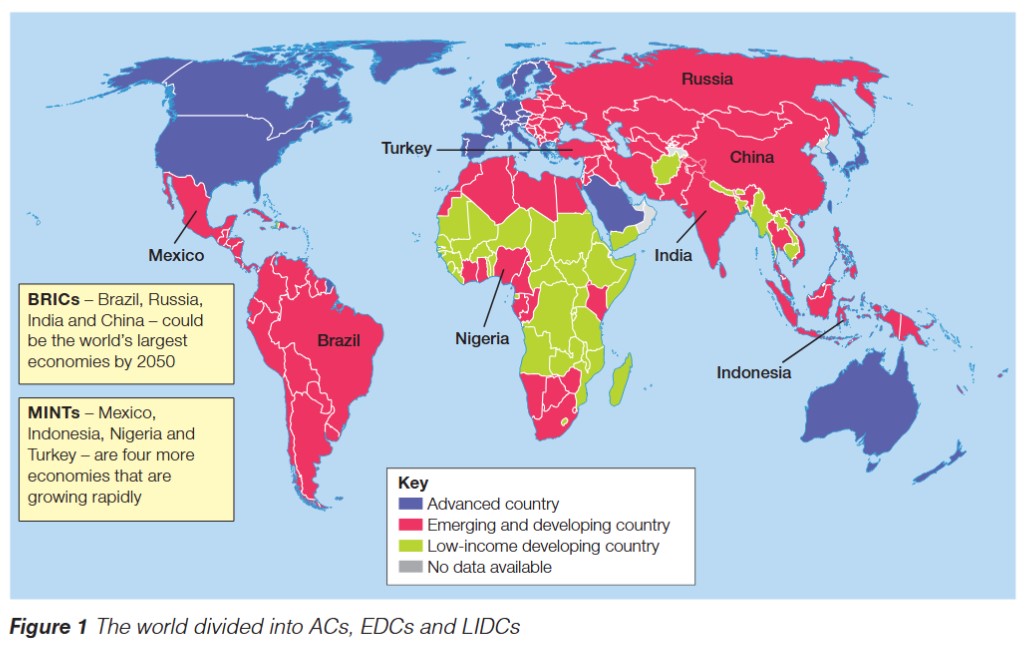
Advanced Countries (ACs)
Advanced Countries represent the world's most economically developed nations. These countries typically have:
- High levels of wealth and income per person
- Well-developed infrastructure and services
- Advanced industrial and technological sectors
- Relatively slower rates of economic growth compared to emerging economies
Geographic distribution: ACs are predominantly located in North America (such as the USA and Canada), Western Europe (including the UK, France and Germany), and Australasia (Australia and New Zealand). These regions form the traditional economic powerhouses of the global economy.
Emerging and Developing Countries (EDCs)
Emerging and Developing Countries are nations experiencing significant economic transformation and growth. These countries are characterized by:
- Rapidly expanding economies
- Increasing industrialization and urbanization
- Rising standards of living
- Growing influence in global trade and investment
Note
EDCs contrast sharply with ACs - while Advanced Countries have slower growth rates, EDCs are experiencing rapid economic expansion and are reshaping the global economic landscape.
Geographic distribution: EDCs are spread across several continents, with significant concentrations in Asia (including major economies like China and India), parts of South America (such as Brazil), Eastern Europe (including Russia), and some African nations.
Low-Income Developing Countries (LIDCs)
Low-Income Developing Countries represent nations with the lowest levels of economic development. These countries typically face:
- Limited economic resources and infrastructure
- Lower standards of living
- Challenges in healthcare, education and basic services
- Dependence on primary industries like agriculture
Geographic distribution: LIDCs are predominantly located in sub-Saharan Africa, forming a large cluster across the central African region. This concentration reflects historical and ongoing development challenges in this part of the world.
Special economic groups: rapidly growing economies
Within the broader classification system, two specific groups of countries have been identified for their exceptional economic growth rates and potential.
BRICs countries
The BRICs are four major emerging economies: Brazil, Russia, India and China. These nations have attracted significant attention because:
- They possess large populations and vast natural resources
- They have experienced extraordinary rates of economic growth
- Economic projections suggest they could become the world's largest economies by 2050
- They represent powerhouses in their respective regions (South America, Eastern Europe, and Asia)
Important
The rapid economic expansion in BRICs countries contrasts sharply with the slower growth rates seen in traditional advanced economies in Europe and North America. This shift represents a major change in global economic power.
MINTs countries
The MINTs represent four additional rapidly growing economies: Mexico, Indonesia, Nigeria and Turkey. These countries are:
- Experiencing fast-paced economic development
- Attracting increased foreign investment
- Developing strong manufacturing and service sectors
- Positioned as the 'next wave' of emerging economic powers
Like the BRICs, MINTs countries are located in diverse regions (North America, Southeast Asia, Africa, and the Middle East/Europe border), demonstrating that rapid economic growth is occurring across multiple continents.
Example
Comparing Growth Patterns: ACs vs. BRICs
Advanced Countries (ACs):
- Slower, steady economic growth
- Already highly developed economies
- Example: USA, UK, Germany
BRICs Countries:
- Rapid, transformative economic growth
- Transitioning from developing to major economic powers
- Example: China's economy has grown at rates often exceeding 6-10% annually, compared to 2-3% in most ACs
Why classification matters for understanding development
The evolution from simple two-way classifications to the more nuanced IMF system reflects the reality that global development is complex and constantly changing. Understanding these classifications helps us:
- Recognize patterns in global economic development
- Identify which regions are experiencing rapid growth
- Understand why some countries face greater development challenges
- Predict future shifts in global economic power
The emergence of BRICs and MINTs countries demonstrates that the traditional divide between 'rich North' and 'poor South' no longer accurately reflects global development patterns. Economic growth is now concentrated in various regions, particularly in Asia, parts of South America, and select African nations.
Summary
Key Points to Remember:
-
The world was historically divided using simple classifications like 'developed vs. developing' or the 'rich North vs. poor South' (Brandt Line), but these have become too simplistic for modern economies.
-
The IMF now classifies countries into three groups: Advanced Countries (ACs), Emerging and Developing Countries (EDCs), and Low-Income Developing Countries (LIDCs).
-
BRICs (Brazil, Russia, India, China) are four major emerging economies that could become the world's largest economies by 2050, showing much faster growth than traditional advanced economies.
-
MINTs (Mexico, Indonesia, Nigeria, Turkey) represent four additional rapidly growing economies across different continents.
-
Geographic patterns: ACs mainly in North America, Europe and Australasia; EDCs in Asia, South America and parts of Africa; LIDCs concentrated in sub-Saharan Africa.
-
The shift from simple binary classifications to the three-tier system reflects the increasing complexity of global development patterns.