Top Down Development in Zambia (OCR GCSE Geography B (Geography for Enquiring Minds)): Revision Notes
📚Revision Notes
Top Down Development in Zambia
What is top-down development?
A top-down development strategy involves large-scale projects planned and implemented by governments or large organisations, often with minimal input from local communities. These projects aim to improve a country's economy and infrastructure through major investments in industry, energy, or transport. The Kariba Dam in Zambia is a significant example of this approach.
Note
Top-down development contrasts with bottom-up approaches where local communities have greater control over planning and implementation. This strategy assumes that national governments and large organisations know what's best for regional development.
The Kariba Dam project
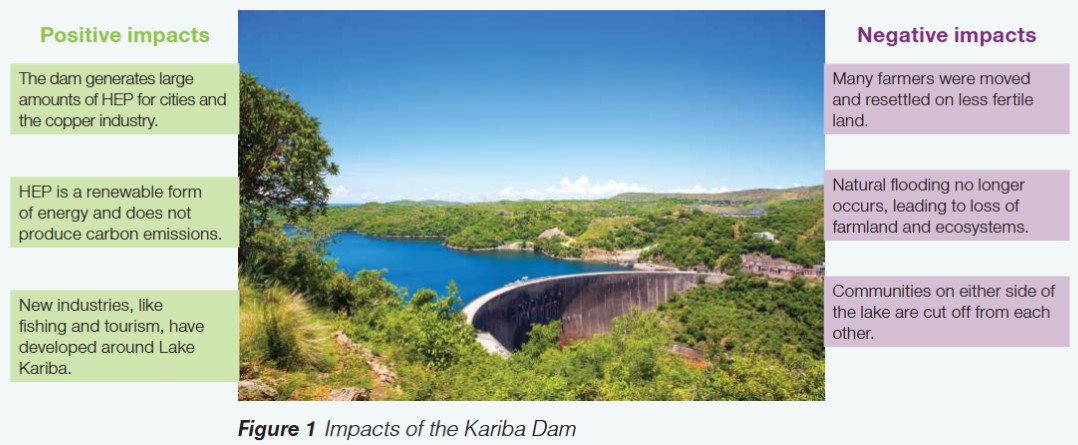
The Kariba Dam, built on the Zambezi River during the 1950s, represents one of the world's most ambitious top-down development schemes. This massive infrastructure project was a joint initiative between Zambia and Zimbabwe, designed to generate hydro-electric power (HEP) for both nations. The dam's construction fundamentally changed the region's landscape and economy.
Location and scale
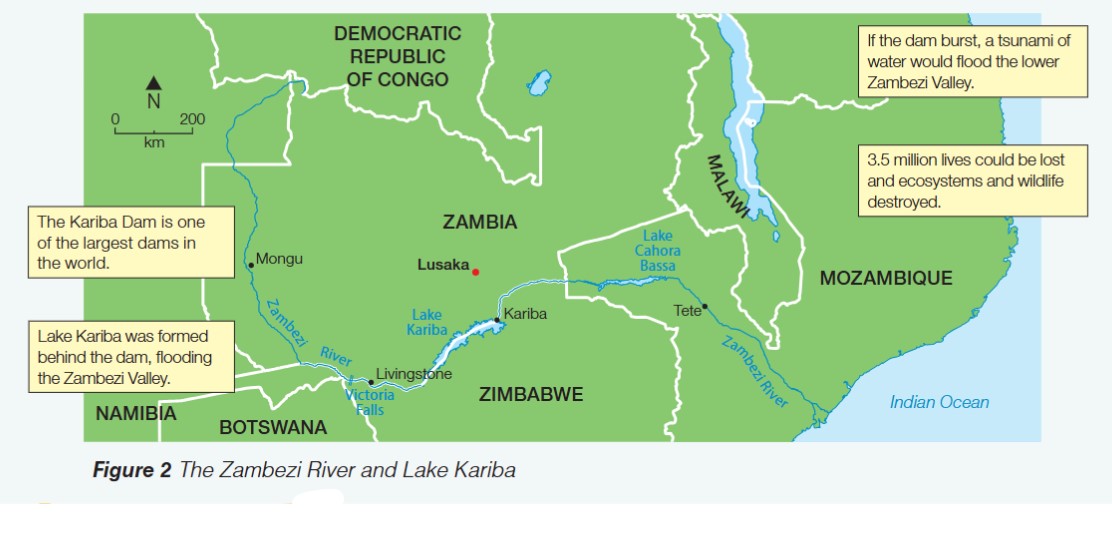
The Kariba Dam is located on the Zambezi River, forming a border between Zambia and Zimbabwe. Its construction created Lake Kariba, which flooded the Zambezi Valley and became one of the world's largest artificial reservoirs. The project ranks among the largest dams globally, demonstrating the scale of top-down development initiatives.
Important
The sheer scale of Lake Kariba is remarkable - it stretches over 220 km in length and reaches widths of up to 40 km, making it visible from space. This massive artificial lake displaced entire ecosystems and communities, illustrating how top-down projects can reshape entire regions.
Why the dam was built
The primary purpose of constructing the Kariba Dam was to produce hydro-electric power for industrial development in both Zambia and Zimbabwe. During the 1950s, both countries needed reliable electricity supplies to support their growing economies, particularly Zambia's important copper mining industry. The dam would provide a renewable energy source that could power cities and industrial centres across both nations.
Positive impacts of the Kariba Dam
The dam has brought several significant benefits to the region:
Energy generation: The Kariba Dam produces substantial amounts of hydro-electric power, supplying electricity to major cities and supporting Zambia's copper industry. This reliable power source has been crucial for industrial development and urban growth.
Environmental benefits: As a renewable energy source, HEP does not produce carbon emissions or contribute to climate change. This makes it a cleaner alternative to fossil fuel-based power generation.
Economic opportunities: New industries emerged around Lake Kariba, particularly fishing and tourism. The lake's creation opened up economic activities that provide employment and income for local communities.
Example
Worked Example: Economic Impact of Tourism
Lake Kariba has become a major tourist destination, attracting visitors interested in:
- Wildlife watching (elephants, hippos, crocodiles)
- Fishing expeditions (particularly for tiger fish)
- Houseboats and water sports
This tourism industry has created jobs in:
- Hospitality and accommodation services
- Tour guiding and boat operations
- Local craft markets and food services
The multiplier effect means that money spent by tourists circulates through the local economy, benefiting multiple businesses and families.
Note
When describing positive impacts in exam answers, use specific examples like "supports the copper industry" rather than just saying "helps industry". This shows detailed knowledge and understanding of the real-world applications.
Negative impacts of the Kariba Dam
Despite its benefits, the project caused serious problems for local people and the environment:
Forced resettlement: Thousands of farmers were relocated from the flooded valley and moved to less fertile land. This displacement disrupted traditional communities and reduced agricultural productivity for many families.
Environmental disruption: The dam stopped the natural flooding cycle of the Zambezi River. This annual flooding had previously deposited nutrient-rich sediment on farmland and supported diverse ecosystems. Without these floods, soil fertility declined and wildlife habitats were damaged.
Social fragmentation: Communities living on opposite sides of Lake Kariba became isolated from each other. The vast expanse of water created barriers between settlements that had previously been connected.
Important
Common Mistake to Avoid:
Many students only describe what happened (e.g., "farmers were moved") without explaining the consequences. Always link negative impacts to specific outcomes: "Farmers were relocated to less fertile land, which reduced crop yields and threatened food security for relocated communities." This shows deeper understanding of the social and economic consequences.
Note
When explaining negative impacts in your exam, link them to specific groups of people affected (e.g., "farmers lost fertile land") to demonstrate understanding of social impacts. This makes your answer more precise and shows you understand who was affected and how.
Risks and concerns
Important
Critical Safety Concerns:
The Kariba Dam presents ongoing risks to the region. If the dam were to fail or burst, experts warn that a devastating tsunami of water would flood the lower Zambezi Valley. This catastrophic event could potentially result in the loss of 3.5 million lives and cause widespread destruction of ecosystems and wildlife across the region.
Engineers regularly monitor the dam's structural integrity, as the concrete has shown signs of wear over its decades of operation. The catastrophic consequences of failure make this monitoring absolutely essential.
Top-down development in LIDCs
This case study raises important questions about development strategies in Lower Income Developing Countries (LIDCs). While large-scale projects like the Kariba Dam can bring economic benefits and infrastructure improvements, they often come with significant social and environmental costs. The experience highlights tensions between national economic goals and local community needs.
Note
When evaluating top-down development in exam questions, always discuss both benefits and drawbacks. Questions using command words like "assess" or "evaluate" require balanced arguments showing you understand multiple perspectives. Consider economic, social, and environmental impacts in your answer.
Summary
Key Points to Remember:
Main Concepts:
- Top-down development involves large-scale projects planned by governments with limited local community input
- The Kariba Dam (1950s) was a joint Zambia-Zimbabwe project to generate hydro-electric power
- Positive impacts include renewable energy production, support for industry, and new economic opportunities in fishing and tourism
- Negative impacts include forced resettlement of farmers, loss of natural flooding patterns, and community fragmentation
- The dam poses serious risks - a failure could affect 3.5 million lives
Key Terms:
- Top-down development: Large-scale projects implemented by governments or organisations with limited local input
- Hydro-electric power (HEP): Electricity generated from the energy of flowing or falling water
- LIDCs: Lower Income Developing Countries - nations with lower GDP per capita and less developed infrastructure
- Resettlement: Forced movement of people from their homes to new locations, often without adequate compensation
Critical Processes to Understand:
- Top-down development often prioritises economic growth over local community needs
- Large infrastructure projects can have both positive and negative long-term impacts
- Renewable energy sources like HEP provide environmental benefits but may cause social disruption
- The displacement of communities and disruption of natural systems are common costs of large-scale development projects