Zambia’s Development Goals (OCR GCSE Geography B (Geography for Enquiring Minds)): Revision Notes
📚Revision Notes
Zambia's Development Goals
Introduction to the Millennium Development Goals
In 2000, leaders from 198 nations came together to commit to a bold global development plan. They agreed on eight Millennium Development Goals (MDGs), aiming to halve world poverty within 15 years by the target year of 2015. This represented one of the most ambitious international efforts to tackle global inequality and improve living standards in developing countries.
Note
The MDGs represented an unprecedented level of international cooperation, with nearly every country in the world committing to measurable development targets. This global agreement created a framework for accountability and allowed progress to be tracked systematically across different nations and regions.
The MDGs were designed to address the most pressing development challenges facing Low Income Developing Countries (LIDCs) like Zambia. These goals covered multiple aspects of human development, from basic needs like food and water to education, health, and economic opportunities. By setting clear, measurable targets, world leaders hoped to track progress and hold governments accountable for improving their citizens' lives.
However, progress towards achieving these goals has been mixed globally. While some countries made significant advances, others struggled to meet the targets, highlighting the complex challenges involved in development.
The eight Millennium Development Goals
The MDGs established in 2000 addressed fundamental development priorities:
- Halve extreme poverty and hunger – Reduce by half the proportion of people living in extreme poverty and suffering from hunger
- Achieve primary education everywhere – Ensure all children complete a full course of primary schooling
- Promote gender equality and empower women – Eliminate gender disparity in education and increase women's opportunities
- Reduce child mortality – Lower the number of children dying at young ages, particularly under five years old
- Improve maternal health – Reduce deaths among mothers during pregnancy and childbirth
- Combat HIV/AIDS and other diseases – Halt and begin to reverse the spread of HIV/AIDS, malaria, and other major diseases
- Ensure environmental sustainability – Integrate sustainable development principles and improve access to safe drinking water and sanitation
- Develop a global partnership for development – Create partnerships between developed and developing countries, including debt relief and increased aid
Note
These goals were interconnected, recognising that poverty, health, education, and environmental factors all influence each other. Improvements in one area could support progress in others, creating positive development cycles. For example, better education helps people make informed health decisions, while improved health allows children to attend school more regularly.
Zambia's progress: an overview
By 2015, Zambia had made mixed progress towards achieving the MDGs. The country succeeded in meeting some targets while falling short on others, reflecting the uneven nature of development even within a single nation. This mixed performance is typical of many LIDCs, where development faces multiple challenges including limited resources, infrastructure gaps, and competing priorities.
Important
One notable pattern in Zambia was the significant difference between urban and rural progress. Cities such as Lusaka experienced substantially greater improvements compared to rural regions. This urban-rural divide is a common feature of development, as urban areas typically benefit from better infrastructure, more concentrated services, and greater economic opportunities. Rural communities often face challenges including geographic isolation, limited service delivery, and reliance on subsistence agriculture.
Zambia's performance across the eight MDGs
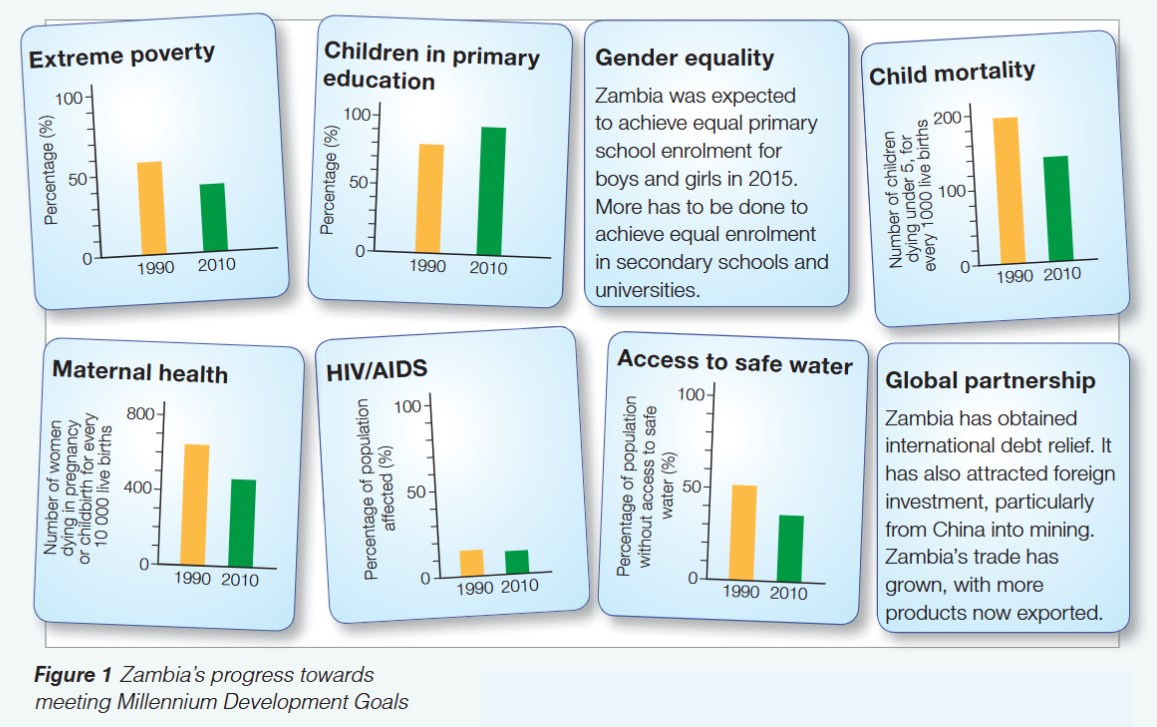
MDG 1: Extreme poverty and hunger
Zambia achieved notable success in reducing extreme poverty between 1990 and 2010. The proportion of the population living in extreme poverty fell from approximately 65% to 45%. This 20 percentage point reduction meant that millions of Zambians moved above the extreme poverty line, gaining access to better food, shelter, and basic necessities.
This progress resulted from several factors, including economic growth driven by copper mining, increased international investment, and improved agricultural productivity in some regions. However, with 45% of the population still living in extreme poverty by 2010, significant challenges remained. Rural poverty rates stayed particularly high, and the goal of halving poverty completely by 2015 was not achieved.
Note
While reducing poverty from 65% to 45% represented real improvement in millions of lives, the target was to halve the poverty rate - meaning it should have fallen to approximately 32.5%. This demonstrates how even significant progress can still fall short of ambitious development targets.
MDG 2: Primary education
Zambia made excellent progress on primary education, representing one of its strongest MDG achievements. Primary school enrolment rates increased dramatically from approximately 75% in 1990 to 95% in 2010. This meant that nearly all Zambian children gained access to basic education, a fundamental building block for individual and national development.
The government implemented policies to increase school access, including abolishing primary school fees in some areas and building more schools, particularly in underserved regions. Higher enrolment rates help break the cycle of poverty, as educated individuals have better employment prospects and can make more informed decisions about health and family planning. However, challenges remained around school quality, teacher training, and ensuring children completed their education rather than dropping out.
MDG 3: Gender equality
Zambia made progress towards gender equality in primary education and was expected to achieve equal enrolment for boys and girls by 2015. This represented important social progress, as girls in many developing countries face particular barriers to education, including cultural attitudes, early marriage, and domestic responsibilities.
However, significant work remained to achieve equal enrolment in secondary schools and universities, where gender gaps persisted. Girls often faced pressure to leave education after primary school, limiting their opportunities for skilled employment and leadership roles. Achieving full gender equality required addressing deep-rooted cultural attitudes, improving girls' safety and facilities in schools, and providing economic support for families to keep daughters in education.
Note
Gender equality in education has multiplier effects on development. Educated women typically have fewer, healthier children, are more likely to send their own children to school, and can contribute more effectively to household income and community development. Progress in girls' education therefore supports progress across multiple other MDGs.
MDG 4: Child mortality
Zambia reduced child mortality rates from approximately 200 deaths per 1,000 children in 1990 to 140 per 1,000 in 2010. While this represented progress, with fewer children dying in their early years, the rates remained high by global standards, indicating that much more needed to be done.
Common causes of child mortality in Zambia included preventable diseases like malaria, pneumonia, and diarrhoeal diseases, as well as complications from malnutrition. Improvements came from increased vaccination coverage, better access to healthcare services, distribution of mosquito nets, and improved nutrition programmes. However, rural areas often lacked adequate healthcare facilities, and many families could not afford treatment or lived too far from clinics.
Important
Even with progress, 140 deaths per 1,000 children meant that approximately one in seven Zambian children died before reaching adulthood in 2010. This high mortality rate highlighted the urgent need for continued investment in healthcare infrastructure, preventive measures, and addressing the underlying causes of child deaths including poverty and malnutrition.
MDG 5: Maternal health
Progress was made in improving maternal health, with deaths during pregnancy and childbirth declining from over 600 per 100,000 live births in 1990 to approximately 400 per 100,000 in 2010. Despite this improvement, Zambia's maternal mortality rate remained dangerously high, with mothers still facing substantial risks when giving birth.
Many maternal deaths resulted from preventable complications including haemorrhage, infection, and eclampsia. Limited access to skilled birth attendants, particularly in rural areas, meant many women gave birth without proper medical support. Other factors included teenage pregnancy, poor nutrition, and limited access to emergency obstetric care. Improving maternal health required more healthcare facilities, training more midwives, better transport for emergencies, and family planning services.
MDG 6: HIV/AIDS and other diseases
Important
A Critical Setback
Unfortunately, Zambia experienced worsening HIV/AIDS infection rates, increasing from approximately 15% of the population in 1990 to 20% in 2010. This represented a significant setback and a major public health crisis. HIV/AIDS not only causes individual suffering and death but also impacts families, communities, and the economy by affecting working-age adults.
The spread of HIV/AIDS in Zambia resulted from multiple factors including poverty, limited health education, cultural practices, gender inequality, and initially inadequate access to prevention and treatment. However, international partnerships helped establish antiretroviral treatment programmes, prevention campaigns, and support services. Combating HIV/AIDS remained a critical priority requiring sustained effort and resources.
MDG 7: Environmental sustainability (safe water access)
Zambia improved access to safe drinking water, with the percentage of the population without safe water access decreasing from approximately 50% in 1990 to 35% in 2010. This meant millions more Zambians gained access to clean water, reducing waterborne diseases and the time spent collecting water, particularly for women and girls.
Investment in water infrastructure, including wells, boreholes, and piped water systems, drove these improvements. However, over a third of the population still lacked safe water access by 2010, particularly in rural and remote areas where infrastructure development was more challenging and expensive. Access to safe water is fundamental to health, as contaminated water spreads diseases like cholera and dysentery.
Note
The time saved by having safe water access closer to home, particularly for women and girls who traditionally collect water, can be invested in education, income-generating activities, and other productive pursuits. This demonstrates how environmental improvements directly support progress in other development areas.
MDG 8: Global partnership for development
Zambia benefited significantly from international partnerships and development cooperation. The country obtained international debt relief, which freed up government resources previously spent on debt repayments to invest in education, healthcare, and infrastructure instead. This debt relief provided crucial fiscal space for development spending.
Zambia also attracted foreign investment, particularly from China in the mining sector. Chinese companies invested in copper mines, creating employment and generating export revenue. Trade also expanded, with Zambia exporting a more diverse range of products rather than relying solely on copper. These partnerships provided capital, technology, and market access that domestic resources alone could not supply. However, foreign investment also raised questions about fair wages, working conditions, environmental standards, and ensuring that resource extraction benefited ordinary Zambians rather than only foreign companies and domestic elites.
Overall assessment of Zambia's development progress
Zambia's experience with the MDGs illustrates both the possibilities and challenges of development in LIDCs. The country achieved notable successes, particularly in expanding primary education and reducing extreme poverty. These achievements improved millions of lives and created foundations for further progress.
Important
Remaining Challenges
However, significant challenges remained across multiple areas. HIV/AIDS rates increased rather than decreased, representing a major crisis. Child and maternal mortality rates, while improved, stayed at concerning levels. Rural areas lagged far behind urban centres in nearly all indicators, highlighting geographical inequality. Meeting the MDGs required not just progress but achieving specific targets, and Zambia fell short in several areas by 2015.
The question of whether LIDCs like Zambia are likely to "stay poor" depends on multiple factors. Progress on the MDGs shows that development is possible, but not inevitable or easy. Success requires sustained political commitment, adequate resources, effective institutions, good governance, and beneficial international partnerships. Countries that maintain these conditions can continue developing, while those that struggle with conflict, corruption, poor governance, or economic shocks may see progress stall or reverse.
Zambia's mixed MDG performance suggests that development is an ongoing process requiring persistent effort across multiple fronts. While the country made real improvements in some areas, achieving comprehensive development that benefits all citizens, including those in rural areas, remained an ongoing challenge beyond 2015.
Remember!
Summary
Key Points to Remember:
Main achievements and challenges:
- In 2000, 198 countries agreed to eight Millennium Development Goals to halve world poverty by 2015
- Zambia achieved some MDG targets (primary education, poverty reduction) but struggled with others (HIV/AIDS, child/maternal mortality)
- Urban areas like Lusaka experienced much greater improvements than rural regions, creating geographical inequality
- While extreme poverty fell from 65% to 45% and primary enrolment rose from 75% to 95%, these successes were partial rather than complete
- HIV/AIDS rates actually increased from 15% to 20%, representing a major setback to development efforts
Essential terminology:
- Millennium Development Goals (MDGs): Eight international targets established in 2000 to reduce global poverty by 2015
- Extreme poverty: Living on very low income, unable to meet basic needs for food, water, and shelter
- Child mortality: Deaths of children at young ages, measured per 1,000 live births
- Maternal health: Health of mothers during pregnancy and childbirth, measured as deaths per 100,000 live births
- LIDC (Low Income Developing Country): Countries with low average incomes and ongoing development challenges
- Urban-rural divide: Differences in development progress between cities and countryside
Critical development patterns:
- Development is uneven, with progress in some areas but setbacks in others
- Urban areas typically develop faster than rural regions due to better infrastructure and concentrated services
- International partnerships (debt relief, foreign investment) can provide resources but must be managed to benefit local populations
- Progress in one area (e.g., education) can support improvements in others (e.g., health, poverty), creating positive development cycles