Zambia’s Reliance on Copper (OCR GCSE Geography B (Geography for Enquiring Minds)): Revision Notes
📚Revision Notes
Zambia's reliance on copper
Introduction to Zambia's copper economy
Zambia is a Less Industrially Developed Country (LIDC) in southern Africa that depends heavily on copper mining for its economic survival. The country's economy is closely tied to global copper markets, making it vulnerable to international price changes.
Important
Zambia's economy is classified as an LIDC, which means it faces particular challenges related to economic development, infrastructure, and reliance on primary product exports. This classification helps explain why copper dependency creates such significant risks.
Zambia's export dependency
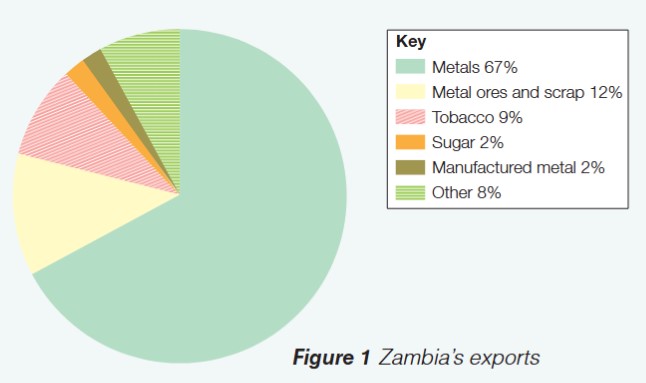
Copper dominates Zambia's export sector, accounting for approximately 70% of all exports. This heavy reliance on a single commodity creates significant economic challenges for the country.
Note
Export Composition Breakdown:
- Metals: 67%
- Metals and metal scrap: 12%
- Tobacco: 9%
- Sugar: 2%
- Manufactured metal: 2%
- Other: 8%
When metals and metal scrap are combined with the main metals category, nearly 80% of Zambia's exports are related to the copper industry.
This data reveals the extreme concentration on one primary product, which makes the economy particularly vulnerable to price fluctuations in the global market. Such dependency means that Zambia's economic health is directly tied to factors beyond its control—namely, global demand for copper and international commodity prices.
The relationship between copper prices and production
Zambia's copper production levels are directly linked to global copper prices. This creates a cyclical pattern that significantly impacts the country's economic performance.
When global copper prices rise:
- Zambian copper production increases
- Mining companies invest more in extraction
- The economy experiences growth
- Government revenue from exports increases
When global copper prices fall:
- Zambian copper production decreases
- Mining operations may reduce output or close
- Economic growth slows
- Government income from exports declines
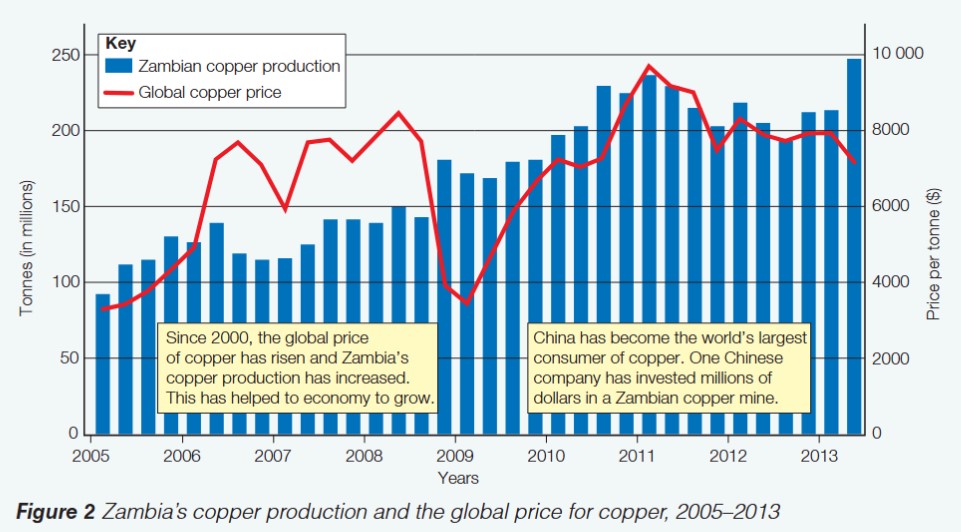
Since 2000, rising global copper prices have driven Zambia's economic expansion. The increased value of copper on international markets encouraged mining companies to boost production levels, which in turn stimulated economic growth across the country.
Important
The Vulnerability Problem:
This same dependency creates serious problems when prices decline. During the 2008-2009 period, copper prices dropped significantly and production became less profitable, demonstrating how external market forces can rapidly impact Zambia's entire economy.
Example
Worked Example: Understanding the Price-Production Relationship
Question: Explain how changes in global copper prices affect Zambia's economy (4 marks)
Model Answer:
When global copper prices increase, Zambian mining companies find it more profitable to extract copper (1 mark). This leads to increased production levels and greater investment in mining operations (1 mark). As production rises, export earnings increase, providing more government revenue and stimulating economic growth (1 mark). However, when prices fall, the opposite occurs—production becomes less profitable, output decreases, and economic growth slows or reverses (1 mark).
China's influence on Zambia's copper industry
China has emerged as the world's largest consumer of copper, which has had profound effects on Zambia's economy. Chinese demand for copper to fuel its rapid industrialisation and infrastructure development has created both opportunities and challenges for Zambia.
Chinese investment in Zambia has grown substantially, with Chinese companies investing millions of dollars directly into Zambian copper mining operations. This foreign direct investment (FDI) has provided capital for mining expansion and technological improvements.
Note
Why China Needs Copper:
China's massive infrastructure projects, construction boom, and manufacturing industries require enormous quantities of copper for electrical wiring, plumbing, electronics, and industrial machinery. This sustained demand has made China the dominant force in global copper markets.
Economic diversification strategy
The Zambian government recognises the risks associated with over-dependence on copper exports. To address this vulnerability, officials have developed a diversification strategy aimed at broadening the economic base.
Currently, over 500 Chinese companies operate in Zambia across various sectors including:
- Mining (beyond just copper)
- Manufacturing industries
- Commercial farming
- Tourism development
This diversification aims to create a more resilient economy that is less vulnerable to fluctuations in global copper prices. By developing alternative economic sectors, Zambia hopes to reduce its reliance on copper from 70% to more sustainable levels. The Chinese investment plays a crucial role in this transformation, bringing capital, technology, and expertise to develop new industries.
Important
Why Diversification is Essential:
Without diversification, Zambia remains at the mercy of global commodity markets. A sustained drop in copper prices could devastate the economy, leading to unemployment, reduced government services, and economic recession. Developing alternative sectors provides a safety net and creates more stable, long-term growth prospects.
The success of this diversification strategy is essential for Zambia's long-term economic stability and development prospects.
Exam guidance
When answering questions about commodity-dependent economies like Zambia, you should apply specific approaches depending on the command word.
For 'explain' questions:
- Clearly identify the cause-and-effect relationship between global prices and production
- Use specific data (e.g., 70% export dependency) to support your explanations
- Explain why production increases when prices rise (greater profitability and investment)
- Explain why production decreases when prices fall (reduced profitability and investment)
For 'assess' or 'evaluate' questions:
- Consider both positive and negative impacts of copper dependency
- Discuss the role of foreign investment (particularly Chinese) in development
- Evaluate the effectiveness of diversification strategies
- Consider short-term benefits versus long-term sustainability
Example
Worked Example: Assessment Question
Question: Assess the impact of Chinese investment on Zambia's economic development (9 marks)
Approach:
Positive impacts:
- Over 500 Chinese companies bring foreign direct investment (FDI) and capital (2 marks)
- Investment supports economic diversification into manufacturing, farming, and tourism, reducing copper dependency (2 marks)
- Chinese demand for copper has driven economic growth since 2000 through higher prices and production (2 marks)
Negative impacts:
- Continued focus on copper extraction maintains vulnerability to price fluctuations (1 mark)
- Dependency on Chinese investment creates new forms of economic reliance (1 mark)
Conclusion: While Chinese investment has brought significant benefits through capital and diversification, Zambia must ensure this investment genuinely reduces copper dependency rather than creating new vulnerabilities (1 mark).
Summary
Key Points to Remember:
-
Copper accounts for 70% of Zambia's exports, creating significant economic vulnerability to global price changes.
-
Zambian copper production rises and falls with global copper prices, demonstrating a direct correlation between international markets and domestic production levels.
-
Since 2000, rising global copper prices have driven economic growth in Zambia, but this dependency also creates risks during price downturns.
-
China has become the world's largest copper consumer, leading to substantial Chinese investment in Zambian mining and other sectors.
-
The Zambian government is pursuing economic diversification through Chinese investment in over 500 companies across mining, manufacturing, farming, and tourism to reduce dependency on copper exports.