Farming and Fishing for Food (OCR GCSE Geography B (Geography for Enquiring Minds)): Revision Notes
📚Revision Notes
Farming and Fishing for Food
Introduction
Food production through farming and fishing is essential for human survival, but modern methods can have significant environmental consequences. This topic explores how mechanised farming and commercial fishing operate, and examines the ways these industrial-scale food production systems modify ecosystems and damage the environment.
Note
Understanding the environmental impacts of food production is crucial for developing sustainable practices. While these industrial methods increase efficiency and food supply, they come with serious ecological costs that affect long-term sustainability.
Mechanised farming
Subsistence farming vs commercial farming
In less industrially developed countries (LIDCs), most farmers practice subsistence farming. These farmers typically work small plots of land and grow just enough food to feed their own families. They use minimal technology and cultivate a diverse range of crops to meet their household needs.
In contrast, commercial farming operates on a completely different scale. Commercial farmers produce food specifically for sale and profit rather than personal consumption. This type of farming is highly mechanised, meaning it relies heavily on modern technology and industrial methods to maximise production efficiency.
Note
Key Distinction: The fundamental difference between these farming types lies in their purpose:
- Subsistence farming = feeding the family
- Commercial farming = generating profit through sales
The mechanised approach
Commercial farming uses extensive technology including tractors, combine harvesters, and chemical fertilisers. This mechanisation allows farmers to grow much larger quantities of food more efficiently than traditional methods. However, this increased efficiency comes at a significant environmental cost.
The industrial nature of mechanised farming means that operations can process vast areas of land quickly, but this rapid, large-scale production fundamentally alters natural ecosystems and causes lasting environmental damage.
Environmental impacts of mechanised farming
Mechanised commercial farming modifies the environment in several damaging ways:
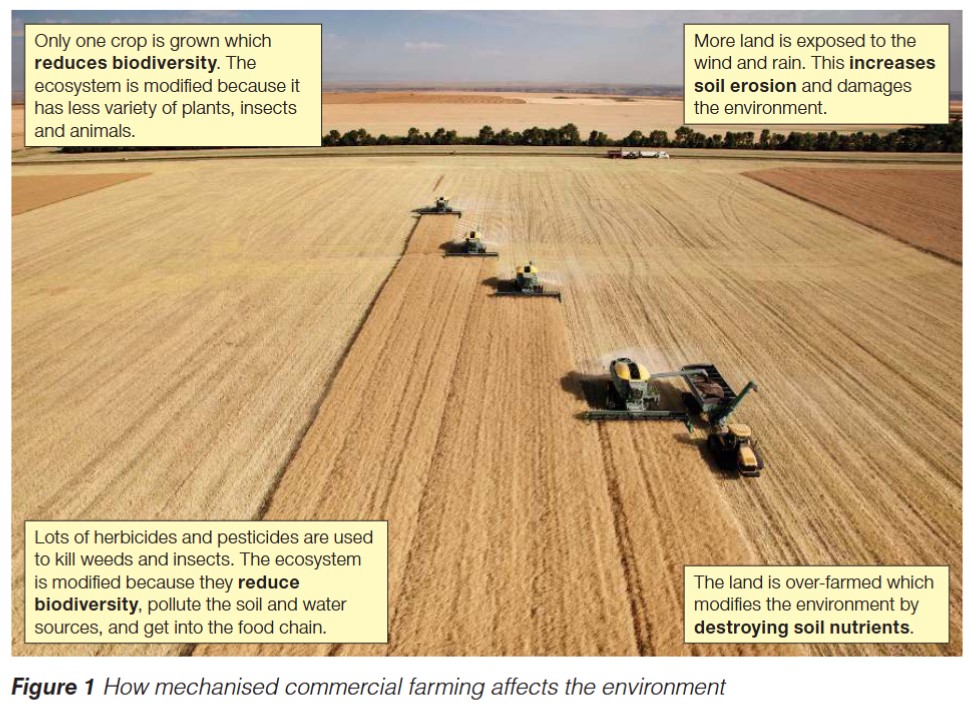
Reduced biodiversity: Commercial farms typically grow only one crop across large areas (monoculture). This practice dramatically reduces biodiversity because the ecosystem becomes modified to support just a single plant species. The natural variety of plants, insects, and animals that would normally exist in that area is lost, creating simplified ecosystems that are less resilient.
Important
Common Mistake to Avoid: Don't simply state that "biodiversity decreases." Instead, explain why it decreases – monoculture replaces diverse natural ecosystems with a single crop species, eliminating habitats and food sources for many organisms.
Increased soil erosion: When large areas of land are cleared for single crops, more soil becomes exposed to wind and rain. Without diverse plant cover to protect it, the topsoil is easily washed or blown away. This erosion damages the land's long-term agricultural viability and can lead to sediment pollution in nearby waterways.
Chemical pollution: Mechanised farms use large quantities of herbicides to kill weeds and pesticides to eliminate insects. These chemicals don't just affect their intended targets – they modify the entire ecosystem. Pesticides and herbicides pollute soil and water sources, and enter the food chain where they can harm wildlife and potentially affect human health.
Soil nutrient destruction: Intensive farming where land is continuously farmed without adequate rest periods depletes the soil of essential nutrients. Over-farming exhausts the land, destroying soil quality and reducing its natural fertility. This creates a vicious cycle where farmers must use increasing amounts of chemical fertilisers to maintain crop yields.
Note
The diagram above illustrates how large-scale mechanised commercial farming operations impact the environment across multiple dimensions simultaneously, showing the interconnected nature of these environmental problems.
Commercial fishing
Purpose and scale
Commercial fishing operations harvest massive quantities of fish specifically for commercial sale and profit. Unlike small-scale artisanal fishing that provides local food supplies, commercial fishing uses industrial methods designed to catch as many fish as possible. These methods significantly modify marine ecosystems and cause extensive environmental damage.
Destructive fishing methods
Important
Critical Concept: All three fishing methods described below are unsustainable and cause severe ecosystem damage. Understanding how each method destroys marine environments is essential for exam success.
Over-fishing: This occurs when too many fish are removed from the ecosystem faster than populations can naturally replenish themselves. Over-fishing disrupts marine food webs, depletes fish stocks, and can cause some species populations to collapse entirely. When key species are removed in excessive numbers, the entire ecosystem becomes unbalanced, affecting predators, prey, and ecosystem functioning.
Bottom trawling: This method involves dragging enormous nets along the seabed. As the nets are pulled across the ocean floor, they scoop up everything in their path indiscriminately. Bottom trawling destroys seabed habitats, including coral reefs and rocky areas where many marine species live and breed. The method catches target fish species but also kills countless other organisms, damaging the entire marine ecosystem structure.
Dynamite fishing: Perhaps the most destructive method, dynamite fishing involves throwing explosives into the water. The blast kills everything within the explosion radius, regardless of species or size. This completely destroys localised areas of the marine ecosystem, killing fish, coral, and other marine life indiscriminately. The method causes permanent damage to reef structures and eliminates entire sections of marine habitat.
Note
Environmental Impact Severity: While all three methods are destructive, dynamite fishing causes the most immediate and complete habitat destruction, while over-fishing creates long-term population collapse that can take decades to reverse.
Ecosystem modification
All three commercial fishing methods fundamentally alter marine ecosystems. They remove key species from food webs, destroy habitats that provide shelter and breeding grounds, and eliminate the biodiversity that makes ecosystems resilient. The environmental damage caused by these industrial fishing practices can persist for decades, with some ecosystems never fully recovering.
Exam guidance
Important
Essential Exam Tips:
When answering questions about farming and fishing for food:
-
Describe questions: Focus on specific methods and their characteristics (e.g., describe how bottom trawling works by explaining the nets dragging along the seabed)
-
Explain questions: Show cause and effect relationships (e.g., explain how mechanised farming reduces biodiversity by discussing monoculture and ecosystem modification)
-
Assess/Evaluate questions: Consider both the efficiency benefits of these methods and their environmental costs, reaching a balanced judgement about sustainability
Always use specific examples and technical terminology to demonstrate your geographical knowledge.
Remember!
Summary
Key Points to Remember:
Commercial vs Subsistence Farming:
- Commercial farming uses mechanised technology (tractors, harvesters, chemicals) to grow large quantities of food for profit, unlike subsistence farming which feeds families
- Mechanised farming damages the environment through reduced biodiversity, increased soil erosion, chemical pollution, and soil nutrient destruction
Commercial Fishing Impacts:
- Commercial fishing uses destructive methods including over-fishing, bottom trawling, and dynamite fishing
- Both mechanised farming and commercial fishing modify ecosystems and cause severe environmental damage while increasing food production efficiency
Key Terms to Master:
- Mechanised farming – farming that uses extensive technology and machinery
- Subsistence farming – growing food primarily to feed one's own family
- Commercial farming – producing food for sale and profit
- Over-fishing – removing too many fish from an ecosystem
- Bottom trawling – dragging nets along the seabed
- Biodiversity – the variety of plant and animal species in an ecosystem
- Ecosystem modification – changes to natural ecosystems caused by human activity