Food Security Through Intensive and Organic Farming (OCR GCSE Geography B (Geography for Enquiring Minds)): Revision Notes
📚Revision Notes
Food Security Through Intensive and Organic Farming
Introduction
As the global population is projected to reach nine billion people by 2050, countries face a critical challenge: how can we produce enough food to feed everyone? Two main agricultural approaches exist – intensive farming and organic farming – each with different impacts on society, the economy, and the environment.
Note
Understanding the trade-offs between these farming approaches is essential for addressing global food security while maintaining environmental sustainability.
Intensive farming
Intensive farming is an approach that aims to produce large quantities of food by using significant amounts of machinery and chemicals such as fertilizers, herbicides, and pesticides. When this method is applied to animal production, it is known as factory farming.
Agribusiness
Large-scale intensive food production is increasingly dominated by agribusiness. This refers to major companies, particularly in Less Industrially Developed Countries (LIDCs), that purchase vast areas of land to grow food. However, their primary motivation is profit maximization rather than achieving food security for local populations.
Important
Agribusiness companies prioritize profits over local food security, which can create tensions between economic goals and social needs in LIDCs.
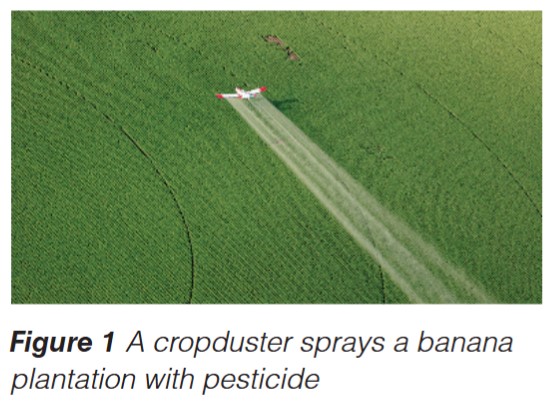
Advantages of intensive farming
Intensive farming offers several benefits across different sustainability dimensions:
Social benefits:
- Huge quantities of food can be produced, maximizing the use of available land to feed more people
- Food is cheap to produce and can be sold at affordable prices in Advanced Countries (ACs), making a healthy diet accessible to more people
Economic benefits:
- Low production costs mean farmers and companies can achieve higher profit margins
- Affordable food prices benefit consumers
Disadvantages of intensive farming
Despite its productivity, intensive farming creates significant problems:
Social impacts:
- Farm workers are exposed to harmful chemical sprays, damaging their health and wellbeing
- Consumers may ingest chemical residues if food is not washed properly before eating
Environmental impacts:
- Farms typically grow monocultures (single crops), which reduces biodiversity in the surrounding ecosystem
- Fertilizers, pesticides, and herbicides cause pollution, contaminating soil, waterways, and air
- Loss of biodiversity can have long-term effects on ecosystem health
Important
Monocultures and Biodiversity Loss
Growing only one type of crop year after year reduces the variety of plant and animal species in an area. This biodiversity loss weakens ecosystems and makes them more vulnerable to disease and climate change.
Organic farming
Organic farming takes a fundamentally different approach by completely banning the use of chemicals in food production. Instead, organic farmers rely on natural methods to maintain soil fertility and control pests.
Note
Natural farming methods include crop rotation, composting, and using natural predators to control pests instead of chemical pesticides.
Advantages of organic farming
Social benefits:
- Food produced without chemical inputs is potentially healthier for consumers
- Farm workers are not exposed to harmful pesticides and herbicides
Environmental benefits:
- Biodiversity increases significantly because organic farms grow a greater variety of crops
- No chemical pollution is released into the environment
- Soil health is maintained naturally over the long term
Disadvantages of organic farming
Social impacts:
- Organic food is more expensive to buy, making a healthy, balanced diet less affordable for many people, particularly in lower-income households
Economic impacts:
- Crop yields are lower because more food is lost to pests and weeds
- Less food is grown on the same amount of land compared to intensive farming, reducing overall food production
- Higher costs affect farmers' profitability unless premium prices can be charged
Evaluating sustainability
When considering which farming approach best achieves food security, we must think critically about sustainability. In the short term, intensive agriculture appears to be the most effective strategy for producing the large quantities of food needed to feed the world's growing population.
However, this short-term success comes with significant long-term risks. Environmental problems such as pollution, soil degradation, and biodiversity loss might make intensive farming an unsustainable approach over time. If intensive farming damages ecosystems beyond repair, future food production could be compromised.
Organic farming presents the opposite trade-off: it is better for the environment and potentially healthier, but it cannot produce as much food. This raises a difficult question: can we afford to prioritize environmental sustainability if it means producing less food for a growing population?
Important
The Sustainability Trade-Off
- Short-term: Intensive farming meets immediate food needs for a growing population
- Long-term: Environmental damage from intensive farming may threaten future food production
- The challenge: Finding a balance between producing enough food now while protecting the environment for the future
The challenge for policymakers and farmers is to find a balance between these two approaches, or to develop new methods that combine high productivity with environmental protection.
Note
The Three Pillars of Sustainability
Remember "SEE" when evaluating farming approaches:
- Social - impacts on people's health, wellbeing, and access to food
- Economic - effects on costs, profits, and affordability
- Environmental - consequences for ecosystems, biodiversity, and pollution
Remember!
Summary
Key Points to Remember:
-
Intensive farming uses machinery, fertilizers, herbicides, and pesticides to maximize food production, making food cheap and plentiful but causing environmental damage and health risks.
-
Organic farming bans chemicals, producing healthier food and protecting biodiversity, but results in lower yields and higher prices.
-
The three pillars of sustainability (social, economic, environmental) reveal trade-offs between intensive and organic approaches.
-
Short-term food security needs may conflict with long-term environmental sustainability.
-
Agribusiness companies prioritize profit over food security, particularly in LIDCs where they purchase large amounts of land.