Food Security Through Technology (OCR GCSE Geography B (Geography for Enquiring Minds)): Revision Notes
📚Revision Notes
Food Security Through Technology
Introduction
One of the biggest challenges facing the world today is food security. With the global population expected to reach 9 billion people by 2050, finding ways to produce enough food for everyone is crucial. Technology, particularly genetic modification, has been proposed as one solution to this growing problem.
Note
The challenge of feeding a growing global population requires innovative solutions. Traditional farming methods alone may not be sufficient to meet future food demands, which is why technological approaches like genetic modification are being explored.
This topic explores how genetically modified crops could help achieve food security and whether this technological approach is truly sustainable in the long term.
What are genetically modified crops?
Genetically modified (GM) crops are plants that have been altered using biotechnology. Scientists transfer DNA from one species into a completely different species to give the plant new characteristics. This process happens in laboratories under controlled conditions, which is why GM crops are sometimes called "laboratory food".
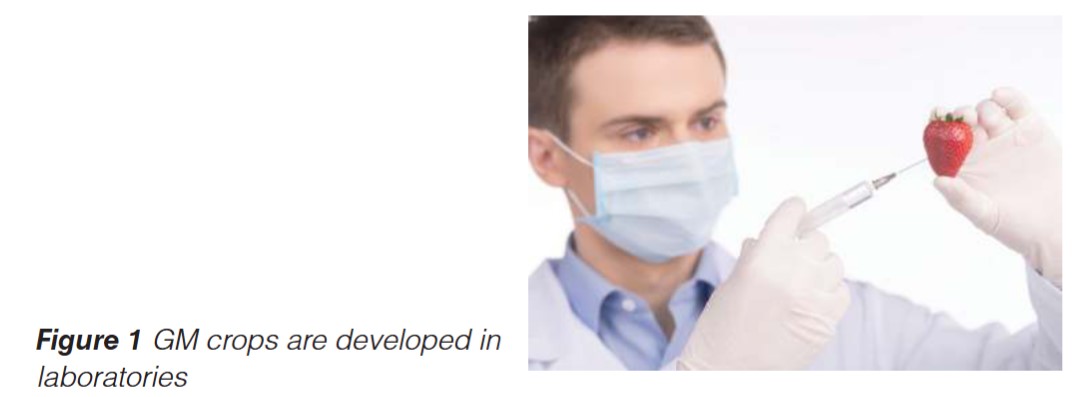
The genetic modification process allows scientists to give crops traits that would not occur naturally.
Example
Worked Example: Frost-Resistant Strawberries
Scientists have successfully created strawberries that can survive freezing temperatures by:
Step 1: Identifying the useful gene
- Arctic flounder fish can survive in extremely cold water
- This fish has specific DNA that allows it to tolerate freezing conditions
Step 2: Transferring the genetic material
- DNA from the Arctic flounder is extracted and inserted into strawberry plants
- This is done in laboratory conditions
Step 3: The result
- The modified strawberry plant can now tolerate very low temperatures
- These strawberries can be grown in places where regular strawberries would die from frost
- This expands the geographical areas where strawberries can be cultivated
This technology represents a significant development in agriculture because it allows crops to grow in conditions that would normally be impossible, potentially increasing global food production.
Impacts of GM crops
The use of genetically modified crops has wide-ranging effects across society, the economy, and the environment. Understanding these different impacts is essential for evaluating whether GM technology is a suitable solution to food security challenges.
Note
When analyzing GM crops, it's helpful to organize the impacts into three main categories: Social, Economic, and Environmental. Each category has both advantages and disadvantages that need to be carefully considered.
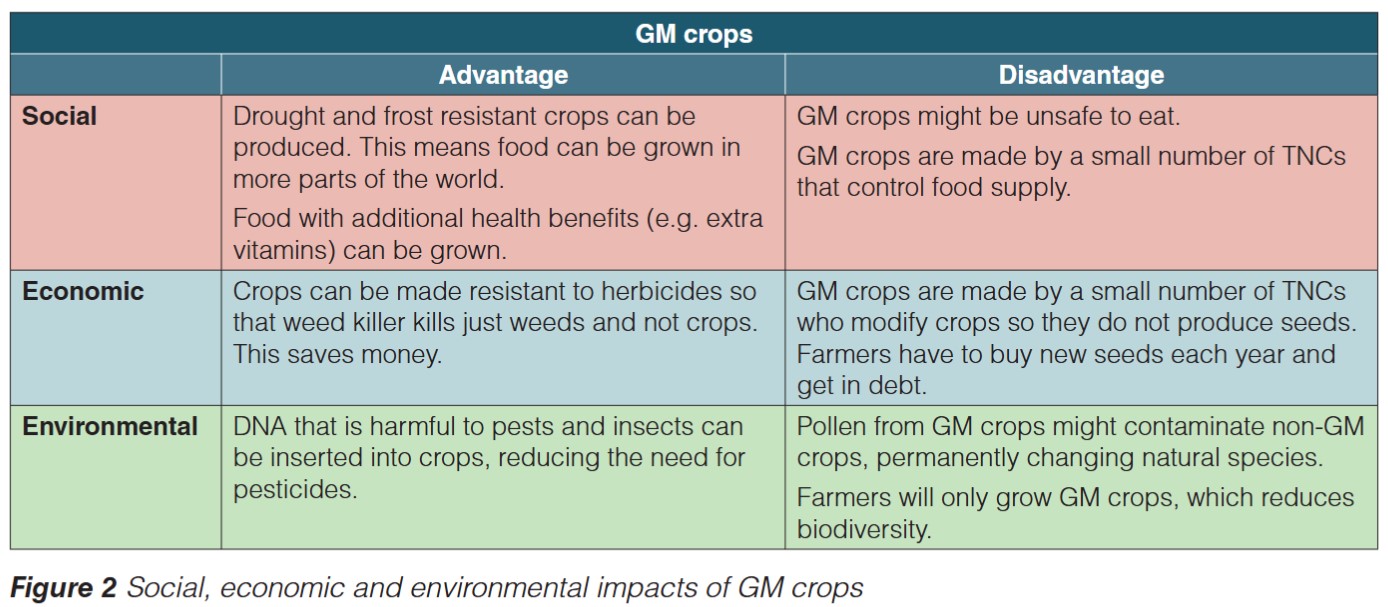 Social impacts
GM crops offer important social benefits for food security. The ability to create drought and frost resistant varieties means that crops can be cultivated in regions where traditional farming is difficult or impossible. This expanded growing area could help feed more people around the world, particularly in countries with challenging climates.
Additionally, scientists can enhance crops with extra nutrients, such as additional vitamins. This could help address malnutrition in developing countries where people's diets may lack certain essential nutrients.
Important
Safety and Corporate Control Concerns
Many people worry about whether GM foods are safe to consume, as the long-term health effects are not fully understood. Another major issue is that a small number of transnational corporations (TNCs) control GM crop technology, giving them enormous power over the global food supply.
However, there are significant social concerns beyond just the corporate control issue. The safety question remains a persistent worry for consumers and health advocates who want more long-term research before widespread adoption.
Economic impacts
From an economic perspective, GM crops can reduce farming costs. Crops engineered to resist herbicides allow farmers to spray weed killers without damaging their crops. This saves money because farmers can control weeds more effectively with fewer applications of chemicals.
The economic disadvantages are substantial, though. The same TNCs that develop GM crops often modify them so they cannot produce viable seeds. This forces farmers to purchase new seeds every planting season rather than saving seeds from their harvest. For many farmers, especially in developing countries, this creates a cycle of debt as they must repeatedly buy expensive seeds from corporations.
Note
The economic impact on farmers varies greatly depending on their location and resources. While large-scale commercial farmers in developed countries may benefit from cost savings, small-scale farmers in developing nations often struggle with the financial burden of purchasing seeds annually.
Environmental impacts
Environmentally, GM crops can reduce the need for chemical pesticides. By inserting DNA that is harmful to specific pests directly into the plant, crops can defend themselves naturally. This means fewer pesticide applications, which is better for the environment and reduces chemical runoff into water systems.
The environmental risks, however, are concerning. Pollen from GM crops can travel and fertilize non-GM crops growing nearby, causing cross-contamination. This could permanently alter natural plant species in ways we cannot predict or control.
Important
Biodiversity Loss Risk
If farmers focus exclusively on growing GM varieties, agricultural biodiversity decreases, making food systems more vulnerable to diseases or pests that could wipe out entire crops. Biodiversity is nature's insurance policy—having variety means that if one crop fails, others may survive.
Furthermore, the reduction in crop diversity creates a dangerous dependency on a small number of plant varieties, which could have catastrophic consequences if a new pest or disease emerges.
The sustainability debate
The question of whether GM crops are a sustainable solution to food security remains highly controversial. There are strong arguments on both sides of this debate.
Arguments supporting GM crops
Supporters of genetic modification argue that GM crops represent our best opportunity to produce sufficient food for the growing global population. They point to the benefits outlined above and emphasize that without such technological innovation, we will struggle to feed 9 billion people by 2050. They see GM crops as essential for future food security.
Proponents also highlight that GM technology continues to advance, potentially addressing current concerns through improved safety testing and more sustainable practices.
Arguments opposing GM crops
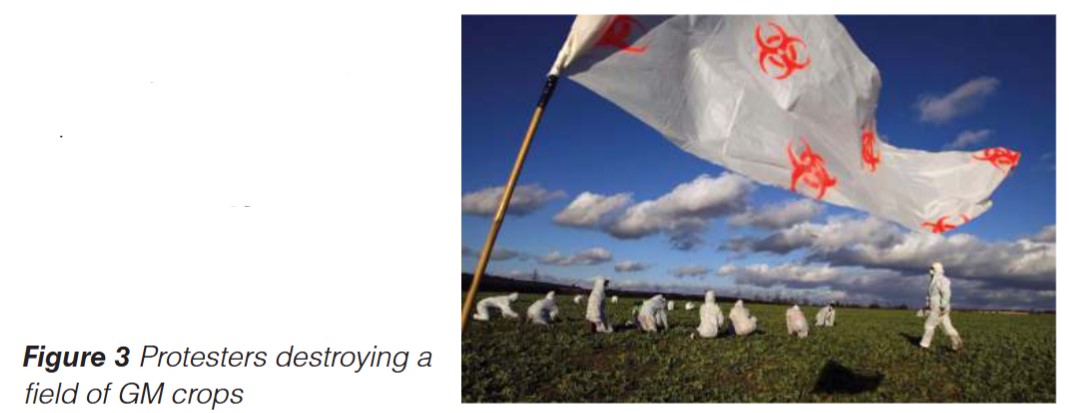
Critics of GM technology argue that the disadvantages will prove disastrous in the long run. They are concerned about unknown health risks, the loss of biodiversity, environmental contamination, and the concentration of power in the hands of a few large corporations. Opponents believe that these long-term consequences make GM crops an unsustainable approach to food security.
Critical evaluation
When evaluating the sustainability of GM crops, it is important to consider multiple perspectives. While the technology offers clear benefits for food production, the concerns about corporate control, environmental impact, and long-term safety cannot be ignored.
Note
What is Sustainability?
Sustainability requires balancing immediate food needs with long-term environmental and social health. A truly sustainable solution must not only solve today's problems but also avoid creating worse problems for future generations.
The debate ultimately centers on whether the potential benefits of feeding more people outweigh the risks of environmental damage, reduced genetic diversity, and increased corporate control over food systems.
Exam guidance
When answering exam questions about GM crops and food security, follow these strategies for different command words:
Note
Exam Success Strategies
For 'describe' questions: Focus on clearly explaining what GM crops are and how they work, using specific examples like the Arctic flounder strawberry.
For 'explain' questions: Make clear links between GM technology and its impacts. For example: "GM crops can help achieve food security because they can be grown in harsh climates which means more areas can produce food."
For 'assess' or 'evaluate' questions: Present both advantages and disadvantages across social, economic, and environmental categories. Use evidence from the table and reach a balanced conclusion about sustainability.
Command word 'justify': Take a clear position (for or against GM crops) and support it with the strongest arguments, while acknowledging but countering opposing views.
Remember!
Summary
Key Points to Remember:
-
GM crops are created by transferring DNA from one species into a different species to give plants new characteristics, such as frost or drought resistance.
-
The impacts of GM crops fall into three categories:
- Social (food security vs. safety concerns)
- Economic (cost savings vs. farmer debt)
- Environmental (reduced pesticides vs. biodiversity loss)
-
A small number of TNCs control GM crop technology, which raises concerns about corporate power over global food supplies and farmer independence.
-
The sustainability debate has two main positions:
- Supporters view GM crops as essential for feeding future populations
- Critics warn of long-term environmental and health consequences
-
When evaluating GM crops for food security, consider whether the benefits of increased food production outweigh the risks of environmental damage, reduced biodiversity, and corporate control.