Goat Aid in Babati, Tanzania (OCR GCSE Geography B (Geography for Enquiring Minds)): Revision Notes
📚Revision Notes
Goat Aid in Babati, Tanzania
Introduction to the case study
Babati is a region in northern Tanzania where the vast majority of people (90%) depend on agriculture for their livelihood. Between 1999 and 2006, a British charity called Farm Africa invested \£200,000 in providing Toggenburg goats to farmers in this area. The aim was to improve food security at a local scale.
Note
This case study is an excellent example of a local scale development project that addresses food security through a practical, sustainable approach. Unlike large-scale aid programs, this initiative focused on providing resources that communities could manage and benefit from in the long term.
Why Toggenburg goats?
Toggenburg goats are dairy goats that are significantly more productive than local cattle. They produce three litres of milk per day, which is three times more than the one litre produced by cows in the region. This makes them an efficient choice for improving nutrition and generating income for farming families.
The choice of Toggenburg goats was strategic - they are hardy animals that adapt well to local conditions while providing substantially greater returns than traditional livestock options available to farmers in Babati.
Benefits of the goat aid scheme
The goat aid program brings multiple advantages across three key areas: social, economic, and environmental. These benefits work together to create a positive cycle of development.
Note
Understanding the Three Benefit Categories:
A helpful way to remember these benefits is using the acronym SEE: Social, Economic, Environmental. Each category represents a different dimension of how the goat aid scheme improves lives in Babati.
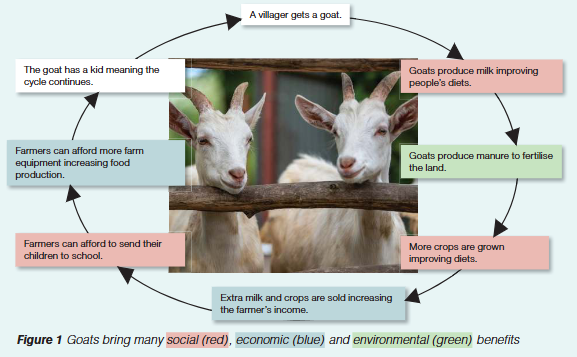
The benefit cycle explained
When a villager receives a goat, it triggers a cycle of improvements that continues to build over time. This multiplier effect is what makes the scheme particularly effective.
Social benefits (improving people's lives):
- Goats produce milk which improves people's diets and nutrition
- Extra milk and crops can be sold, increasing the farmer's income
- With more income, farmers can afford to send their children to school, improving education opportunities
Environmental benefits (helping the land):
- Goats produce manure which acts as a natural fertilizer for the land
- This leads to more crops being grown, which improves diets further
Economic benefits (generating wealth):
- Extra milk and crops are sold, increasing the farmer's income
- With higher earnings, farmers can afford to purchase more farm equipment, increasing food production
- When the goat has a kid (baby goat), the cycle continues, providing ongoing benefits
Important
The Power of the Cycle:
The key to this scheme's success is that benefits are interconnected and self-reinforcing. Each improvement leads to the next, creating a sustainable pathway out of poverty. This is not a one-time aid package - it's a long-term development solution that continues to deliver results years after the initial investment.
Criticisms of the scheme
While the goat aid program has many benefits, there are some limitations to consider. It's important to evaluate development projects critically and understand their constraints.
Important
Key Criticisms to Consider:
- Water requirements: Goats need substantial amounts of water, which can be difficult to provide in areas where water is already scarce
- Veterinary costs: Farmers may have to pay expensive vet bills when goats become ill, which can be a financial burden
- Limited scale: Small-scale projects like this can only help a relatively small number of people, so the impact is geographically limited
These criticisms don't necessarily mean the project has failed, but they do highlight important considerations for similar development schemes in other regions.
Has the scheme been successful?
Evidence suggests that the goat aid scheme has been successful in achieving its aims. The data supports several positive outcomes that demonstrate the effectiveness of this approach.
Key indicators of success include:
- The program delivers long-term benefits that continue even after the initial project has finished
- Statistics show that farmers who receive goats make three times more profit than farmers who do not receive goats
- The multiplier effect means benefits continue as goats reproduce and the cycle repeats
Note
Remember the "3-3-3" Rule:
A simple way to recall the key statistics: 3 litres of milk per day, 3 times more than cows, and 3 times more profit for farmers who receive goats. This makes the numbers easy to remember for exam answers.
The success of this scheme demonstrates that well-planned, locally-appropriate aid projects can make a real difference to food security at a local scale.
Exam guidance
Note
Writing About Goat Aid in Exams:
When writing about goat aid in Babati, remember to:
- Describe: Include specific facts and figures (e.g. \£200,000, 3 litres of milk, 3x profit)
- Explain: Show how the benefit cycle works and link causes to consequences
- Evaluate: Consider both the benefits and criticisms to give a balanced answer
- Use the three categories (social, economic, environmental) to structure your answer clearly
Remember!
Summary
Key Points:
- Babati is in northern Tanzania where 90% of people depend on agriculture for their livelihood
- Farm Africa spent \£200,000 on Toggenburg goats between 1999 and 2006 to improve food security
- Toggenburg goats produce 3 litres of milk per day (3x more than cows) and create a positive cycle of benefits
- Benefits are social (better nutrition, education), economic (increased income, 3x profit), and environmental (manure fertilizes land)
- Criticisms include high water needs, expensive vet bills, and limited scale of impact
Key Terms:
Food security, local scale development, Toggenburg goats, multiplier effect, small-scale project
Critical Process - The Benefit Cycle:
goat → milk/manure → improved diet/crops → income → education/equipment → goat has kid → cycle continues