Measuring Food Security (OCR GCSE Geography B (Geography for Enquiring Minds)): Revision Notes
📚Revision Notes
Measuring Food Security
Why we measure food security
Measuring food security helps us understand whether populations around the world have reliable access to enough food to maintain healthy lives. Different measurement methods provide insights into both the economic ability to purchase food and the health outcomes that result from food access. These measurements are essential for identifying areas of concern and targeting support where it is needed most.
Note
Food security measurements serve multiple purposes: they help governments allocate resources effectively, enable international organizations to identify priority areas for intervention, and allow researchers to track progress over time.
Wealth measurements
Wealth-based indicators assess whether people have the economic resources to purchase adequate food. These measurements focus on income and poverty levels to determine affordability of food.
Key wealth indicators include:
- GNI per capita at purchasing power parity (PPP): This measures the average income per person in a country, adjusted for what money can actually buy in that location. Higher GNI per capita generally indicates greater ability to afford food.
- Percentage of population living on less than a dollar a day: This poverty indicator identifies the proportion of people living in extreme poverty who may struggle to afford basic food needs.
Note
Wealth measurements provide a clear economic picture of food affordability, but they do not tell us whether people are actually accessing nutritious food or maintaining good health. This is why multiple measurement approaches are necessary for a complete understanding of food security.
Health measurements
Health-based indicators reveal whether populations have been able to access and consume healthy food over time. These measurements look at health outcomes that may be influenced by nutrition.
Key health indicators include:
- Life expectancy: The average number of years a person is expected to live, which can reflect overall nutrition and health standards.
- Death rate of children under five: The proportion of young children who die before reaching age five, often linked to malnutrition and inadequate food access.
- Average daily calorie consumption: The typical number of calories consumed per person each day, indicating whether energy needs are being met.
Limitations of health measurements
Important
An important disadvantage of using health measurements is that they do not directly measure food security. These indicators examine factors that might suggest food insecurity, but they can be influenced by other issues. For example, low life expectancy might result from smoking or other health problems rather than lack of access to food. Therefore, health measurements should be interpreted carefully alongside other indicators.
The Global Hunger Index
The Global Hunger Index (GHI) is a comprehensive tool that brings together multiple measures to assess hunger levels across countries. It uses four specific indicators that mainly focus on children, as they are particularly vulnerable to food shortages. The GHI produces a score out of 100, where a higher score indicates more severe hunger in that country.
Note
The Global Hunger Index focuses primarily on children because they are especially vulnerable to food shortages and their health outcomes provide sensitive indicators of food insecurity. Children's nutritional status reflects both current and long-term food access issues within a population.
Four indicators of the Global Hunger Index
The GHI combines four key measures to create an overall hunger score:
1. Undernourishment
This measures the proportion of the population who do not receive adequate nutrition to meet their basic energy needs. Undernourishment indicates chronic food deprivation across the general population.
2. Child wasting
This indicator tracks the percentage of children under five years old who weigh too little for how tall they are. Child wasting reflects acute malnutrition and indicates that children are not receiving enough food in the short term.
3. Child stunting
This measures the proportion of children under five who are shorter than expected for their age. Stunting results from chronic malnutrition and shows that children have experienced long-term nutritional deficiencies that have affected their growth and development.
4. Child mortality
This indicator records the death rate of children under five years old. High child mortality rates often reflect severe malnutrition and inadequate food access, as young children are especially vulnerable to the effects of hunger.
By focusing on children through three of its four indicators, the GHI highlights populations at greatest risk and provides a sensitive measure of food insecurity.
Note
Remember the GHI indicators using "USMC":
- Undernourishment
- Stunting
- Mortality
- Child wasting
This mnemonic can help you recall all four indicators in exam situations.
Global patterns of hunger
Hunger levels vary significantly across different regions of the world, reflecting diverse economic, political, and environmental conditions.
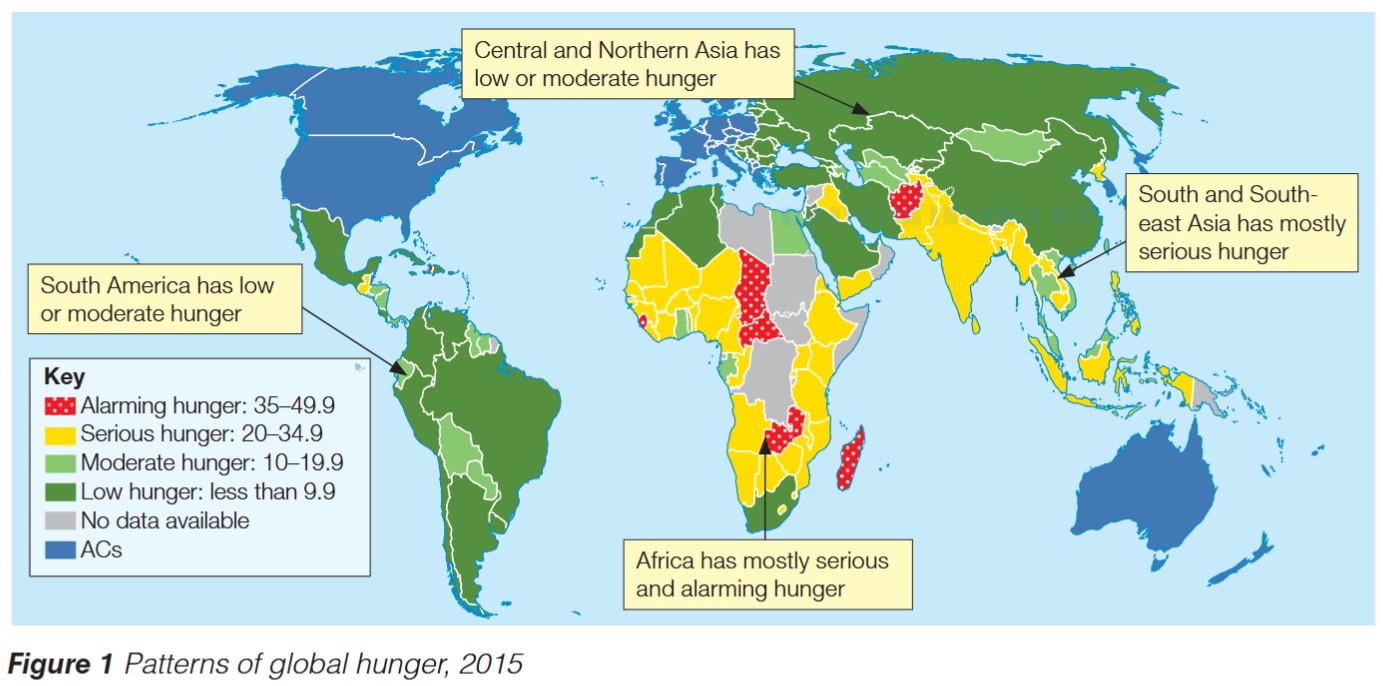
The 2015 global hunger map reveals distinct regional patterns:
Africa experiences mostly serious and alarming hunger levels, with many countries scoring in the red and yellow categories. This reflects widespread food insecurity across much of the African continent, particularly in sub-Saharan regions.
South and Southeast Asia show predominantly serious hunger levels, with multiple countries facing significant food security challenges. This region contains large populations experiencing undernourishment and child malnutrition.
Central and Northern Asia demonstrate low or moderate hunger levels, indicating better food security compared to other parts of Asia. These countries generally have more stable food supplies and lower rates of malnutrition.
South America displays low or moderate hunger across most of the continent, suggesting relatively better food security conditions. However, some variation exists between countries in the region.
Advanced countries (ACs), shown in blue on the map, have very low hunger levels and strong food security. These nations typically have well-developed food systems and high levels of economic development.
Note
The map illustrates that hunger is not evenly distributed globally. The most severe food insecurity is concentrated in Africa and parts of Asia, while more developed regions enjoy greater food security. Understanding these patterns is crucial for directing international aid and development efforts.
Exam guidance
When answering questions about measuring food security:
- Describe questions require you to identify and explain the different measurement methods without justifying why they are used.
- Explain questions need you to show understanding of how and why particular measurements indicate food security levels, including cause-and-effect relationships.
- Evaluate or assess questions ask you to consider the strengths and limitations of different measurement approaches, such as the disadvantages of health measurements.
Important
Key exam tips:
- Always refer to specific indicators or measurements rather than general statements.
- Use evidence from the Global Hunger Index or other named indicators to support your points.
- When discussing limitations, provide specific examples of how factors like smoking or disease can affect health measurements independently of food security.
Summary
Key Points to Remember:
-
Food security can be measured using both wealth measurements (like GNI per capita and poverty rates) and health measurements (like life expectancy and child mortality rates).
-
Health measurements have limitations because they are not directly about food security and can be affected by other factors such as smoking or disease.
-
The Global Hunger Index uses four indicators focused mainly on children: undernourishment, child wasting, child stunting, and child mortality.
-
The higher the Global Hunger Index score, the more severe the hunger problem in that country.
-
Global hunger patterns show that Africa and parts of Asia face the most serious food security challenges, while advanced countries and regions like South America generally have better food security.