Tanzania’s Bid to Grow All Its Own Wheat (OCR GCSE Geography B (Geography for Enquiring Minds)): Revision Notes
📚Revision Notes
Tanzania's bid to grow all its own wheat
Background: food security challenges in Tanzania
During the late 1960s and early 1970s, Tanzania experienced severe food shortages that threatened the wellbeing of its population. The government recognised that developing domestic food production was essential to achieving food security and reducing dependence on imports. Tanzania decided to focus on wheat production and sought international assistance to make this possible.
Note
Food security means ensuring a population has reliable access to sufficient, safe, and nutritious food to meet their dietary needs for an active and healthy life.
This case study examines whether large-scale agricultural development projects can successfully improve food security in developing countries, and what costs and benefits such projects bring to local communities.
The Tanzania-Canada Wheat Programme
Between 1968 and 1993, Canada provided approximately $95 million in development aid to help Tanzania establish large-scale wheat production. The programme transformed the Hanang Plains in northern Tanzania into extensive wheat farms.
What the programme provided
The Canadian aid package included multiple components designed to modernise wheat farming:
- Seeds: High-yield wheat varieties suitable for Tanzanian conditions
- Training: Technical education for Tanzanian farmers and workers in modern agricultural methods
- Chemical inputs: Fertilisers to boost crop yields
- Machinery: Tractors, combine harvesters and other mechanised equipment
Initially, the chemicals and equipment were provided free of charge. However, as the programme progressed, Tanzania was required to pay for these resources, creating ongoing financial commitments.
Land use and indigenous communities
The Hanang Plains selected for wheat production were not empty land. The area had been traditionally used by the Barabaig people, a pastoral community who relied on these plains for grazing their cattle. The establishment of wheat farms meant this land was no longer available for traditional use.
Important
Critical Impact on Indigenous Communities
The Barabaig people claim they were forcibly displaced from their ancestral lands, with reports of violent eviction. This displacement affected approximately 40,000 Barabaig people, who lost both their land and their traditional livelihood. This raises serious questions about the social costs of development projects and the rights of indigenous communities.
Production outcomes
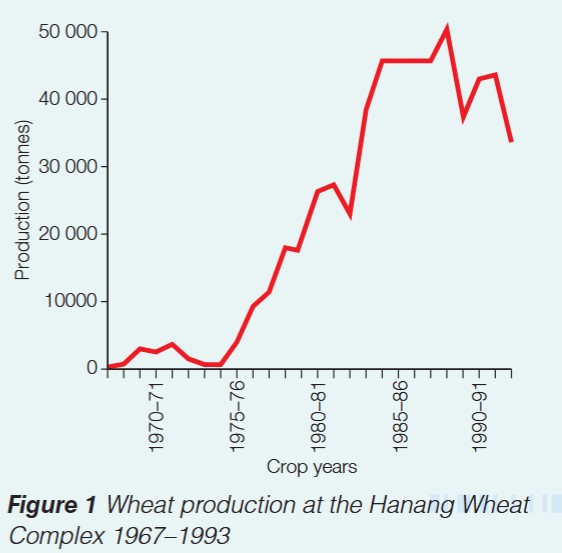
The wheat programme achieved significant production increases over its lifetime. Output rose dramatically from the late 1960s through to the mid-1980s, reaching a peak where the Hanang Wheat Complex was producing around 50,000 tonnes annually. At its height, the programme supplied 60% of Tanzania's total wheat consumption.
Note
The graph reveals important trends in the programme's lifecycle. Notice how production peaked in the mid-1980s but then declined significantly in the late 1980s and early 1990s. This decline raised questions about the long-term sustainability of the project.
Mechanisation of wheat farming
The programme relied heavily on modern agricultural machinery to cultivate large areas of land efficiently. This mechanised approach was very different from traditional small-scale farming methods used elsewhere in Tanzania.
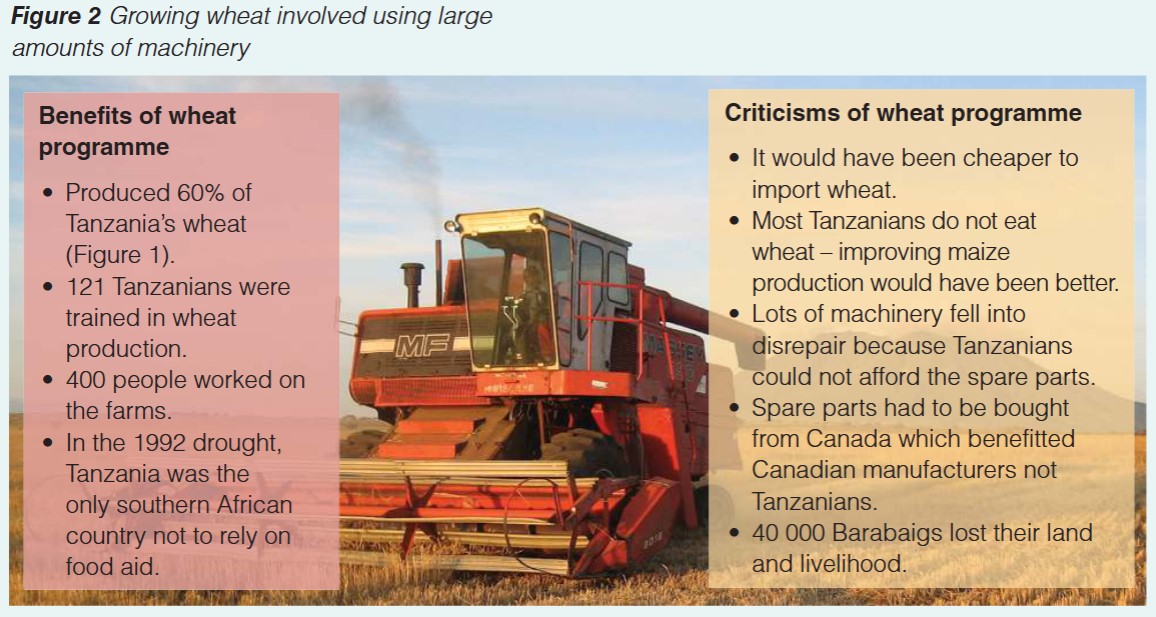
The use of expensive imported machinery had important implications for the programme's sustainability, as we'll see in the evaluation below. While mechanisation allowed for large-scale production, it also created dependency on imported spare parts and technical expertise.
Evaluating the programme's effectiveness
Views differ significantly on whether the Tanzania-Canada Wheat Programme was successful. The Canadian and Tanzanian governments considered it a success, while many development experts and local communities argue it failed to achieve sustainable food security.
Benefits of the programme
The programme brought several positive outcomes:
Increased domestic production: At its peak, the programme produced 60% of Tanzania's wheat requirements, reducing dependence on imports.
Skills development: 121 Tanzanian citizens received training in modern wheat production techniques, developing valuable agricultural expertise.
Employment creation: The wheat farms provided jobs for approximately 400 people, creating income opportunities in the region.
Example
Success During Crisis: The 1992 Drought
During the severe 1992 drought that affected much of southern Africa, Tanzania was the only country in the region that did not need to rely on food aid. This demonstrated the programme's significant contribution to national food security during a critical period.
Criticisms of the programme
However, the programme faced substantial criticisms:
Economic efficiency: Analysis suggested it would have been cheaper for Tanzania to import wheat rather than invest heavily in domestic production. The programme required significant financial commitment without clear economic benefits.
Cultural appropriateness: Most Tanzanians do not traditionally eat wheat as a staple food. The majority of the population relies on maize. Investing in improved maize production would have been more relevant to actual dietary needs and preferences.
Technical sustainability: Much of the imported machinery deteriorated over time due to lack of maintenance. Tanzanian farmers could not afford the expensive spare parts needed for repairs, causing equipment to fall into disrepair.
Dependency on imports: Spare parts had to be purchased from Canada, creating ongoing costs that benefited Canadian manufacturers rather than the Tanzanian economy. This made the programme dependent on continued imports rather than achieving true self-sufficiency.
Important
The Question of Appropriate Technology
A key criticism centres on whether large-scale mechanised farming was the appropriate technology for Tanzania's context. The programme created dependency on expensive imported equipment that local farmers could not maintain or repair. This raises important questions about whether development aid should focus on technologies that can be sustained by local communities with local resources.
Social justice issues: The displacement of 40,000 Barabaig people from their traditional lands raised serious concerns about land rights and the social costs of development. Indigenous communities lost their livelihoods while having little say in the decision.
Exam guidance
When answering questions about this case study, remember to:
Note
Exam Strategy Tips
For describe questions: Focus on specific facts and figures (e.g., $95 million aid, 60% of wheat production, 40,000 people displaced).
For explain questions: Show links between causes and effects (e.g., machinery broke down because spare parts were too expensive, therefore production declined).
For evaluate or assess questions: Present both benefits and criticisms, then make a judgement about overall effectiveness. Consider both economic and social impacts. Use evidence to support your conclusion.
Command words to watch for: 'Assess the success' requires you to weigh up benefits against costs. 'To what extent' asks you to judge how far the programme achieved its aims.
Remember!
Summary
Key Points to Remember:
-
The Tanzania-Canada Wheat Programme (1968-1993) aimed to achieve food security by developing large-scale wheat production in the Hanang Plains using $95 million of Canadian aid.
-
The programme produced 60% of Tanzania's wheat at its peak but required displacing 40,000 Barabaig people from their traditional grazing lands.
-
Benefits included: domestic production, skills training (121 Tanzanians), employment (400 people), and resilience during the 1992 drought when Tanzania didn't need food aid.
-
Criticisms focused on: poor economic efficiency (cheaper to import), cultural inappropriateness (Tanzanians eat maize not wheat), unsustainable technology, and serious social justice concerns.
-
The programme's decline in the late 1980s showed that large-scale mechanised farming may not be sustainable without ongoing technical and financial support, raising questions about appropriate technology for developing countries.